Nadia had never considered her grandmother’s garden an ordinary collection of flowers. To anyone else, it might have looked like a beautiful yard surrounding an old lake house, filled with roses, lavender, peonies, daisies, herbs, and flowering shrubs. To Nadia and her grandmother Penny, however, almost every plant represented a particular moment. The garden had gradually become a living record of their family, with new flowers appearing after celebrations, difficult periods, recoveries, and milestones.
When Nadia was eight, Penny gave her a small green watering can and began explaining those stories. The pink peonies were connected with the year Nadia was born. Lavender had been planted after Penny returned home following surgery because she wanted something peaceful and fragrant surrounding her after spending time in a hospital. Roses near the porch marked an anniversary, while white daisies were associated with Nadia’s first school recital. Even the colorful bee balm had a meaning: Penny planted it after a difficult summer because she believed the family needed something cheerful.
As a child, Nadia wondered how her grandmother remembered so many details. Penny explained that she thought gardens preserved memories differently from photographs. A photograph could capture a single afternoon, birthday, or celebration, but plants required someone to continue caring long afterward. Flowers needed water and attention. They had to survive storms, cold winters, weeds, and changing seasons. To Penny, that continuing effort was what made a garden special.
Nadia understood her grandmother’s lesson much better after Penny died. Penny left the lake house to her granddaughter, along with a simple handwritten message: “Keep it lived in.” Nadia took those words seriously. She repaired things when necessary but resisted transforming the property into something modern and unfamiliar. Penny’s yellow cabinets remained in the kitchen, her old cooking equipment stayed in its drawers, and the handmade cushions continued decorating the rooms.
The garden received even more attention. Whenever possible, Nadia spent Saturdays maintaining it. She trimmed roses, removed weeds, cared for the lavender, and checked the plants Penny had spent decades establishing. Her husband, Zac, understood that the property represented much more than its financial value. He knew the lake house contained memories Nadia could not simply replace by purchasing new furniture or hiring someone to redesign the landscaping.
Zac’s sister Kelsey saw the property differently. She appreciated how beautiful it was but had never completely understood Nadia’s emotional attachment to every detail. That difference became important shortly before Kelsey’s wedding. Two days before the ceremony, she arrived at Nadia and Zac’s home unexpectedly, carrying wedding materials and looking extremely stressed. The restaurant booked for her wedding had suffered serious water damage, leaving the event without a venue at almost the last possible moment.
Nadia immediately sympathized. Guests were already traveling, vendors had been booked, and months of preparation could disappear because of something nobody had expected. Kelsey explained that she had contacted numerous alternative venues, but nothing suitable was available with only two days remaining. Then she opened her planning binder and revealed a photograph of Penny’s lake house. In her mind, the answer to the problem was sitting right in front of them.
Kelsey argued that the property already had everything necessary for a beautiful wedding setting: a large lawn, water in the background, mature trees, and plenty of space for photographs. Nadia remained hesitant. The house had never been designed as a wedding venue, and allowing a large group onto the property with virtually no preparation made her uncomfortable. Kelsey promised that the event would be carefully managed and that only temporary furniture and decorations would be brought in.
When Kelsey mentioned floral arrangements, Nadia immediately established a firm boundary. Nothing could be taken from Penny’s garden. No roses could be cut, no lavender removed, no peonies disturbed, and no flower beds changed. She also asked that heavy tables remain away from softer sections of the lawn and that everything brought onto the property be removed afterward. Inside the house, furniture and personal belongings were supposed to remain where they were.
Kelsey agreed. She seemed impatient with the details, but she repeatedly assured Nadia that she understood. Eventually, Nadia decided to help. She knew how devastating it would be for Kelsey to lose her wedding venue two days before the ceremony, particularly with guests already traveling. She therefore allowed the lake house to be used, believing the rules were clear enough to protect what mattered most.
On the morning of the wedding, an unrelated family emergency changed Nadia and Zac’s plans. Nadia’s aunt suddenly collapsed and was taken to a hospital after doctors became concerned about a possible heart problem. Nadia and Zac immediately went to be with her. From the hospital, Nadia contacted Kelsey and explained that they would no longer be able to attend the wedding.
Kelsey asked for the access code to the lake house so preparations could continue without them. Before providing it, Nadia repeated the most important condition: the garden remained off-limits. Kelsey responded impatiently that she remembered the rules and made a sarcastic comment about the flowers. Zac heard her response and was unhappy about it, but medical staff called Nadia and Zac away before the disagreement could continue.
Fortunately, Nadia’s aunt eventually stabilized. By the time doctors were comfortable with them leaving, however, it was late and both Nadia and Zac were exhausted. Instead of making another long drive to the lake house, they decided to return the following morning. Nadia went to sleep believing that, despite the difficult circumstances, Kelsey had probably enjoyed her wedding and respected their agreement.
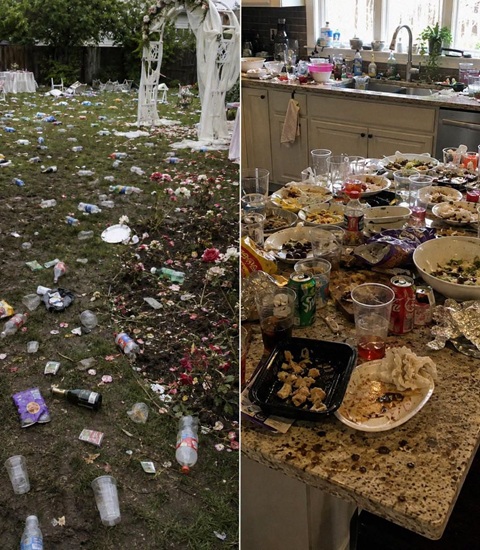
The next morning, that assumption disappeared before Nadia even entered the property. One of Penny’s handmade cushions was lying near the driveway. Rain had fallen overnight, leaving the fabric soaked and dirty. Nadia stopped beside the gate and looked farther into the yard. What she saw made her heart sink.
Disposable cups and plates covered sections of the lawn. Bottles had been abandoned near the dock, while napkins, decorations, and pieces of confetti were scattered across the grass. Some lightweight debris had reached the shoreline. Heavy furniture appeared to have been dragged across wet ground, creating deep tracks in areas Nadia had specifically asked everyone to avoid.
Muddy footprints covered the porch and continued through the kitchen. The cleanup alone would require hours. Still, Nadia could have accepted the mess if that had been the only problem. Then she saw the wedding arch near the lake. Flowers were hanging from it, and she immediately recognized where they had come from.
Penny’s anniversary roses had been cut back dramatically. Sections of lavender had been pulled directly from the soil. White daisies associated with Nadia’s childhood recital had been tied to decorative ribbons, and several peonies had been uprooted completely. Their roots remained exposed beneath wire and fabric around the wedding structure. Some of the flowers were already wilting.
This was clearly not accidental damage caused by guests wandering through the garden. Someone had deliberately removed the plants to create wedding decorations. Zac stared at the flower beds and reminded Nadia that he had personally told his sister not to touch them. Inside the house, they discovered stained cushions, piles of used dishes, and Penny’s rocking chair sitting on the damp porch with a damaged leg.
Nadia called Kelsey and asked for an explanation. Kelsey was preparing for her honeymoon and seemed frustrated that Nadia wanted to discuss the property immediately. When Nadia asked why flowers had been removed from the garden, Kelsey admitted they had needed fresh decorations for the wedding arch. From her perspective, using flowers already growing on the property had seemed convenient.
Nadia reminded her that protecting the garden had been the clearest condition of using the lake house. Kelsey defended her decision by saying she had wanted the wedding to look beautiful. When Nadia asked her to return and help repair the damage, Kelsey dismissed the idea. Flowers grew back, she argued, and because Nadia owned the property, cleaning everything afterward was ultimately her responsibility.
The conversation ended without resolving anything. Nadia remained in the kitchen looking through the window at the damaged beds. Normally, Zac might have tried to prevent a larger family argument by asking Nadia to wait before responding. This time he recognized that doing so would simply require Nadia to absorb the consequences of his sister’s actions. Instead, he asked what he could do to help.
Nadia remembered something Penny had left behind: a detailed map of the garden. Her grandmother had documented the location of significant plants, often adding dates and small descriptions explaining why they mattered. Nadia retrieved Penny’s old cedar seed box while Zac found the rolled garden map. Together they spread it across the dining table.
Reading Penny’s handwritten notes changed the atmosphere immediately. The peonies were connected to Nadia’s early childhood. Lavender marked Penny’s recovery from surgery. Daisies remembered the recital. Other sections referenced anniversaries, graduations, family gatherings, storms, and difficult years that the family had survived. Penny had preserved far more information than Kelsey could have imagined.
Nadia and Zac spent the afternoon comparing the map with the damaged garden. They documented everything that had been uprooted, cut, crushed, or otherwise seriously affected. When they finished, their list contained 286 plants requiring replacement or restoration. Seeing the number gave Nadia an idea based directly on Kelsey’s dismissive comment that flowers simply grew back.
Nadia prepared 286 numbered packets corresponding with Penny’s map. Some represented seeds, while others identified roots or replacement plants that would need to be obtained. She placed everything inside Penny’s cedar seed box and included a laminated copy of the original garden plan. A small plaque on top contained only two words: “RESTORATION KIT.”
The box reached Kelsey the following day. She called Nadia almost immediately, confused and irritated by the numbered packets. When Nadia explained that the 286 numbers represented the plants damaged during the wedding, Kelsey suggested hiring a landscaping company. She was willing to pay someone to replace the flowers and considered that a reasonable solution.
Nadia explained why that was not enough. The problem was never simply the retail value of roses, lavender, daisies, or peonies. The garden had been created over decades, with plants connected to specific family memories. Replacing everything with similar-looking flowers might restore the appearance, but it would not teach Kelsey why ignoring the boundary had been so hurtful.
For the first time, Nadia described some of the stories in detail. She explained why Penny had planted the lavender after surgery, why the anniversary roses mattered, and why the peonies were associated with Nadia’s birth. Kelsey became quieter. She admitted she had not known any of those things when she took flowers for the arch.
Nadia acknowledged that Kelsey had not understood the history, but she also explained that she should not have needed to understand it to respect the original request. Permission to use the lake house had come with a clear condition, and Kelsey had ignored it. Nadia proposed that instead of paying someone else, Kelsey come to the lake house each Saturday and participate in restoring the garden herself.
Kelsey initially rejected the idea. Gardening was not something she enjoyed, and she did not want to spend her weekends working in flower beds. Nadia did not threaten her. She simply left the decision with Kelsey. If the flowers really were as easily replaceable as she had claimed, then helping them grow again would demonstrate that.
The following Saturday, Kelsey arrived. Her gardening gloves were new, her sneakers were spotless, and her expression made it obvious she was not enthusiastic. Nadia handed her the first packet and showed her Penny’s map. Kelsey was surprised to discover that the garden had been measured and documented so carefully.
During the first morning, she complained frequently. She worried about her clothes, the mud, and the amount of work involved. By lunchtime, she asked how many plants they had completed. Nadia checked the records and told her eight. Kelsey stared at the remaining list, realizing that 278 were still waiting.
Nevertheless, she returned the next Saturday. This time she wore old jeans and practical shoes. As she worked, she began asking questions. She wanted to know why one flower bed curved around an old bench. Nadia explained that Penny and her husband had used that spot during their anniversaries.
Another section contained bee balm planted after a difficult summer. When Kelsey asked why, Nadia repeated Penny’s explanation: sometimes a family needed something cheerful that refused to behave. Kelsey smiled slightly at that story. Slowly, the garden became something more complicated to her than plants arranged around a house.
Neighbors occasionally stopped by while they worked. People who had known Penny remembered different parts of the garden. Someone recalled roses surviving a violent storm. Another remembered herbs Penny used for soup. Someone else recognized flowers connected with Nadia’s graduation. Each story added another layer to something Kelsey had previously considered ordinary landscaping.
Her behavior gradually changed. She stopped rushing through each planting and began checking the measurements carefully. The jokes about Nadia being overly protective disappeared. She also stopped treating each Saturday as punishment and started paying attention to whether the plants were developing properly.
One afternoon, Kelsey stood near the wedding arch and looked toward the restored beds. She admitted that the arch had seemed beautiful to her on her wedding day. Only now did she understand that she had created that temporary beauty by taking something meaningful from somewhere else without permission.
Nadia did not need to argue anymore. Kelsey finally understood the difference between replacing an object and repairing the harm caused by ignoring someone’s boundary. Her apology began to mean more because it was accompanied by effort rather than words alone.
Eventually only packet number 286 remained. It represented one of the peonies connected with Nadia’s childhood. Kelsey measured the location twice, prepared the soil carefully, and planted the replacement without rushing. When she finished, she asked Nadia whether those were really the flowers Penny had planted around the time Nadia was born.
Nadia confirmed that they were. Kelsey looked around and admitted that during the wedding she had seen only flowers. She had assumed that anything she removed could simply be purchased again. After spending weeks learning the history behind the garden, she understood why Nadia had reacted so strongly.
Zac also recognized that the conflict had taught him something. He apologized to Nadia for previous occasions when he had expected her to be the “reasonable” person simply because his sister was more difficult to confront. He realized that avoiding conflict by asking the more accommodating person to surrender was not actually keeping the peace.
Kelsey apologized as well. There was no dramatic confrontation or elaborate reconciliation. The three simply finished their work and packed away the gardening tools. By then, the weeks of restoration had communicated more than another argument could have accomplished.
When spring arrived, Penny’s garden began finding its familiar shape again. Some flowers appeared in slightly different places, and certain sections needed more time to mature. Still, lavender once again bordered the walkway, roses grew near the porch, and young peonies emerged from the soil.
One Saturday, Nadia arrived at the lake house and discovered Kelsey already working. Nobody had asked her to come. She was kneeling near the peonies, quietly removing weeds before Nadia had even opened the gardening shed.
A young girl visiting a neighboring cottage approached one of the flowers and reached toward it. Kelsey gently asked her to be careful. The child wanted to know why the flower was so important. Kelsey smiled and explained that somebody had loved it long before either of them arrived.
Standing nearby, Nadia remembered something Penny had told her when she was eight. Photographs preserved moments, but gardens showed what happened afterward. A garden survived because someone kept returning to care for it.
Penny’s garden now contained another story. Alongside memories of births, anniversaries, recoveries, graduations, and difficult summers was the story of a wedding that damaged something precious and the months of work that followed.
The garden had not simply grown back. People had returned to repair it. And in the process, Kelsey finally understood the lesson Penny had taught Nadia years earlier: sometimes the most meaningful part of caring for something is choosing to keep showing up.
