
Michael J. Fox has lived with Parkinson’s disease for more than three decades, and the condition has shaped nearly every part of his professional and personal life. He was diagnosed in 1991 at the age of 29, when he was already one of the most recognizable actors in Hollywood. At the time, Fox was still enjoying major success from Family Ties, the Back to the Future films, and other projects. The diagnosis came unexpectedly and forced him to rethink a career that had been built around quick movement, precise timing, and the ability to perform consistently in front of a camera.
Fox did not immediately reveal his diagnosis to the public. For several years, he continued working while privately trying to understand what Parkinson’s would mean for his future. He eventually disclosed the condition publicly in 1998. By that point, the disease had already begun affecting his daily life, and he had started to recognize that he would have to make difficult decisions about how much work he could continue to take on.
Rather than disappearing completely from entertainment, Fox gradually adjusted his career. He continued acting for years, including starring on Spin City, where he played Deputy Mayor Mike Flaherty. He remained with the series for four seasons before stepping away in 2000, partly because his Parkinson’s symptoms were becoming more difficult to manage while maintaining the demanding schedule of a weekly television comedy.
His departure from Spin City was not the end of his acting career. Fox continued appearing in guest roles and other projects when his health allowed. One particularly memorable return came in 2004, when he appeared in two episodes of Scrubs. That role reunited him with producer Bill Lawrence, the same television creator who had worked with Fox on Spin City.

At the same time, Fox was becoming increasingly active in Parkinson’s advocacy. In 2000, he founded The Michael J. Fox Foundation for Parkinson’s Research. The organization was created with the goal of accelerating research into better treatments and, ultimately, a cure. Over the years, the foundation has become one of the most prominent organizations focused on Parkinson’s research.
Fox has often spoken about Parkinson’s without minimizing the difficulty of the disease. He has never presented himself as someone who simply conquered it through optimism. Instead, he has described a much more complicated reality involving physical limitations, pain, uncertainty, falls, mobility changes, and periods when maintaining hope became difficult.
In interviews, Fox has explained that he now adapts to each day depending on what his body allows. Some mornings are easier than others. He has also said that he uses a wheelchair more frequently than he once did and that adjusting to those changes took time.
His experience reflects the progressive nature of Parkinson’s disease, although every patient’s course can be different. Parkinson’s can affect movement, balance, speech, and other functions, and symptoms can change over time. Fox has been unusually open about how those changes affected his work as an actor.
One of the biggest challenges involved speech and memorization. Acting often requires long stretches of dialogue delivered repeatedly and consistently. In his 2020 memoir No Time Like the Future: An Optimist Considers Mortality, Fox wrote about how increasingly unreliable speech and difficulty recalling lines made performing harder than it had been earlier in his career.

For several years, Fox largely stepped away from acting. That period gave him more time to focus on his foundation, his family, writing, and his health. But even while he was not regularly appearing on screen, he never completely ruled out the possibility of performing again.
That opportunity arrived through Shrinking, the Apple TV+ comedy-drama created by Bill Lawrence, Jason Segel, and Brett Goldstein. The series stars Segel and Harrison Ford and explores grief, relationships, therapy, and personal change. Ford plays Dr. Paul Rhoades, a therapist who is also living with Parkinson’s disease.
Fox learned that Ford’s character had a Parkinson’s storyline and contacted Lawrence. According to later accounts, Fox essentially asked why he had not been invited to participate in the series. Lawrence was receptive, and the conversation eventually led to Fox joining the third season.
The role created a meaningful connection between fiction and Fox’s real-life experience. In the series, Fox appears opposite Harrison Ford, whose character is dealing with the same disease Fox has lived with since his twenties. Their scenes allow Parkinson’s to be discussed directly without making it the only defining aspect of either character.
One of the moments shown in promotional material takes place in a medical waiting area. Fox’s character sits next to Ford’s Paul Rhoades. When Fox asks why Paul is there, Paul answers plainly: “Parkinson’s.” Fox then delivers a joke about being there for a haircut.
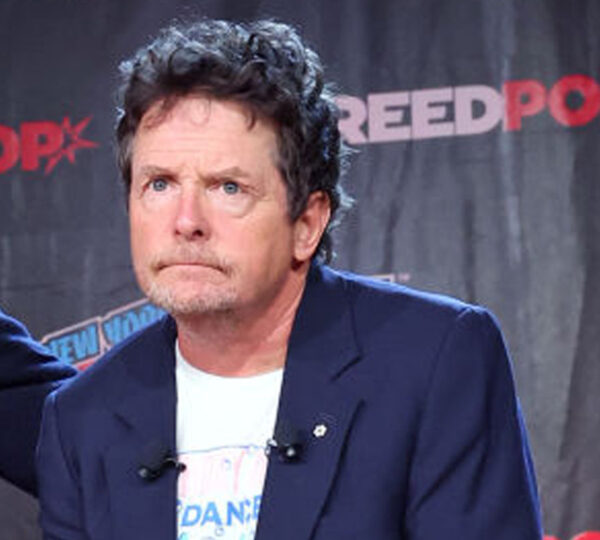
The exchange is short, but it captures something that has long been central to Fox’s public persona: his ability to use humor while discussing serious circumstances. He does not use comedy to pretend Parkinson’s is harmless. Instead, humor gives him a way to remain himself while acknowledging the reality of the disease.
That approach has appeared repeatedly throughout his interviews. Fox has often been candid about how difficult Parkinson’s can be, while also refusing to define his life only through suffering. In 2023, while discussing the documentary Still: A Michael J. Fox Movie, he spoke openly about the disease and about his dislike of pity.
Fox has said that he does not want people to feel sorry for him simply because he has Parkinson’s. His position has been that the disease is real and difficult, but his life is also meaningful and full of experiences he values. That perspective has helped shape the way many fans understand his public journey.
His return to acting has also had a strong personal effect. In a later interview, Fox said that acting again had made his life more interesting and described it as something that had “really prolonged” his life. That statement is best understood emotionally rather than medically. There is no evidence that acting itself slows the progression of Parkinson’s disease, but Fox was clearly describing how meaningful work gave him renewed energy and purpose.
He has also clarified that he does not consider himself completely retired from acting. Instead, Fox now allows Parkinson’s to influence what work is realistic for him. If a role can be performed safely and meaningfully, he may consider it. If his symptoms make something too difficult, he accepts that limitation.
That flexibility represents a major change from earlier stages of his career. As a young actor, Fox worked constantly and built a reputation around speed, timing, and physical comedy. Today, the question is no longer whether he can work at the same pace he once did. It is whether a particular project can fit the reality of his current health.
His relationship with Bill Lawrence makes the Shrinking appearance especially meaningful. Their professional connection stretches back decades. Fox starred in Spin City at a time when Parkinson’s was beginning to influence his career in ways the public was only starting to understand. Later, his role on Scrubs showed that he could still return to comedy under the right circumstances.
Now, Shrinking adds another chapter to that relationship.
The role also gives viewers a chance to see Parkinson’s represented without reducing a character entirely to the disease. Ford’s Paul remains a therapist, mentor, friend, and complicated human being. Fox’s appearance reinforces that same idea: Parkinson’s is part of a person’s life, but it does not automatically become the only thing worth discussing.
Fox’s work through his foundation has followed a similar philosophy. The Michael J. Fox Foundation has supported research aimed at understanding Parkinson’s more precisely and improving treatment. Over the years, the organization has helped fund large studies, clinical research, and work involving biomarkers that may allow scientists to identify biological changes connected with the disease more accurately.
For Fox, that work became one of the most important parts of his public life. He used the fame he had already earned as an actor to draw attention to Parkinson’s research and fundraising. Instead of retreating from public view after his diagnosis, he increasingly used his platform to support scientific progress.
His health journey, however, has included more than Parkinson’s alone. Fox underwent surgery for a spinal tumor in 2018 and later experienced serious falls during recovery. He has discussed how those physical challenges complicated an already difficult period and tested the optimism with which he had long been associated.
That is another reason his story should not be simplified into a motivational slogan. Fox has admitted that there have been dark periods. He has spoken about frustration, physical setbacks, and moments when hope felt less accessible.
His outlook has evolved over time.
After living with Parkinson’s for more than 35 years, Fox has said that the disease has become part of the ordinary structure of his life. He no longer wakes up every morning surprised by the diagnosis. Instead, he checks what kind of day his body is giving him and adjusts accordingly.
That acceptance does not mean giving up.
It means adapting.
Fox continues to spend time with his family, support the foundation, appear publicly, write, and occasionally act. His life is different from the one he imagined when he was 29, but it has not stopped being meaningful.
His fans have also played an important role in that journey. Fox has repeatedly expressed gratitude for the people who supported him through his acting career and later through his advocacy. He has described that support as something that gave him both encouragement and responsibility.
For longtime viewers, seeing him back on television can be emotional. Many people first knew Fox as the energetic Alex P. Keaton on Family Ties or as Marty McFly in Back to the Future. Those characters belonged to a period when few viewers knew what he would eventually face.
His appearance on Shrinking does not attempt to recreate that younger version of him. It shows Fox as he is now: an actor living with a progressive neurological condition, still capable of humor, still interested in storytelling, and still willing to perform when the circumstances are right.
That distinction matters.
The comeback is not a story about Parkinson’s disappearing.
It is not proof that Fox has been cured.
It is not evidence that determination alone can overcome a neurological disease.
It is a story about adaptation.
More than three decades after his diagnosis, Michael J. Fox continues to make decisions based on the realities of his health while still leaving room for unexpected opportunities. Returning to acting in Shrinking allowed him to reconnect with an old collaborator, share the screen with Harrison Ford, and bring his own experience into a storyline that addresses Parkinson’s directly.
For fans, the result is significant not because Fox is pretending nothing has changed, but because so much has changed and he is still finding ways to participate in the work he loves.
His career has taken a path he could never have predicted when he was first diagnosed at 29. Parkinson’s altered his plans, affected his physical abilities, and ultimately pushed him toward advocacy on a scale few actors ever achieve.
Yet acting never completely disappeared from his identity.
Now, with Shrinking, Fox has shown that the door remains open.
He may not know exactly how many roles are still ahead, and he has been careful not to make promises about the future. But he has also made something equally clear: he does not consider himself fully retired simply because Parkinson’s has changed what acting looks like for him.
For Michael J. Fox, the focus is no longer on returning to the career he once had.
It is on making the most of the opportunities that are still possible.
And after more than 35 years of living with Parkinson’s disease, that approach may be the clearest reflection of how he has learned to move forward—without denying what the disease has taken, without allowing pity to define him, and without closing the door on meaningful work before he has to.
