
After my wife Sarah died, I never believed I would love someone again. Losing her only hours after the birth of our daughter changed the entire shape of my life. Everything we had planned vanished in a single day, and suddenly I was raising a newborn while trying to understand how grief could exist beside ordinary responsibilities. For years, my focus was simple: keep our daughter Ari safe, keep moving forward, and somehow make sure she grew up knowing that her mother had loved her deeply even though they never had the chance to build memories together.
One of the few things Sarah left behind for Ari was a recording on my phone. During the final weeks of her pregnancy, she had recorded herself singing a lullaby. It was not polished. She forgot part of the words, hummed through a section, and laughed when the baby kicked. That imperfect recording became one of the most important things in our home. On difficult nights, when Ari cried and nothing seemed to calm her, I would play Sarah’s voice and quietly tell our daughter that the woman singing was her mother.
The first years after Sarah’s death were mostly about survival. My mother helped with childcare whenever she could, and I returned to work because life did not stop simply because mine felt broken. I was constantly exhausted and often moved through the day without remembering what I had done an hour earlier. I kept photographs of Sarah throughout the house and tried to answer Ari’s questions when she became old enough to notice them. She would point at a picture and ask who the woman was, and I would tell her, “That’s your mommy.”
Ari wanted details. She wanted to know whether Sarah was funny, what her voice sounded like, and what she had enjoyed doing. Sometimes I answered. Sometimes I changed the subject because the memories hurt too much. I told myself Ari was too young to understand grief, but the truth was that I was the one struggling to talk about it. I did not realize that by avoiding those conversations, I was unintentionally making Sarah feel more distant to our daughter.
When Ari was two, I met Claire in a toy store. I had gone in looking for a birthday gift and had absolutely no idea what to buy. Ari was holding tightly to my leg and watching everyone suspiciously. Claire worked behind the counter. Instead of immediately approaching her, she crouched down and used a stuffed rabbit to make Ari laugh. She understood within minutes that my daughter did not need to be pushed into conversation. She simply needed patience.
That small moment stayed with me. We returned to the store a week later, and Claire remembered Ari. Conversations slowly turned into coffee, then dinners, then weekends together. I told Claire about Sarah early because I did not want to build a relationship by pretending my past no longer mattered. I explained that I still loved Sarah and that even happiness could sometimes make me feel guilty.
Claire never told me to “move on.” She never suggested that enough time had passed or that I should stop talking about my late wife. Instead, she said something simple: “You don’t have to stop loving Sarah to care about someone else.” That sentence changed the way I thought about the possibility of a future. She did not ask me to erase part of my life in order to make room for her.
When Claire began spending time with Ari, she was careful. She never asked to be called Mom and never acted as though she had arrived to replace anyone. She read stories when Ari handed her a book, colored beside her, and learned every ridiculous rule in the imaginary games my daughter invented. Before moving anything in the house, Claire even asked whether I wanted Sarah’s photographs left exactly where they were.
I remember asking whether the pictures made her uncomfortable.
“Why would they?” she said. “She’s part of your family.”
That answer meant more to me than she probably realized.
After more than two years together, Claire and I married in a small garden ceremony. Ari threw flower petals in nearly every direction except where she was supposed to, and everyone laughed. For the first time in years, happiness stopped feeling like something I needed to apologize for. Our home gradually became louder and warmer. Claire danced while cooking, made lunches, and somehow convinced Ari that broccoli was worth eating by calling it “superhero trees.”
Still, I began noticing something unusual. Whenever Claire and Ari had a particularly happy day, Ari often became quiet afterward. If Claire braided her hair in the morning, I might later find Ari standing in front of Sarah’s photograph. When Claire tucked her into bed, Ari sometimes came to me minutes later and asked to hear “Mommy’s song.” Every time, I played Sarah’s lullaby.
Claire noticed the pattern too. She worried that Ari did not truly accept her. I reassured her that the situation was simply part of adjusting to a new family structure. Neither of us understood that Ari’s behavior had very little to do with rejecting Claire.
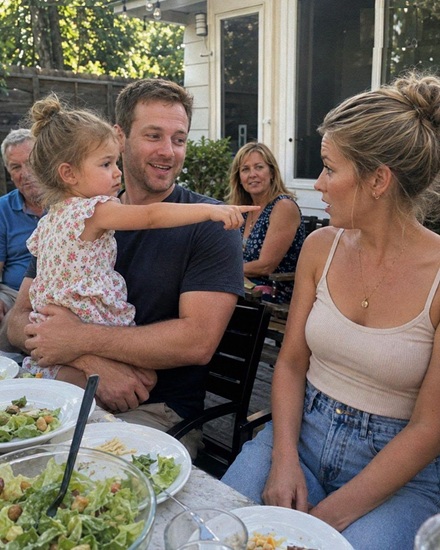
A few weeks after the wedding, I invited my parents and younger sister over for dinner. It was meant to be a relaxed family evening. Claire cooked roasted chicken, fresh bread, and apple pie. Ari helped set the table, although most of the silverware ended up in the wrong places. My mother arrived with a hug, my father brought flowers, and my sister immediately started making jokes.
Dinner was full of laughter. It felt good to hear so much noise in the house again. During dessert, my mother became emotional and told Claire how grateful she was that Ari and I had someone caring in our lives. She carefully added that nobody could ever replace Sarah.
Claire nodded immediately.
“Nobody should.”
Then my mother said she thought Sarah would be glad knowing that Ari and I were not alone.
That was when everything changed.
Ari suddenly pushed her chair away from the table.
She stood and pointed directly at Claire.
“She’s a monster.”
The room went completely quiet.
I asked her gently why she would say something like that.
Ari looked toward Sarah’s photograph.
Then she began to cry.
“Because when I love Claire, Mommy disappears.”
For a second, I could not speak.
Ari explained that when Claire brushed her hair, she worried she was forgetting what it would have been like if Sarah had done it. When Claire hugged her, she worried that she could no longer imagine her mother’s hugs. When adults called Claire her “new mommy,” Ari heard something entirely different from what they intended.
To her, “new mommy” meant “old mommy is going away.”
She looked at us and said, “In stories, monsters make people disappear.”
Claire’s eyes filled with tears.
Suddenly, every confusing moment made sense. Ari had never been trying to distance herself from Claire. Every time she asked for Sarah’s lullaby after having fun with Claire, she was reassuring herself that her mother still existed. Every time she stood in front of the photographs, she was trying to hold on to a connection she feared was fading.
The realization hurt because I understood my own role in creating that fear. I had answered Ari’s questions about Sarah quickly because remembering was painful for me. I thought protecting her from grief meant keeping the conversations small. Instead, I had unintentionally taught her that her mother was a fragile memory that might disappear if we stopped talking about her.
Claire quietly left the table.
For a moment, I thought Ari’s words had hurt her too deeply.
Then Claire returned carrying Sarah’s framed photograph.
She placed it on an empty chair beside Ari.
“Your mommy can sit with us too,” she said.
Ari stared at her.
Claire gently moved her own chair back a little.
“I don’t want Sarah to disappear. I’ve never wanted her place.”
Then she asked Ari, “Can you tell me something about your mommy?”
Ari looked down.
“I don’t know enough.”
Those words broke my heart.
So I started telling stories.
I told Ari that Sarah had once made blueberry muffins and forgotten the sugar. My mother laughed because she remembered it. My father reminded us that I had eaten three of them anyway because I did not want to hurt Sarah’s feelings.
“They tasted like warm bread,” I admitted.
Ari laughed.
Then I told another story. Sarah used to sing badly while cleaning the kitchen. She cried at animal rescue commercials. She talked to Ari before she was born because she was convinced babies recognized voices.
My parents added stories of their own.
One memory became another.
And for the first time since Sarah died, saying her name did not feel like reopening something that needed to stay closed. We were remembering her as a whole person instead of treating her as a painful subject nobody should mention.
Claire listened to everything.
She laughed when we laughed.
She cried when we cried.
She never tried to insert herself into Sarah’s memories.
Eventually, Ari climbed onto Claire’s lap.
“You still love me?” she asked.
“Very much.”
“Even if Mommy stays?”
Claire kissed the top of her head.
“I hope she always stays.”
Ari looked confused.
“If Mommy stays, where do you go?”
Claire smiled.
“I don’t need your mommy’s place. I’d like my own.”
Ari seemed to think about that seriously.
Then she nodded.
The next morning, Claire found an old recipe tin in the back of a cabinet. It belonged to Sarah. Inside were handwritten recipes, and one of the first cards we found was for blueberry muffins.
Claire held it up.
“Should we try?”
We all understood what she meant.
She was not trying to become Sarah.
She was making room for Sarah in the life we were building.
The kitchen became a mess. Ari cracked eggs far too aggressively, flour covered the counter, and batter landed on Claire’s sleeve. Some muffins were crooked, one burned around the edge, and none looked especially impressive.
Ari declared them perfect.
While they cooled, I picked up my phone.
Sarah’s lullaby was still saved there.
For years, I often left the room after pressing play because hearing her voice felt unbearable.
This time, I stayed.
Sarah’s voice filled the kitchen.
She forgot the same lyrics.
She hummed through the same section.
She laughed in exactly the same place.
It still hurt.
But the pain was no longer the only thing I felt.
Ari listened quietly. Then she picked up Sarah’s photograph and carried it to the breakfast table. There were three places set.
She added a fourth napkin beneath the frame.
Claire brought the muffins over and placed one beside Sarah’s photograph.
Ari smiled.
Then she took Claire’s hand.
She was not choosing one mother over another.
She was finally understanding that she did not have to.
That evening changed the way our entire family thought about loss. Adults often talk about moving forward as though the past must become smaller before new happiness can grow. Children may hear that message even more literally. Ari had believed that every new memory with Claire was taking something away from Sarah.
We stopped using language that suggested replacement. Claire was not a “new mother” who had arrived to fill an empty position. She was Claire, someone who loved Ari in her own way. Sarah remained Ari’s mother, even though she was no longer physically present.
The difference mattered.
Our home still contains Sarah’s photographs. Her recipes remain in the kitchen. Her lullaby is still on my phone. We continue telling Ari stories about the woman who loved her before she was born.
There are also photographs of Claire.
Pictures of the two of them cooking, laughing, reading, and building blanket forts.
Those memories do not compete with each other.
They belong to the same family.
I once thought healing meant eventually reaching a point where Sarah’s absence stopped hurting. I no longer believe that. Grief can remain while life continues around it. New love does not need to erase older love, and remembering someone who died does not prevent us from caring deeply about someone who is here.
Ari taught us that without meaning to.
She called Claire a monster because she was frightened of losing a mother she barely had the chance to know.
Claire answered not by defending herself, but by giving Sarah a place at the table.
And that simple gesture helped our daughter understand what all of us had been struggling to express.
No one needed to disappear.
No one needed to be replaced.
Love simply had to become large enough to hold the past and the present at the same time.
This is a fictional narrative created for storytelling purposes. It should not be presented as a verified real-life event, personal testimony, or local news report.

