
I was seven months pregnant when Adam, the man I had planned to marry, died only six weeks before our wedding. In a matter of moments, the future we had spent years imagining disappeared, leaving me to prepare for motherhood without him. When our daughter Lily was born, I promised myself that she would still grow up knowing who her biological father had been. I filled our home with photographs and stories, telling her about Adam’s sense of humor, the music he loved, his terrible jokes, and how excited he had been when we learned that we were going to become parents.
For several years, Lily and I formed our own little family. Life wasn’t easy, but eventually we found a rhythm that belonged to us. Then Tony entered our lives in the most ordinary way possible. He worked maintenance at our apartment complex and first knocked on our door because the kitchen sink was leaking. One repair led to another conversation, conversations became friendship, and friendship gradually developed into something deeper. What mattered most to me was that Tony never behaved as though loving us required replacing Adam or erasing his memory.
Tony simply became part of our everyday life. He attended Lily’s school performances, helped with homework, learned how to braid her hair despite being terrible at it, and stayed beside her whenever nightmares woke her during the night. When Tony and I eventually married, Lily surprised him during the reception by calling him “Dad” for the first time. Tony froze before kneeling beside her and wrapping his arms around her. Later, away from the guests, he admitted that hearing that one word meant more to him than anything else about the wedding.
For a while, our lives finally felt stable. Then Lily started becoming unusually tired. Bruises appeared without obvious explanations, and she gradually lost the energy that had once kept her moving all day. We initially hoped the symptoms had a simple explanation, but medical appointments and tests followed. Within this fictional story, doctors eventually diagnosed Lily with leukemia, and our family suddenly entered a world dominated by hospitals, medications, treatment schedules, blood tests, and uncertainty.
For two years, Tony remained beside Lily through every difficult stage. He memorized medication schedules, learned which foods she could tolerate after treatment, and spent nights sleeping in uncomfortable hospital chairs rather than leave her alone. There were encouraging periods when we allowed ourselves to believe everything might eventually return to normal, followed by setbacks that reminded us how unpredictable serious illness could be. We learned to celebrate good days without assuming they guaranteed what would happen next.
Eventually, Lily’s doctors explained that the treatments were no longer helping in the way everyone had hoped. Continuing aggressive treatment was unlikely to provide the benefit we desperately wanted, and the focus needed to shift toward keeping her comfortable and giving her meaningful time with the people she loved. Telling our ten-year-old daughter was one of the hardest conversations Tony and I had ever faced, yet Lily listened with a quiet strength that left both of us struggling to control our emotions.
After a long silence, Lily told us she had two wishes. She wanted to see Cinderella’s castle, something she had talked about since she was little, and she wanted to put her feet in the ocean. The wishes sounded simple until we looked at our finances. Years of medical expenses had consumed much of our savings, and traveling to Florida seemed almost impossible. Tony, however, refused to dismiss something that mattered so deeply to her.
I sold a gold bracelet my mother had left me, while Tony accepted additional maintenance shifts and weekend repair jobs. Friends helped with travel points, and a local charity contributed toward some of the expenses. Little by little, the numbers began working. What had initially seemed impossible eventually became a real itinerary sitting on our kitchen table, and when we told Lily we were going, her expression made every sacrifice worthwhile.
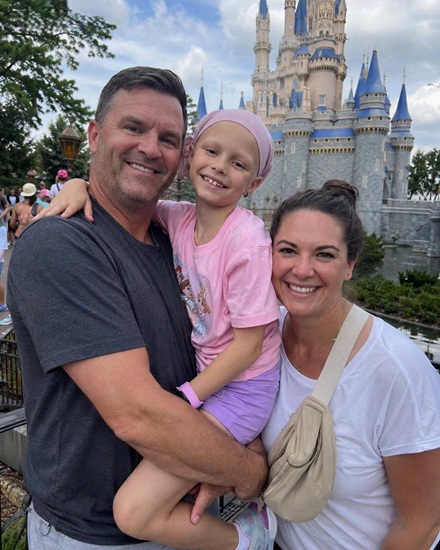
For several days in Florida, Lily seemed to rediscover the childhood that illness had interrupted. She smiled in front of the castle, laughed during breakfast with costumed characters, and insisted on taking photographs everywhere we went. At the beach, an adaptive wheelchair allowed us to bring her close enough to the shoreline for the water to reach her feet. The first cold wave surprised her so much that she pulled her legs back, then immediately laughed and asked Tony to move her closer.
I stood behind them watching Lily laugh while the water moved around her feet, wishing there were some way to preserve that exact moment. For once, nobody was talking about medication, test results, or the next appointment. There was simply the ocean, Tony beside her, and our daughter behaving like an ordinary ten-year-old on vacation. It was everything we had wanted the trip to give her.
Then came our final morning. Lily remained asleep upstairs while Tony went outside to organize the rental car. I walked to the hotel reception desk expecting nothing more complicated than completing the checkout paperwork. Instead, the manager hesitated before reaching beneath the counter. Within this fictional story, her name was Denise, and she placed a sealed envelope in front of me before explaining that several expenses connected with our trip had been paid by someone else.
The name on the paperwork immediately stopped me. Robert. I had not spoken that name comfortably in sixteen years. Robert was Adam’s father and therefore Lily’s biological grandfather. The last time we had been part of each other’s lives was during the terrible period following Adam’s death, when grief had transformed into anger and both families had said things they later regretted.
Letters had been exchanged, accusations had been made, and eventually communication stopped completely. I convinced myself that Robert wanted nothing to do with Lily or me. What I did not understand was that Robert had developed the opposite belief. He thought I had deliberately excluded him and that contacting us would only create more pain. Instead of confronting those misunderstandings, we allowed years to accumulate around them.
Denise then told me that Robert was nearby. He had traveled there hoping for an opportunity to meet Lily, but he understood that no meeting could happen unless I agreed. Confusion immediately became anger when I realized there was only one person who could have told him where we were. I walked outside and found Tony standing beside the rental car.
“You contacted Robert?” I asked. Tony looked at the envelope in my hand and knew immediately that the secret was over. He admitted that while searching through our documents for paperwork required for Lily’s trip, he had discovered old correspondence between Robert and me. One final letter contained Robert’s telephone number and a request asking to be contacted someday if Lily ever wanted to know him.
Tony had called him without telling me. He explained Lily’s illness and told Robert about the trip. When Robert asked whether he could help, Tony allowed him to pay several expenses directly through the hotel rather than giving us money personally. Tony had also made it clear that financial help would not guarantee Robert access to Lily and that any meeting would ultimately depend on my agreement.
I was furious because Tony had made a major family decision without consulting me. I told him that good intentions did not give him permission to contact someone from a painful part of my past behind my back. Tony did not try to defend the secrecy. He simply admitted that he knew I might refuse if he asked first, but he had become frightened that everyone was waiting for a perfect moment that might never arrive.
“Lily doesn’t have unlimited time, Claire,” he said quietly. “I didn’t want her to lose a choice because the adults were still angry.” I understood the reasoning, but understanding was not the same as approving. Tony had crossed an important boundary, and we both knew there would be difficult conversations about trust after the trip. Before that conversation could continue, however, we learned that Lily had awakened upstairs and was asking where everyone had gone.
We returned to the room and decided that whatever happened next should not be hidden from her. I showed Lily an old photograph of Adam as a child and explained that his father was downstairs. She studied the photograph carefully, tracing Adam’s face with one finger before looking toward me. “He has my eyes,” she said softly. I asked whether she wanted to meet the grandfather she had never known, making clear that saying no was completely acceptable.
Lily nodded without hesitation. Robert entered the room several minutes later looking far more nervous than I remembered him. He carried no expensive presents and made no dramatic speech. In his hands was a small wooden music box that had belonged to Adam when he was a child. He placed it gently in Lily’s hands, and when she opened it, a simple melody filled the room.
Then Robert began telling stories. He told Lily that Adam hated tying his shoes, loved pancakes, and once tried to raise a frog in the family bathtub. He described a boy who pretended not to be afraid of thunderstorms and a teenager who could never keep his bedroom organized. These were not extraordinary stories, but that was precisely what made them so valuable. I had spent Lily’s entire childhood describing Adam as the young man I loved; Robert could tell her about the little boy he had raised.
Lily listened to every word. Eventually, she asked the question none of us wanted to answer: why had Robert waited so long to meet her? Robert looked toward me before responding. He did not accuse me or attempt to rewrite the past. He simply told her that sometimes adults who are grieving hurt each other, and then pride and fear make it increasingly difficult to repair the damage.
His answer affected me because it was true. Robert and I had both lost Adam, yet instead of allowing that shared grief to bring us together, we had treated each other like opponents. Sixteen years later, our granddaughter was the one showing us how unnecessary some of that distance had become.
Within this fictional story, Lily was comfortable enough for us to extend the trip by one additional day after confirming that the change would not interfere with her care. Robert offered to cover the additional hotel and travel costs. This time, the arrangement was discussed openly, and I agreed because the extra day belonged primarily to Lily.
That afternoon, we returned to the beach. Tony pushed Lily’s wheelchair toward the shoreline while Robert walked beside him. I followed several steps behind and found myself watching two men whose lives were connected through someone who was no longer there. Robert had raised Adam, while Tony had helped raise Adam’s daughter. Neither relationship diminished the other.
When the waves reached Lily’s feet, she laughed exactly as she had the first time. Robert quietly wiped tears from his face. Tony rested one hand on Lily’s shoulder while she asked them both to move her a little closer to the water. For several minutes, everyone simply watched the waves, and there was no need to discuss the complicated history that had brought us there.
Before leaving the beach, Lily asked a hotel employee to take a photograph of us. We gathered behind her wheelchair but instinctively left uncomfortable spaces between ourselves. Lily immediately noticed. “Closer,” she instructed. Tony stepped toward Robert, and I moved beside them.
I jokingly asked why everyone had to squeeze together. Lily looked toward the camera and answered with the simple logic of a child. “Because I want everyone who came for me in the same picture.” The photographer pressed the button while none of us knew exactly how to react. That imperfect photograph became one of the most important images I carried home.
It did not erase sixteen years of silence between Robert and me. It did not make every painful letter disappear. It also did not erase the fact that Tony had contacted Robert without my knowledge. Reconciliation is not the same thing as pretending nothing wrong happened, and forgiveness does not eliminate the need for boundaries.
After returning home, Tony and I had several difficult conversations. I told him that he could not make major decisions involving our family secretly simply because he believed his intentions were good. He apologized and acknowledged that he should have included me. I accepted his apology, but I also admitted something uncomfortable about myself.
Had Tony asked me before contacting Robert, I probably would have said no. My decision would have been based largely on sixteen-year-old anger rather than on what Lily might want. That did not make Tony entirely right, and it did not make me entirely wrong. It simply demonstrated how complicated love, grief, trust, and fear can become when people believe they are protecting someone.
Robert and I also began communicating again. We did not suddenly become close, and neither of us pretended that years of resentment could disappear because of one emotional afternoon. We started slowly. A telephone call here, a photograph there, and occasional conversations about Adam and Lily were enough.
We could not recover the sixteen years we had lost. We could only decide whether we wanted to lose more. That became one of the most important lessons of the trip. Reconciliation cannot rewrite history, but sometimes it can prevent history from repeating itself.
Our vacation had begun with two simple wishes: a castle and the ocean. Lily received both. Yet she also received something we had never planned. She met the man who had raised her biological father, heard stories about Adam that I could never have told her, and discovered another part of the family history that belonged to her.
Tony also learned something about good intentions. Wanting a positive outcome does not automatically justify keeping important secrets from a spouse. Trust requires communication even when the conversation is uncomfortable. I learned something equally difficult: protecting a child does not always mean deciding everything on that child’s behalf, particularly when the child is old enough to express what matters to them.
Robert learned that waiting for the perfect moment can become another form of losing time. He had spent years believing there would eventually be a better opportunity to repair the relationship. Instead, one year became another until a medical crisis reminded everyone that time is not something families can assume they will always have.
The photograph from the beach eventually became the image I returned to most often. Nobody looked perfectly comfortable. Tony looked exhausted, Robert looked emotional, and I was still processing everything that had happened. Lily, however, was smiling directly at the camera.
That smile mattered more than the awkwardness surrounding it. For one afternoon, our daughter was not defined by a diagnosis or hospital schedule. She was simply a child surrounded by people who loved her in different ways.
Robert could never replace the years he had missed. Tony could never replace Adam, nor had he ever tried. I could never erase the arguments that helped separate our families. But none of those truths prevented us from giving Lily one peaceful day together.
Sometimes reconciliation is described as though everyone suddenly forgives everything and returns to the relationship they had before the conflict. Real reconciliation is often much quieter. It can mean acknowledging what happened, accepting that some damage cannot be undone, and deciding to behave differently with whatever time remains.
Tony should have told me he contacted Robert. Robert and I should have tried to communicate years earlier. I should have considered Lily’s wishes before assuming that protecting her meant keeping Robert outside her life forever. None of us could go backward and correct those choices.
But when Lily asked us to stand closer for one photograph, we could do that.
So we did.
For that brief moment, there were no old letters, no arguments, no accusations, and no sixteen years of silence. There was only Lily sitting near the ocean, surrounded by her mother, the father who had raised her, and the grandfather who finally had the opportunity to tell her about the father she never knew.
And somehow, after all those years apart, everyone finally fit inside the same frame.

