
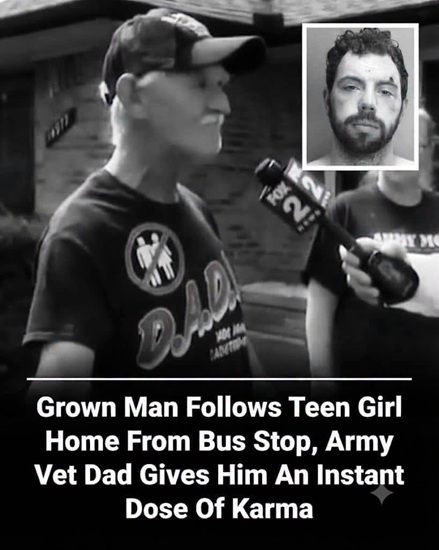
A disturbing incident in Livonia, Michigan, attracted national attention in 2019 after a teenage girl was followed home from her school bus stop by an adult man. According to contemporary police reports and local news coverage, the situation escalated when the man followed the girl onto her property and into her home. Her father, Army veteran Mike Oliver, was inside at the time and immediately realized that something was seriously wrong. The encounter quickly developed into a neighborhood search that ended with police locating and arresting the suspect.
Oliver’s daughter was 15 years old and attending Franklin High School when the incident occurred. She had gotten off the school bus and was walking home through the neighborhood when a man later identified by police as David Roberts began following her. What should have been an ordinary walk from the bus stop became increasingly frightening as the teenager realized that the stranger was continuing in the same direction and was not simply passing through the area.
According to reports from Livonia police, Roberts followed the girl as far as her home and onto the porch. He reportedly asked whether her parents were inside before continuing after her into the residence. That detail made the situation far more serious than an uncomfortable encounter on the street. Fortunately, the teenager’s father was at home when she entered.
Oliver later said that he encountered the unfamiliar man near the entrance to the house and immediately questioned why he was there. Rather than remaining and explaining himself, Roberts reportedly fled. Oliver reacted quickly and pursued him outside while the family also contacted emergency services.
The confrontation moved into the surrounding neighborhood. Oliver later described physically struggling briefly with Roberts before the man managed to get away and continue running. The incident understandably triggered a strong protective response from the father, but later coverage also made clear that the situation could easily have become more dangerous.
Oliver then used his vehicle to continue following the suspect’s movements from a distance while information was relayed to police. His son and at least one neighbor also helped monitor where Roberts was going. This community awareness helped authorities narrow down the area in which he was attempting to hide.
Both Oliver and his daughter contacted 911. That was an important part of the response because it allowed trained officers to take over the search rather than leaving the family to continue confronting an unknown adult on their own. Police units arrived quickly and began searching nearby yards and residential areas.
Roberts was ultimately located hiding in a backyard close to the family’s home. Officers took him into custody after the short neighborhood search. Some later online versions of the story described a dramatic vehicle chase and police cars surrounding a fleeing truck, but contemporary reports indicate that the suspect primarily fled on foot and was found nearby.
The criminal charges also deserve careful description. Local reporting stated that Roberts was charged with breaking and entering and assaulting a police officer. His bond was reportedly set at $100,000 with ten percent required. Although his alleged conduct toward the teenager was widely described as following or stalking behavior, the strongest contemporary reports did not list a formal stalking charge in connection with this specific case.
That distinction is important when reporting criminal incidents accurately. A person may be described as following someone when police say that is what happened, but formal criminal charges should be reported only when they are confirmed through authorities or court records. Exaggerating the number or severity of charges can turn an already serious story into misinformation.
Oliver’s military background became a major part of many headlines about the case. He was described as an Army veteran, and his ability to remain focused during a stressful situation was emphasized in several reports. However, claims that he used specialized military tactics or conducted a professional-style pursuit go beyond what reliable reporting established.
What is clear is that he reacted immediately to protect his daughter and help authorities locate the man who had entered their home. He later acknowledged that physically confronting a stranger carried risks and that the situation could have ended differently.
That is an important point because stories involving protective parents can easily be framed as celebrations of revenge or vigilantism. In reality, confronting an unknown person can expose both the parent and child to additional danger, particularly if the stranger is armed or unpredictable.
The safer elements of the Livonia response were the teenager getting inside, the family contacting 911, neighbors staying alert and police being given information about the suspect’s location. Those steps helped officers find Roberts within a relatively short period.
For the teenager, however, the arrest did not immediately erase what she had experienced. Her mother later said the girl became afraid to return to school after the incident. A familiar route between the school bus and home had suddenly become associated with fear, and the fact that the man had followed her into the house made the experience even more unsettling.
Her reaction illustrates how the emotional effects of a frightening encounter can continue after the immediate danger has ended. Someone can be physically safe while still struggling with anxiety, fear or a loss of confidence in places that previously felt ordinary.
The case also led local officials and school representatives to remind students about personal safety. Young people were encouraged to remain aware of their surroundings, stay with friends when possible and tell a trusted adult when someone’s behavior feels suspicious or threatening.
If a person believes they are being followed, reaching a populated or secure location is usually more appropriate than confronting the stranger. Calling a trusted adult or emergency services can also help. The exact response will always depend on the circumstances, but creating distance and finding help are generally safer priorities than trying to investigate the person yourself.
Parents can also discuss these situations before an emergency occurs. A teenager who already knows where to go, whom to call and what information to remember may be better prepared to react if something feels wrong.
That does not mean children should be taught to fear every unfamiliar person. Most strangers are not dangerous, and ordinary daily life should not be framed as constantly threatening. The goal is simply to help young people recognize unusual behavior and know that asking for help is appropriate when they genuinely feel unsafe.
The Livonia case also demonstrates how community involvement can help without becoming vigilantism. Neighbors reportedly assisted by observing where Roberts had gone and sharing that information. They did not need to make the arrest themselves. Their role was helping law enforcement understand what was happening in the area.
Police ultimately handled the arrest.
That division of responsibility matters. Members of the public can provide descriptions, directions, license-plate numbers or other observations when safe to do so, while trained officers handle the potentially dangerous confrontation.
Over time, the story was repeatedly reshared online and became increasingly dramatic. Some versions portrayed Oliver as launching an extended high-speed pursuit, using tactical military techniques and personally delivering “instant karma.”
Those details make for a more sensational headline, but they are not necessary.
The documented facts are already serious.
A 15-year-old girl left her school bus and began walking home. An adult man followed her. Police said he entered her residence behind her. Her father confronted him. The man fled. Family members and neighbors helped track his movements, and police later located him hiding in a nearby backyard.
That is the version that should be preserved.
The incident also offers a useful reminder that frightening situations can begin in very ordinary surroundings. A familiar neighborhood, a normal school day and a short walk home do not guarantee that nothing unexpected will happen.
At the same time, the lesson should not become one of constant fear.
It is about awareness and preparation.
The teenager recognized that the situation was wrong and reached her home.
Her family reacted.
Emergency services were contacted.
Neighbors paid attention.
Police arrived and made an arrest.
Each part of that response contributed to the outcome.
For families, perhaps the most practical takeaway is the value of having simple safety plans. Teenagers can know which nearby homes or businesses are safe places to enter, carry a charged phone when possible and understand that they should not feel embarrassed about contacting an adult if they are genuinely frightened.
Parents can also encourage children to trust their instincts while still distinguishing discomfort from confirmed danger. If someone keeps following, attempts unwanted contact or tries to enter a private space, seeking immediate assistance is reasonable.
In the Livonia incident, the most troubling element was not simply that a stranger walked in the same direction as a teenager.
Police said he followed her onto the porch and into the house.
That behavior turned the situation into a serious criminal matter.
Years later, the case continues to circulate because of the powerful image of a father reacting to protect his daughter. But the most responsible way to tell the story is not as a revenge fantasy.
It is a story about a teenager recognizing danger, a family responding quickly and a community helping police locate a suspect.
The father’s determination mattered.
The neighbors’ attention mattered.
And the police response mattered.
Most importantly, the teenager reached a place where adults could help her.
That is the part of the story worth remembering: when something felt wrong, she did not ignore it. She sought safety, and the people around her acted.

