
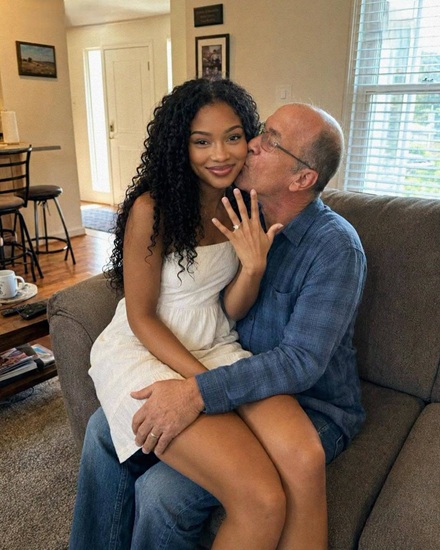
When my twenty-two-year-old daughter Chloe sent me a photograph announcing that she had married a fifty-six-year-old man named Arthur, I stared at my phone in disbelief. There had been no engagement announcement, no invitation and no warning that she was even considering marriage. In the picture, Chloe stood beside a silver-haired man dressed in an expensive-looking coat, with a simple gold band visible on her finger. Before asking a single question, I convinced myself that I already understood the situation: my daughter had married a wealthy older man because of his money.
Chloe and I had been extraordinarily close for most of her life. After her father and I separated, raising her became my primary responsibility. Money was rarely comfortable, so I cleaned homes, accepted extra shifts at a care facility and learned to make almost everything last longer than it was designed to. I didn’t consider those sacrifices heroic. They were simply what needed to be done, and watching Chloe grow into an intelligent and compassionate young woman made every difficult year worthwhile.
When Chloe was accepted into a nursing program in London, I was more proud than frightened, although the financial reality was intimidating. I used a large portion of my savings to help her get started because I wanted her education to open doors that had never been available to me. During her first months abroad, she called frequently and told me everything: difficult classes, tiny rooms, unfamiliar streets and the constant fear that she wasn’t good enough to succeed.
Over time, however, our conversations changed. Chloe still called, but she often sounded exhausted and distracted. Sometimes she ended conversations suddenly because she needed to return to the hospital or complete an assignment. I assumed nursing school was simply consuming her life. I had no idea that another relationship was developing in the background until the photograph of Arthur appeared on my phone.
I called immediately and demanded an explanation. Instead of listening, I accused Chloe of throwing away her future. I asked whether Arthur had promised her a house, money or financial security. I even used the phrase “gold digger,” a word I regretted almost immediately. Chloe remained surprisingly calm and asked me to wait until she returned home. She said there were things I did not know.
For the following week, I allowed my imagination to fill every gap. I pictured a luxurious apartment, expensive gifts and an older millionaire using wealth to control my daughter. By the time Chloe arrived, I was prepared for an argument. Then she walked through the airport looking thin, tired and emotionally drained. Whatever had been happening in London, it clearly wasn’t the carefree life I had invented in my mind.
At home, I asked again whether she had married Arthur for money. Chloe quietly opened her bag and placed an old document on the kitchen table. I recognized the hospital name immediately. Ten years earlier, when Chloe was twelve, I had been treated for cancer. The diagnosis had frightened us, but the financial burden surrounding treatment had created another kind of fear that I rarely discussed with my daughter.
During that period, an anonymous charitable donor had helped cover expenses I could not afford. I never learned the donor’s identity. I simply remembered crying when I discovered that a major financial burden had been removed. The assistance allowed me to concentrate more fully on treatment and recovery instead of spending every night wondering how I would pay the next bill.
Chloe pointed toward information connected with that old assistance and then placed additional paperwork beside it. Within this fictional story, she had discovered that Arthur had supported the charitable program responsible for helping patients like me. He had never known my name and had never expected anything in return. He had simply contributed to a fund designed to help people facing serious medical and financial difficulties.
Chloe had met Arthur while completing part of her nursing training. He was seriously ill with advanced heart disease and required extensive medical support. During their conversations, she learned about his history of charitable giving. Eventually, details in his records reminded her of the documents I had kept from my own treatment. That connection ultimately revealed something neither of them could have expected.
Arthur was one of the people whose generosity had helped our family.
When Chloe told him what she had discovered, he reportedly became emotional. He had donated money without knowing whether he would ever learn what happened to the people receiving assistance. Suddenly, the nursing student standing beside him was explaining that his generosity had helped her mother receive treatment and remain present throughout her childhood.
Their relationship changed after that discovery.
They talked more frequently, and Chloe began seeing Arthur as something other than a patient. She learned about his life, regrets, family difficulties and fears about losing independence as his health deteriorated. Arthur, meanwhile, came to trust Chloe because she listened to what he wanted rather than assuming illness had removed his right to make decisions.
The situation involving Arthur’s family was complicated. He had adult children with whom he had developed serious disagreements about his care, property and future arrangements. Arthur believed some relatives were becoming increasingly focused on his estate while paying less attention to his preferences about how he wanted to spend the time he had left.
That was when I asked Chloe the question that still troubled me.
“Why marriage?”
Her answer was not the simple explanation I expected.
Within this fictional narrative, Arthur had consulted independent lawyers about protecting his wishes and organizing his affairs. Importantly, marriage by itself would not automatically give Chloe unlimited authority over his healthcare or finances. Those matters depend on applicable law and properly prepared legal documents. Arthur therefore formally documented his medical preferences and financial arrangements while professionals considered him capable of making those decisions.
Chloe became one of the people he trusted to support those wishes.
Their eventual marriage was unconventional. Chloe described it as a relationship based on companionship, trust and a profound sense of responsibility rather than the traditional romance I had imagined from seeing their photograph.
That explanation did not instantly remove all my concerns.
Chloe was still twenty-two.
Arthur was fifty-six and wealthy.
The age difference was substantial, and I believed questions about consent, independence and financial influence were reasonable.
But asking questions was very different from declaring my daughter guilty before hearing the answers.
A week later, I traveled to London to meet Arthur.
The man waiting for me looked nothing like the controlling millionaire I had constructed in my imagination. Arthur was physically frail and frequently needed a wheelchair, but his mind remained engaged during our conversations. He had a dry sense of humor and seemed almost embarrassed when I tried to thank him for the financial help my family had unknowingly received years earlier.
“I didn’t save your life,” he told me within the fictional story. “Your doctors did that.”
Then he smiled.
“I just made one problem smaller.”
That sentence stayed with me.
During the following weeks, I watched Chloe help Arthur manage everyday life. She organized appointments, assisted with medication schedules and accompanied him when he wanted support. But she did not speak over him or treat him as though illness had erased his independence.
When Arthur could make decisions, he made them.
Chloe’s responsibility was to support his choices.
That distinction gradually changed my understanding of their relationship.
The family dispute nevertheless continued. Some of Arthur’s adult children questioned the marriage and argued that Chloe might be exploiting someone whose health had made him vulnerable. Given the circumstances, those concerns had to be evaluated seriously rather than dismissed merely because Chloe was my daughter.
Evidence mattered.
Arthur had legal representation.
His intentions had been documented.
Medical professionals had evaluated relevant questions concerning his decision-making capacity.
Witnesses could describe what he had said about his wishes.
Within this fictional story, those safeguards became crucial when disagreements eventually reached a formal legal process. The outcome did not depend on an emotional courtroom speech or on Chloe simply claiming that she knew what Arthur wanted. Records, professional assessments and properly executed documents were necessary.
Ultimately, Arthur’s arrangements were allowed to remain in place.
That did not make every disagreement within his family disappear.
Nor did it prove that relationships involving large age differences and substantial wealth should never raise questions.
It simply meant that, within this story, the evidence supported Arthur’s ability to make his own decisions.
Meanwhile, his health continued deteriorating.
I stayed in London longer than originally planned.
I watched Chloe become increasingly tired as she balanced nursing responsibilities with supporting Arthur. There were no extravagant parties or endless shopping trips.
There were medical appointments.
Quiet dinners.
Long conversations.
And difficult nights when Arthur’s illness reminded everyone that time was becoming limited.
Several months later, Arthur died.
Before his death, he reportedly told Chloe something she carried with her afterward.
“Don’t let difficult people make you hard.”
Those words seemed appropriate for a man whose generosity had connected our families years before either Chloe or I knew his name.
Afterward, I looked again at the photograph that had made me so angry.
Nothing in the image had changed.
Arthur was still thirty-four years older than my daughter.
He was still wealthy.
Chloe was still only twenty-two.
What had changed was my belief that those facts automatically explained everything else.
They didn’t.
I had seen an age difference and assumed manipulation.
I had seen wealth and assumed greed.
I had seen a wedding ring and assumed my daughter had abandoned the values I spent years trying to teach her.
Most painfully, I had decided what Chloe’s motivations were without allowing her to explain them.
The experience did not teach me that every unconventional relationship should be accepted without questions. Quite the opposite. When significant differences in age, wealth, health or dependency exist, questions about consent and exploitation can be important.
Vulnerable adults deserve protection.
People entering unusual financial or caregiving arrangements can benefit from independent professional advice.
And medical or legal authority should be established through proper processes rather than assumptions about marriage.
But concern should be based on evidence.
It should not become an excuse to humiliate someone before understanding the situation.
I could never erase the things I said during that first telephone call.
Chloe eventually forgave me.
Forgiving myself took longer.
The old hospital paperwork remained in my kitchen drawer afterward.
Sometimes I looked at it and remembered the anonymous stranger who had helped me when Chloe was twelve.
Arthur never knew that his generosity would eventually circle back into his own life.
He simply helped because he could.
Years later, my daughter found herself in a position to offer companionship and advocacy when he felt increasingly vulnerable.
Their relationship was unconventional.
It was complicated.
And it was impossible to understand from a single photograph.
That became the lesson I carried forward.
Sometimes the people we love make choices that frighten or confuse us. We can ask questions. We can express concerns. We can encourage them to protect themselves.
But there is a difference between concern and condemnation.
I learned that difference the painful way.
When Chloe first showed me her wedding ring, I thought it represented everything I had failed to prevent.
Later, I understood that it represented a story I had never bothered to hear.
And sometimes, before deciding that someone we love has lost their way, the most important thing we can do is give them enough time to tell us where they actually are.

