
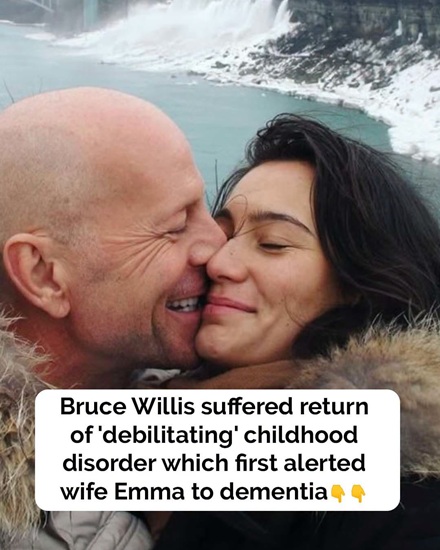
Emma Heming Willis has spoken candidly about the difficult journey her family has experienced since Bruce Willis was diagnosed with frontotemporal dementia, commonly known as FTD. In addition to discussing caregiving and raising their daughters, Emma has shared what she remembers about the changes that appeared before the family fully understood what was happening. One detail has become especially significant in hindsight: Bruce’s childhood stutter, which he had learned to manage successfully for decades, began becoming more noticeable again.
Bruce’s family first announced in March 2022 that he would step away from acting after receiving a diagnosis of aphasia, a condition affecting a person’s ability to communicate. Almost a year later, in February 2023, his family provided another update explaining that doctors had reached a more specific diagnosis of frontotemporal dementia. The announcement brought greater clarity to the communication problems that had contributed to the end of his acting career.
FTD is a group of neurological disorders associated primarily with changes in the frontal and temporal areas of the brain. Depending on the particular form and progression of the disease, it can affect language, behavior, judgment, personality and movement. Symptoms can differ significantly from person to person, which is one reason FTD does not necessarily resemble the image many people have when they hear the word “dementia.”
That distinction has become an important part of Emma’s public advocacy. She has explained that people sometimes ask whether Bruce still recognizes members of his family, apparently assuming that all forms of dementia begin with severe memory loss. Emma has emphasized that Bruce has FTD rather than Alzheimer’s disease and that his experience initially centered heavily on communication and language.

For Bruce, those communication changes were particularly complicated because he already had a history of stuttering.
Emma has explained that Bruce experienced a severe stutter during childhood. She characterized it as debilitating when he was young. Over the years, however, he developed ways of managing it effectively enough to build a career in an industry where speaking and communication were fundamental parts of his work.
That accomplishment becomes especially remarkable when considering the enormous success Bruce ultimately achieved.
His breakthrough television role in Moonlighting demonstrated his ability to handle rapid dialogue and comedy. His subsequent film career transformed him into one of Hollywood’s most recognizable stars through projects including Die Hard, Pulp Fiction, The Sixth Sense, Armageddon and many others.
His distinctive voice and delivery became part of his screen identity.
That is why Emma found the later communication changes so unusual.
She has explained that Bruce’s stutter never completely disappeared. Rather, he had learned to manage it throughout adulthood. As his health began changing, Emma noticed that the strategies he had relied upon no longer seemed to work as effectively.
The stutter became increasingly noticeable.
At the time, however, the explanation did not immediately seem alarming.
Bruce had dealt with stuttering before.
From Emma’s perspective, it could understandably appear that an old difficulty was simply becoming harder for him to manage.
Only later did the family understand that the communication changes were occurring within a much larger neurological picture.
Emma has acknowledged that she never imagined the returning speech difficulties might ultimately be associated with dementia.
That point is important because hindsight can make symptoms seem obvious even when they were not obvious while they were occurring.
A family member cannot necessarily look at one communication change and know that it represents a progressive neurological condition.

In Bruce’s case, there was already a familiar explanation available.
He had a lifelong history of stuttering.
The eventual FTD diagnosis therefore changed the way Emma understood some of those earlier experiences.
However, Bruce’s story should not be interpreted to mean that a returning or worsening stutter is generally a sign of frontotemporal dementia.
Stuttering can occur for different reasons, and FTD cannot be diagnosed from a single symptom.
Anyone experiencing significant new changes in speech, language, movement, behavior or cognitive functioning should seek appropriate medical assessment rather than comparing one symptom directly with Bruce Willis’ experience.
Bruce’s initial aphasia diagnosis also deserves clarification.
Aphasia refers to difficulty with language and communication. It can affect speaking, understanding language, reading or writing depending on its cause and characteristics.
It is not itself synonymous with dementia.
In Bruce’s case, the family later explained that his condition had progressed and that doctors had identified FTD as the more specific diagnosis underlying his difficulties.
Since that announcement, Emma has increasingly devoted attention to raising awareness about FTD.
Her public conversations have also explored another aspect of the family’s experience that receives less clinical attention: the emotional burden carried by caregivers.
Emma recently discussed this while reflecting on her 50th birthday.
Under different circumstances, reaching 50 might have been an uncomplicated reason to celebrate.
For Emma, it was emotionally complicated.
She admitted that she initially did not feel particularly celebratory and considered allowing the milestone to pass quietly.
A close friend encouraged her to reconsider.
The friend reminded Emma that turning 50 was something worth acknowledging and that she might eventually regret not allowing herself to celebrate it.
Emma thought carefully about that advice.
Eventually, she agreed.
She realized that she did not want to look back years later and wonder why she had denied herself the opportunity to recognize an important milestone.
So she celebrated with people close to her.
The decision did not make the difficult circumstances surrounding Bruce disappear.
Emma acknowledged that she continues wrestling with guilt.
That emotion can be familiar to caregivers who sometimes feel uncomfortable experiencing happiness while someone they love is living with a serious illness.
Emma has said she has learned that carrying guilt is not particularly helpful.
Instead, she asks herself a different question.
What would Bruce want for her?
Based on the man she knows, Emma believes her husband would want her to continue experiencing life, spending time with family and friends and recognizing important occasions.
That perspective allows her to make room for joy without pretending that caregiving is easy.
Bruce and Emma first met in Los Angeles in 2005 and eventually began a relationship. They married in 2009 and share two daughters, Mabel and Evelyn.
Bruce also has three adult daughters—Rumer, Scout and Tallulah—from his previous marriage to Demi Moore.
The extended family has remained publicly united throughout Bruce’s health journey.
When his FTD diagnosis was announced in February 2023, the statement came jointly from Emma, Demi and Bruce’s five daughters.
They thanked supporters for the compassion they had received while explaining that obtaining a clearer diagnosis had provided some relief after a difficult period of uncertainty.
They also expressed hope that Bruce’s situation could increase public awareness of FTD.
There is currently no cure that reverses the underlying progression of frontotemporal dementia.
Care generally focuses on managing symptoms, maintaining quality of life and supporting both the individual and the people providing care.
Because FTD can present differently among individuals, families may face very different challenges depending on how the condition progresses.
That variability is another reason speculation about Bruce’s current symptoms should be avoided.
His family has chosen to share certain information publicly.
Other aspects of his health remain private.
Those boundaries deserve respect.
Emma’s own accounts already provide meaningful insight without outsiders attempting to guess at details she has not disclosed.
She has spoken about communication changes.
She has described the return of Bruce’s stutter.
She has explained how difficult it was to recognize those changes for what they eventually proved to be.
And she has discussed the emotional reality of caring for someone while continuing to raise a family.
Her comments about the stutter are especially powerful because they demonstrate how complicated early symptoms can be.
When something familiar returns, people naturally interpret it through what they already know.
Bruce had stuttered since childhood.
He had spent decades learning to manage it.
When that ability began changing, Emma did not immediately have a reason to connect it with dementia.
She has said that such a possibility never entered her mind.
That does not represent a failure to recognize something obvious.
It demonstrates why neurological diseases can be difficult to identify before a full clinical picture develops.
Symptoms may appear gradually.
They can resemble existing conditions.
And families often need medical specialists to determine what those changes actually mean.
The same principle applies to Emma’s discussion of guilt.
There is no simple instruction manual for continuing ordinary life while someone you love is living with a progressive illness.
Birthdays still arrive.
Children continue growing.
Friends still invite you places.
Life does not stop simply because one part of it has become extraordinarily difficult.
Emma ultimately decided that acknowledging her 50th birthday did not diminish her commitment to Bruce.
She could celebrate and still be a caregiver.
She could experience happiness and still feel grief.
Those emotions did not have to cancel one another out.
Her reflections also provide useful context for families encountering FTD for the first time.
Dementia is not one single disease with one predictable set of symptoms.
Memory loss may dominate public understanding because of Alzheimer’s disease, but other dementias can initially affect language, personality, behavior or movement in different ways.
Bruce’s experience is one example—not a universal template.
For Emma, the years since the diagnosis have involved learning to understand the disease while also adapting to the realities of caregiving.
She has increasingly transformed that experience into advocacy.
By speaking publicly, she has helped bring attention to a condition that many people knew little about before Bruce’s diagnosis became public.
At the same time, she continues emphasizing the person behind the diagnosis.
Bruce Willis is not simply a medical case.
He is her husband.
He is a father.
And he is a man whose personality and career existed for decades before FTD became part of his family’s life.
That perspective helps explain why Emma repeatedly returns to the question of what Bruce himself would want.
When guilt appears, she thinks about the husband she knows.
And her answer is that he would want the people he loves to continue living.
The return of Bruce’s childhood stutter now carries a different meaning for Emma because she knows what followed.
But she could not have known that future when the changes first appeared.
Today, she can only look backward with the information the family eventually received.
Rather than treating that hindsight as blame, Emma has increasingly used it as an opportunity to educate others.
Her message is not that every speech problem signals dementia.
It is that neurological conditions can appear in unexpected ways and that persistent changes deserve appropriate professional evaluation.
And her broader message about caregiving may be equally important.
Loving someone through serious illness does not require abandoning every moment of happiness.
For Emma Heming Willis, learning to accept that truth appears to be an ongoing process—one shaped by Bruce, their daughters and the life they continue navigating together.

