
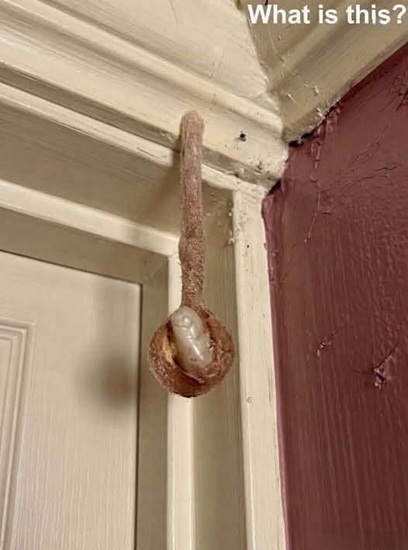
What begins as an ordinary hotel stay can sometimes lead to an unexpected encounter with nature. Imagine arriving after a long journey, unpacking your belongings and opening the curtains to enjoy the last light of the afternoon. Everything seems perfectly normal until something unusual catches your attention near the top of the window. Attached to the wall is a small brown structure that looks as though someone carefully shaped wet clay and left it there to dry. At first, the discovery could understandably cause concern.
An unfamiliar nest inside or around a room might immediately bring thoughts of aggressive insects or a larger infestation. Looking at the structure from a safe distance, however, can reveal something quite different. Certain solitary wasps commonly called mud daubers construct nests from mud, and their remarkable building behavior can produce structures that resemble small tubes, cells or compact patches of dried earth. Mud daubers are not one single species.
The name is generally applied to several types of wasps known for constructing nests using mud. Their behavior differs significantly from that of familiar social wasps that may live together in large colonies. A female mud dauber generally works independently, gathering building material, constructing chambers and preparing those chambers for her offspring.
The construction process is remarkably methodical. A female locates moist soil or mud, collects a small portion and carries it back to the chosen nesting location. She then shapes that material before returning for another load. This process can be repeated numerous times as individual sections of the nest gradually take form.
Protected locations are particularly useful because rain and harsh weather could damage an exposed mud structure. This helps explain why mud-dauber nests may appear beneath roof overhangs, around garages, inside sheds, beneath bridges or in other sheltered spaces. Occasionally, a wasp can find its way into a building and choose an indoor location that seems suitable.
A quiet corner beside a window can provide exactly the kind of protected surface an insect needs.
To a person entering the room, however, the result can look completely out of place.
The exterior of the nest is only one part of the story.
Mud daubers are predators, and many species hunt spiders as food for their developing young. A female can capture a spider and use her sting to immobilize it. She then carries the prey back to the nest and places it inside one of the prepared chambers.
Several spiders may be stored within a chamber, depending on the species and circumstances.
The female then lays an egg before sealing the chamber with additional mud.
When the egg hatches, the developing larva has a prepared food supply available inside the protected nest. It feeds and develops within the chamber before eventually undergoing further development and emerging as an adult wasp.
What looks like a simple lump of dried mud therefore represents an intricate reproductive strategy.
There is construction.
There is hunting.
There is food storage.
And there is protection for the next generation.
All of this is carried out by an insect without anything resembling the planning process humans associate with construction.
That complexity is one reason mud-dauber nests can be fascinating to observe.
However, observation should not mean touching or attempting to open the nest.
Mud daubers possess stingers. They are generally considered less defensive around their nests than many social wasps, but that does not mean they are incapable of stinging. Handling, trapping or crushing a wasp can increase the possibility of defensive behavior.
People who have experienced serious allergic reactions to insect stings should be especially cautious around unfamiliar wasps.
In a hotel or another property managed by someone else, the safest response is straightforward.
Do not disturb the structure.
Keep a reasonable distance.
Inform the staff.
Hotel employees can inspect the area and, when necessary, contact an appropriate pest-management professional who can determine what species is present and whether removal is required.
That approach protects both the guest and the property.
It also avoids another common mistake: assuming that every unfamiliar insect nest belongs to the same species.
Different insects build different structures, and identification from appearance alone is not always easy for someone without experience. A mud structure could have characteristics associated with mud daubers, but professional identification can be useful when there is uncertainty.
Taking a photograph from a safe distance may help document the discovery.
A close photograph can sometimes reveal fascinating construction details as well. Individual layers of dried mud may remain visible, providing evidence of the repeated trips required to build the structure.
Each small portion represents material gathered elsewhere and transported back to the nesting site.
For such a small animal, that represents a considerable investment of effort.
The encounter also provides an opportunity to reconsider how people respond to insects.
Fear is understandable when an unfamiliar wasp appears unexpectedly, particularly indoors. Yet not every wasp behaves like the highly defensive social species people often imagine.
Mud daubers are solitary.
They do not normally maintain large colonies containing many workers dedicated to defending a communal nest.
That behavioral difference is significant.
Still, saying they are typically less defensive is more accurate than calling them completely harmless. Any animal can behave differently when trapped, handled or threatened, and unnecessary contact should be avoided.
There is also an ecological dimension to their presence.
Because many mud daubers capture spiders, they participate in the natural predator-prey relationships surrounding homes, gardens and other environments. They are one small component of a much larger ecosystem that continues functioning even in places dominated by human construction.
Buildings unintentionally create habitats for many organisms.
Small openings provide shelter.
Roof overhangs protect animals from rain.
Artificial lights attract insects.
Warm walls create microclimates.
Quiet corners remain undisturbed long enough for nesting.
From a human perspective, a hotel is designed exclusively for guests.
From an insect’s perspective, it is simply another landscape filled with potential shelter.
This does not mean an active nest should necessarily remain in an occupied room. Hotels have legitimate responsibilities regarding cleanliness, maintenance and guest comfort.
Staff can address the practical problem appropriately.
But discovering the nest does not require turning the situation into something frightening or mysterious.
Understanding what may be happening can transform an alarming first impression into curiosity.
A person might initially see a strange clump of dirt.
After learning about mud daubers, the same structure becomes evidence of an animal gathering construction material one tiny load at a time.
The experience also illustrates the importance of resisting sensational explanations.
An unusual structure in a hotel room does not automatically mean an aggressive swarm is hidden behind the walls.
Likewise, a mud-dauber nest should not be portrayed as completely risk-free.
Accurate information exists between those extremes.
Mud daubers are real wasps capable of stinging, but their solitary lifestyle and generally less defensive behavior distinguish them from some better-known social wasps.
Their nests are functional structures designed to support reproduction rather than to frighten people.
Once this is understood, the discovery becomes much more interesting.
Something built from ordinary soil and water can protect developing offspring.
An insect with no tools can construct individual chambers.
A predator can capture and transport food for young that have not even hatched.
These behaviors have developed over countless generations.
And occasionally, they unfold only a few feet away from people who have no idea they are happening.
That may be the most memorable part of discovering a nest in an unexpected location.
Nature does not exist exclusively in forests, fields or documentaries.
It operates underneath roofs, beside windows, behind sheds and around the buildings people occupy every day.
Often, we simply do not notice it.
A strange structure in the corner of a quiet room might initially interrupt an otherwise ordinary stay.
But with appropriate caution and accurate identification, it can also become a small lesson in biology.
There is no need to panic.
There is also no need to handle it yourself.
Observe it safely, report it to whoever manages the property and allow knowledgeable professionals to decide whether removal is necessary.
Sometimes the most surprising discoveries are not dangerous secrets at all.
They are simply reminders that the natural world continues building, hunting and reproducing alongside us—even in places designed almost entirely for human life.

