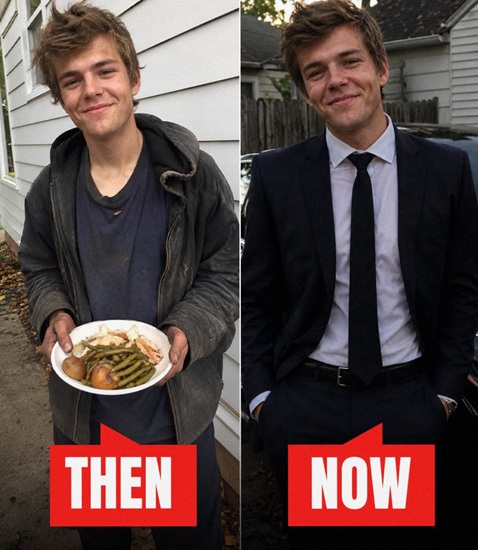
For many years, I believed my childhood had been shaped by a simple injustice. While my family struggled to make ends meet after my father’s passing, my mother regularly carried freshly prepared meals to a young homeless man named Luke. As an eight-year-old child, I couldn’t understand why someone outside our family seemed to receive food that I wished had been placed on our own dinner table. It took decades, and one final promise made beside my mother’s hospital bed, for me to realize how incomplete my understanding had been.
Luke first appeared near the abandoned lot at the edge of our neighborhood not long after my father’s death. He looked older than I was used to seeing teenagers look, with tired eyes, worn clothing, and the cautious expression of someone who expected rejection wherever he went. Most people passed him without stopping, but my mother never ignored him. Nearly every afternoon she wrapped leftovers or whatever she had managed to prepare, covered the plate carefully, and quietly walked down the street without asking for recognition or thanks.
Life inside our home was far from easy. Money was limited, bills arrived faster than they could be paid, and every grocery trip required careful planning. My mother somehow managed to stretch every ingredient into several meals, often pretending she had already eaten whenever food was running short. At the time, I never noticed those small sacrifices. I only noticed that Luke always seemed grateful, smiling sincerely every time my mother handed him another warm meal.
One afternoon, everything changed in my mind. My mother had baked an apple pie, something she only made on rare occasions. I assumed we would finally enjoy dessert together after dinner. Instead, I watched her cover the pie and prepare to take it outside. When she gently explained that it was meant for Luke, disappointment quickly became anger. I asked why someone we barely knew deserved my favorite dessert when we could hardly afford enough for ourselves. My mother’s response was immediate and firm. She told me that another person’s hardship should never become a reason to lose compassion. Although I stopped arguing, I carried resentment with me for years.
From then on, I viewed Luke as the reason my mother always seemed distracted. Whenever he greeted me while I walked home from school, I ignored him. Once he carved a small wooden bird and quietly offered it to me. Without saying a word, I placed it on the ground and continued walking. He never became upset. Instead, he simply wished me a safe trip home, a kindness I refused to acknowledge because I had already decided who he was.
As the years passed, Luke eventually disappeared from the neighborhood. My mother never explained where he had gone, and I convinced myself I no longer cared. After finishing school, I moved away to build my own life. Phone calls home became less frequent, and visits became even rarer. Looking back, I realize I wasn’t only creating distance from my hometown—I was creating distance from the person who had sacrificed the most for me.
More than a decade later, everything changed with a single phone call. A nurse informed me that my mother had suffered a severe stroke and urged me to come immediately. By the time I reached the hospital, she was weak but awake. I apologized for the years we had spent apart and promised to take care of everything she would leave behind. She squeezed my hand gently before whispering words I never expected to hear.
“Please don’t forget Luke.”
Those were the final words she ever spoke.
After saying goodbye to family and friends at the funeral, I returned to our old neighborhood carrying a container of homemade stew. I believed I was simply honoring the promise I had made, expecting to search for Luke near the place where he once slept. Instead, I found a neatly dressed man standing beside a dark SUV outside my mother’s house. His appearance had changed completely, but there was something familiar in the way he smiled.
It was Luke.
Inside the house, he placed a weathered metal box on the kitchen table. Carefully unlocking it, he revealed a collection of cassette tapes labeled in my father’s handwriting. Each recording had been prepared for an important moment in my life—a birthday, graduation, marriage, parenthood, and even the difficult days my father believed everyone eventually faces. Luke explained that my father had entrusted him with the recordings before his death, believing they would one day help guide me through life.
My mother, however, could never bring herself to give them to me. According to Luke, hearing my father’s voice again reopened wounds she struggled to carry. Every year he returned to ask whether she felt ready. Every year she quietly asked him to wait a little longer. He admitted that he should have insisted, but gratitude toward my parents—and respect for my mother’s wishes—kept him from breaking that promise.
Luke then shared something I had never known. Years earlier, before my father’s death, my parents had quietly helped Luke and his mother through an incredibly difficult period in their lives. They had offered practical support when no one else did, expecting nothing in return. After my father passed away, my mother simply continued helping because she believed compassion should not end with tragedy. She never saw Luke as replacing her family. She simply refused to turn away from someone who had nowhere else to go.
That evening we listened to the first cassette together. My father’s familiar voice filled the quiet kitchen, bringing back memories I barely realized I still carried. He spoke about kindness, resilience, family, and the importance of treating others with dignity, especially during difficult times. One sentence remained with me long after the recording ended.
“The greatest gifts we leave behind are not possessions, but the kindness we choose to show when no one is watching.”
In that moment, years of misunderstanding finally began to fade. I realized my mother had never loved me less because she cared for Luke. She had simply lived according to the values she and my father believed mattered most. Compassion had never reduced what she felt for her family. Instead, it had expanded her ability to care for someone who desperately needed hope.
Since then, Luke and I have remained part of each other’s lives. We cannot recover the years lost to silence and misunderstanding, but we have learned that forgiveness often begins with listening to a story we never knew existed. Every autumn, I bake an apple pie using my mother’s recipe. Before serving it, I always divide it into equal slices, remembering that generosity is rarely about having more than enough. More often, it is about choosing to share even when life feels uncertain, trusting that kindness has a way of returning when it is needed most.
