
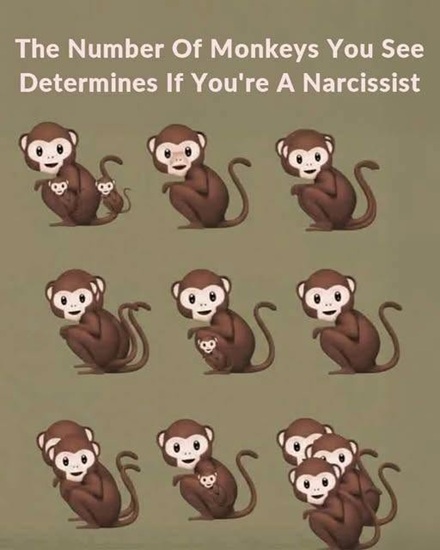
Every day, millions of people encounter eye-catching images on social media that promise to reveal hidden aspects of their personalities. Among the most widely shared are visual puzzles that invite viewers to count objects, identify hidden figures, or spot differences within a picture. One of the most popular examples is an illustration featuring smiling monkeys arranged in a way that encourages people to count how many they can see.
The accompanying captions often make bold claims, suggesting that the final number reveals whether someone is highly observant, creative, intelligent, or even narcissistic. While these statements may sound intriguing, psychologists emphasize that such claims should be approached with caution because they are not supported by scientific evidence. The popularity of these puzzles reflects something fundamental about human curiosity. Most people naturally enjoy learning about themselves and comparing their experiences with those of others.
When a simple image promises to reveal something meaningful about personality, many people instinctively pause to participate. The activity takes only a few seconds, yet it often sparks lengthy discussions among friends and family members. Some people confidently announce the number they counted, while others return to the image several times, convinced they may have overlooked hidden details. This combination of curiosity and conversation explains why these visual challenges spread so rapidly across social media platforms.
At first glance, the monkey illustration appears straightforward. Many viewers immediately identify the larger figures and feel certain they have counted every monkey correctly. Others, however, continue examining the picture and begin noticing smaller shapes cleverly incorporated into the design. Hidden outlines, overlapping forms, and visual patterns gradually become more apparent the longer someone studies the illustration. As a result, different people may report different totals despite looking at exactly the same picture. Rather than indicating that one person is right and another is wrong, these differences demonstrate how individual attention can influence visual perception.
Researchers who study vision have long explained that human perception is not identical to the way a camera records an image. Cameras capture every visible detail within a frame without deciding what is important. The human brain, by contrast, constantly filters incoming information. Every second, enormous amounts of visual data enter our eyes, and the brain must quickly determine which details deserve immediate attention and which can safely be ignored. This remarkable process allows people to react efficiently to their surroundings, but it also means that two individuals can focus on different parts of the same scene and come away with different impressions.
One reason these differences occur is that the brain relies on mental shortcuts known as heuristics. These shortcuts help people make rapid decisions without analyzing every piece of information individually. In everyday life, heuristics are extremely useful because they allow us to recognize familiar objects, navigate busy environments, and respond quickly to changing situations. However, the same shortcuts can sometimes cause people to overlook subtle visual details hidden within complex illustrations. Optical illusions and visual puzzles are specifically designed to take advantage of these natural tendencies, encouraging viewers to look beyond their first impression.
Some people naturally approach visual puzzles by identifying the overall structure before examining individual details. They tend to focus on the larger picture and quickly arrive at a conclusion. Others instinctively slow down, scanning each section carefully while searching for smaller patterns that may not be immediately obvious. Neither approach is inherently better than the other. Instead, these differences illustrate the variety of ways human attention can operate. Cognitive psychologists have noted that individuals often shift between broad observation and detailed analysis depending on the task they are performing, their previous experiences, and even their level of concentration at a particular moment.
One of the most common misconceptions surrounding viral visual puzzles is the claim that the number of objects someone sees can diagnose personality traits or mental health conditions. In the case of the monkey illustration, many captions claim that counting a particular number of monkeys indicates narcissism. There is no credible scientific evidence supporting this assertion. Narcissistic Personality Disorder is a complex mental health condition that can only be evaluated through comprehensive clinical assessment conducted by qualified mental health professionals. It cannot be diagnosed—or even meaningfully predicted—by counting figures in a drawing or participating in an online visual puzzle.
Although the personality claims are unsupported, the exercise itself still offers something valuable. Looking closely at a detailed image encourages patience, concentration, and careful observation. It reminds us that our first impression is not always complete and that spending a little more time examining a situation can reveal information we initially overlooked. Many educators and psychologists use similar visual exercises—not as diagnostic tools—but as demonstrations of how perception works and how attention influences what people notice. In this way, the puzzle becomes less about discovering a hidden personality trait and more about appreciating the remarkable complexity of the human mind.
Ultimately, the enduring popularity of visual illusions says as much about human curiosity as it does about perception itself. People enjoy solving mysteries, comparing answers, and discovering hidden details that were invisible only moments earlier.
Whether someone counts five monkeys, ten monkeys, or another number entirely, the experience illustrates an important scientific principle: perception is an active process shaped by attention, expectation, and previous experience. Rather than revealing secret truths about personality, these puzzles provide an engaging opportunity to reflect on how our brains interpret the visual world and why different people can honestly see the same image in remarkably different ways.
The widespread popularity of visual puzzles also reflects a broader human desire to understand how the mind works. People are naturally drawn to activities that appear to reveal something unique about themselves, especially when those activities are quick, entertaining, and easy to share. Social media platforms amplify this curiosity by encouraging users to compare their answers with friends, family members, and other viewers around the world. A simple illustration can quickly become the center of thousands of conversations, not because it provides scientific conclusions, but because it encourages people to think about how they perceive the world differently.
Psychologists often explain that perception is an active process rather than a passive one. Instead of recording every detail exactly as it appears, the brain continuously interprets information based on previous experiences, expectations, attention, and context. This process allows people to recognize familiar objects almost instantly, but it also means that important details can sometimes be overlooked. Visual illusions demonstrate this principle in a harmless and engaging way by showing that what seems obvious to one person may not immediately stand out to someone else viewing the very same image.
Attention also plays an important role in how people experience these puzzles. When someone approaches an illustration expecting to find only the largest figures, the brain may naturally focus on those obvious shapes while ignoring smaller details. On the other hand, a person who deliberately searches every corner of the image may discover additional patterns hidden within overlapping lines and contours. Neither approach indicates greater intelligence or superior reasoning. Instead, each reflects a different strategy for processing visual information, both of which can be useful depending on the situation.
Scientists who study cognitive psychology have shown that attention is a limited resource. Because people cannot consciously process every piece of visual information at once, the brain constantly decides what deserves priority. This selective attention helps individuals navigate busy environments efficiently, whether crossing a crowded street, driving a vehicle, or reading a page filled with information. The same mechanism explains why two people looking at an identical illustration may notice different elements first. Their brains are simply directing attention toward different features of the image.
Another reason these puzzles remain popular is that they encourage people to slow down. Modern life often rewards quick decisions and immediate reactions, leaving little time for careful observation. Optical illusions invite viewers to pause, reconsider their first impression, and examine details they may have initially missed. This process can serve as a gentle reminder that patience often reveals information that hurried observation overlooks. While the illustration itself may be simple, the habit of looking more carefully can be valuable in many everyday situations.
It is equally important to distinguish entertainment from scientific assessment. Online personality quizzes and viral visual puzzles are designed primarily for engagement and enjoyment. They should not be interpreted as diagnostic tools or used to draw conclusions about a person’s mental health, intelligence, or character. Qualified psychologists rely on validated assessments, structured interviews, and evidence-based methods when evaluating personality or psychological conditions. A cartoon illustration, regardless of how cleverly designed, cannot provide those kinds of reliable conclusions.
The discussion surrounding these puzzles also highlights the importance of critical thinking in the digital age. Social media allows information to spread rapidly, but popularity alone does not guarantee accuracy. Eye-catching headlines are often written to encourage clicks, comments, and shares rather than to communicate scientific facts. Before accepting extraordinary claims—especially those involving psychology or health—it is helpful to consider whether the information is supported by credible research, recognized experts, or peer-reviewed studies. Taking a moment to verify a claim can prevent misinformation from spreading further.
Beyond their entertainment value, visual illusions offer an opportunity to appreciate the remarkable complexity of the human brain. The ability to recognize patterns, interpret shapes, and adapt to changing visual environments is the result of sophisticated neurological processes that researchers continue to study. Every person brings unique experiences, expectations, and habits of attention to the same image, making slight differences in perception both natural and expected. Rather than suggesting that one observer is “correct” and another is “wrong,” these differences demonstrate the flexibility and diversity of human cognition.
In the end, the real lesson behind the viral monkey puzzle has very little to do with the number of monkeys someone counts. Its lasting value lies in reminding us that first impressions are not always complete and that careful observation can uncover details that initially escaped our attention. Whether you notice only the most obvious figures or eventually discover additional hidden shapes, the experience illustrates an evidence-based principle of psychology: human perception is influenced by attention, expectation, and context. Looking a second time is not a sign that something is wrong with your mind—it is simply a reflection of how the brain continually interprets and reinterprets the world around us.

