
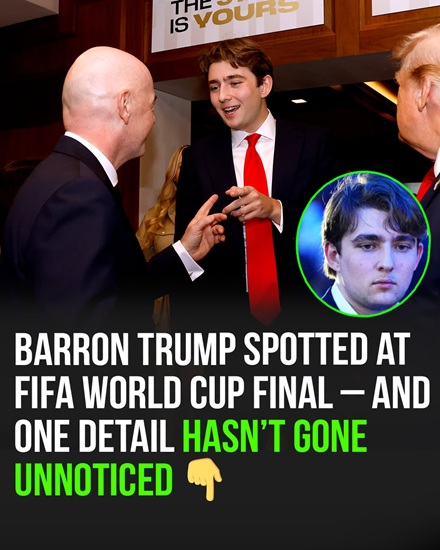
Barron Trump accompanied President Donald Trump and First Lady Melania Trump to the FIFA World Cup Final at MetLife Stadium in East Rutherford, New Jersey, where they joined numerous international guests for one of the world’s most closely watched sporting events. The championship match attracted tens of thousands of spectators inside the stadium and millions more watching around the globe. In addition to football supporters, the final drew political leaders, business executives, athletes, entertainers, and FIFA officials, making it one of the year’s highest-profile international gatherings.
The Trump family watched the match from the stadium’s VIP seating area alongside FIFA President Gianni Infantino and other invited guests. Security arrangements were extensive, reflecting the presence of heads of state and other senior officials attending the event. As is customary for occasions involving current and former national leaders, the seating area included enhanced protective measures while allowing invited guests to watch the match comfortably.
Throughout the evening, photographers and television broadcasters captured numerous images of the presidential family before, during, and after the match. Among the photographs that received significant attention was one showing President Trump, Barron Trump, and FIFA President Gianni Infantino standing together inside the VIP section. Because of the worldwide audience following the final, images from the event quickly appeared across news organizations, sports publications, and social media platforms.
Many online discussions centered on Barron Trump’s appearance, including his formal attire for the occasion. Observers noted that he wore a dark suit paired with a red necktie while standing alongside his father. Clothing worn by members of presidential families frequently becomes a topic of public discussion during major public appearances, particularly when photographs are widely circulated after internationally televised events. Such conversations are common and often focus on fashion choices rather than official matters.
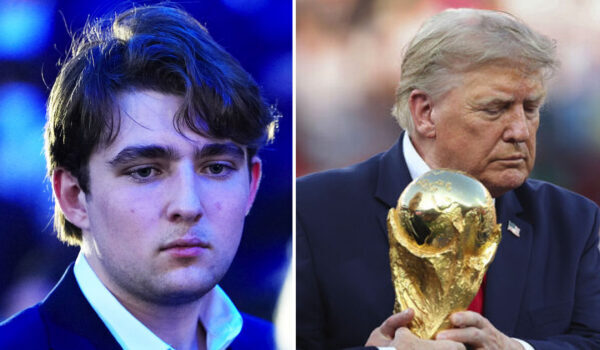
Another detail visible in several widely shared photographs was a stadium banner positioned in the background of one camera angle. Because the banner happened to appear above the VIP seating area from that particular perspective, some social media users commented on its placement while sharing the image online. However, there is no verified evidence that the banner was intended to reference any individual in attendance or that it carried a message directed toward the presidential family. Stadium signage is routinely displayed throughout large sporting events as part of event branding and venue presentation.
Media coverage of the World Cup Final primarily focused on the match itself, which concluded with Spain defeating Argentina to claim the championship. The event also featured an elaborate halftime entertainment program and a post-match trophy presentation attended by FIFA officials, participating teams, and invited dignitaries. As with previous World Cup finals, the ceremony was broadcast internationally and marked the official conclusion of the tournament.
Following the match, President Trump joined FIFA officials during portions of the medal ceremony before the winning team celebrated its victory. Images from the presentation were widely distributed by international news agencies and sports broadcasters. Because the ceremony unfolded before a global audience, many individual moments were shared online, sometimes accompanied by commentary or personal interpretations. Responsible reporting distinguishes between documented events captured on official broadcasts and opinions expressed later on social media.
As public figures, members of the Trump family regularly attract significant public interest whenever they attend major international events. Photographs from such appearances often generate conversations about fashion, body language, and other visual details. While these discussions can become highly visible online, they frequently include a mixture of verified observations, personal opinions, and speculation. For that reason, careful reporting focuses on information that can be independently confirmed while clearly separating factual events from unverified interpretations.
As photographs from the FIFA World Cup Final continued to circulate following the match, they became the subject of extensive discussion across news websites and social media platforms. This pattern is common after globally televised events, where images are viewed by millions of people within a short period. Public figures, particularly presidents and members of presidential families, are often photographed from numerous angles, leading to a wide range of observations and commentary. While these discussions can attract significant public attention, they frequently combine verified facts with personal interpretations, making it important to distinguish between the two.
One image that received particular attention showed President Donald Trump standing alongside Barron Trump and FIFA President Gianni Infantino inside the VIP section. Some online users commented on Barron’s formal attire, including his dark suit and red necktie. Fashion choices by members of prominent public families have long been a subject of media coverage during official appearances, especially at internationally televised events. However, clothing preferences alone do not provide evidence of political messaging or intended symbolism unless confirmed by the individuals involved.
Another topic discussed online involved a banner that appeared in the background of certain photographs. Because the wording happened to be visible behind the VIP seating area from a particular camera angle, some social media users offered their own interpretations of the image. However, there is no verified evidence that the banner was designed to reference Barron Trump, President Trump, or any other individual attending the match. Event organizers routinely install banners and promotional displays throughout stadiums for branding and presentation purposes, and photographs may capture those signs from different perspectives depending on camera position.
Media literacy experts frequently note that images shared on social media can quickly become disconnected from their original context. A single photograph may encourage viewers to assign meaning to details that were simply coincidental or related to the venue itself. For this reason, responsible reporting avoids presenting speculation as established fact and instead focuses on information that can be independently verified through official broadcasts, accredited photographers, or statements from event organizers.
The FIFA World Cup Final itself remained the central event of the evening. Spain secured a 1–0 victory over Argentina to claim the championship after an intensely contested match. The tournament concluded with the traditional medal ceremony and trophy presentation, attended by FIFA officials, representatives of both teams, and invited international guests. As one of the most watched sporting events in the world, the final attracted global television audiences as well as extensive media coverage before, during, and after the match.
President Trump also participated in portions of the official trophy presentation alongside FIFA President Gianni Infantino. Video footage from the ceremony was widely distributed by international broadcasters and news agencies, showing the presentation of medals before the championship trophy was awarded to the Spanish team. Various moments from the ceremony were later discussed online, often accompanied by personal opinions and commentary. While those reactions reflected public interest, they should be distinguished from verified reporting describing the sequence of official events.
Large international sporting events routinely attract attention that extends well beyond the competition itself. The attendance of political leaders, celebrities, athletes, business executives, and other invited guests often results in additional media coverage focusing on fashion, protocol, public appearances, and interactions among attendees. This broader interest is a common feature of events such as the FIFA World Cup Final, Olympic Games, and other internationally televised ceremonies.
Photographs of Barron Trump have consistently generated public interest throughout the years because he has largely maintained a private life despite belonging to one of the world’s most closely followed political families. As a result, each public appearance tends to receive significant media attention. News organizations generally focus on confirmed details regarding the event itself, while many social media discussions extend into personal opinions that are not independently verified.
Experts in digital communication also point out that viral posts often spread because they encourage viewers to speculate about visual details rather than because they reveal new factual information. Headlines suggesting that audiences have “noticed something” frequently generate substantial engagement, even when the observations are based entirely on individual interpretation. This is one reason fact-checking organizations continue encouraging readers to evaluate claims carefully and distinguish between documented facts and unsupported speculation circulating online.
Ultimately, the verified events surrounding the World Cup Final remain straightforward. Barron Trump attended the championship match with President Donald Trump and First Lady Melania Trump, watched the match from the VIP section alongside invited guests, and appeared in official photographs taken during the evening.
Spain defeated Argentina to win the tournament, and FIFA officials conducted the traditional post-match medal and trophy ceremony. Beyond those confirmed facts, many interpretations shared online represent personal opinions rather than established evidence. Separating verified reporting from speculation helps readers better understand major public events while reducing the spread of misinformation.

