
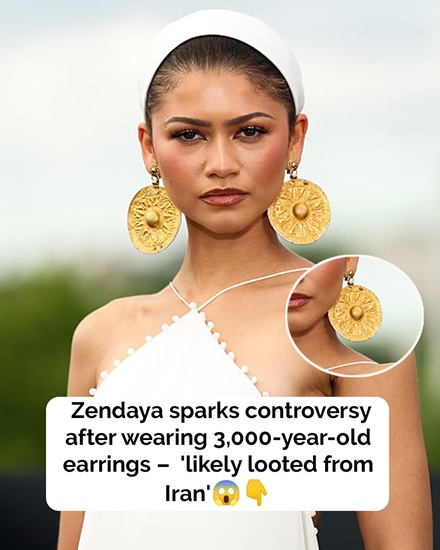
Zendaya’s appearance at a London promotional event for Christopher Nolan’s upcoming film The Odyssey attracted international attention for more than her fashion choices. While the award-winning actress has long been recognized for her elegant red carpet style, this particular appearance quickly became the focus of widespread discussion after many observers learned that her gold earrings incorporated ancient Iranian medallions estimated to be approximately 3,000 years old.
The discovery prompted conversations extending well beyond fashion, touching on archaeology, cultural heritage, museum ethics, and the preservation of historical artifacts. The actress, who portrays the Greek goddess Athena in Nolan’s adaptation of Homer’s The Odyssey, attended the London photocall wearing a white Jacquemus dress complemented by distinctive gold earrings.
Fashion enthusiasts initially praised the sophisticated styling, but attention soon shifted toward the remarkable history behind the jewelry. Reports explained that the earrings featured ancient Iranian medallions dating to the first millennium B.C., making them far older than almost any modern accessory seen at contemporary entertainment events.
According to publicly available information, the medallions are associated with the Ziwiye Treasure, a collection of ancient artifacts connected to the Median period and discovered in northwestern Iran during the late 1940s. The treasure has long attracted the interest of archaeologists, historians, museums, and collectors because it contains objects reflecting the artistic traditions of one of the ancient civilizations that flourished in the region thousands of years ago. Over the decades, individual pieces connected to the collection have appeared in museums, private collections, and scholarly publications, although the precise history of some objects has remained the subject of academic discussion.

The earrings worn by Zendaya were created by London jeweler Glenn Spiro as part of his Materials of the Old World collection. Rather than reproducing ancient designs, the collection incorporates authentic historical artifacts into contemporary jewelry settings. In previous interviews discussing the project, Spiro explained that his goal was to combine historical craftsmanship with modern design, allowing ancient objects to be appreciated in a new context while preserving their original form. The contemporary setting surrounding the medallions includes 18-karat yellow gold and diamonds designed to complement, rather than replace, the ancient pieces.
The jewelry is currently owned by luxury jewelry house Barron London, which has publicly addressed questions regarding the construction of the earrings. The company stated that the ancient medallions are secured using a noninvasive claw setting intended to avoid permanently altering or damaging the original artifacts. According to the company’s explanation, the design allows the historical objects to remain intact while being incorporated into wearable jewelry. Barron London also emphasized that conversations surrounding cultural heritage deserve thoughtful and informed discussion rather than simplified conclusions.
The company further noted that the earrings highlight Iran’s rich artistic history, independent of present-day political events. In its public statement, Barron London expressed hope that the jewelry could encourage greater appreciation of the country’s long artistic tradition and archaeological legacy. Ancient Persia and neighboring civilizations made lasting contributions to architecture, metalworking, sculpture, literature, and decorative arts, influencing cultures across the ancient Near East for centuries.

Despite those explanations, discussion quickly expanded across social media platforms, where many users questioned whether ancient artifacts of such historical significance should be transformed into wearable jewelry at all. Rather than focusing solely on fashion, many participants began debating broader issues involving archaeological preservation, ownership of cultural objects, museum collections, and the responsibilities of collectors. These discussions reflected longstanding international conversations that extend far beyond this single event.
Some archaeologists, historians, and cultural heritage advocates have argued for many years that artifacts with important historical value are often best preserved in museums or research institutions, where they can be carefully studied, documented, and made accessible to the public. Others note that many historically significant objects have legally entered private collections over decades through auctions, inheritances, or earlier acquisitions that complied with laws in effect at the time. Because the legal and historical circumstances surrounding individual artifacts often differ, specialists generally examine each case individually rather than making broad assumptions.
One point repeatedly discussed online involved the concept of provenance. In archaeology and museum studies, provenance refers to the documented history of an object’s ownership, discovery, and transfer over time. Establishing clear provenance helps researchers understand an artifact’s historical context and provides important information regarding authenticity and legal ownership. When provenance records are incomplete or disputed, questions may naturally arise among scholars, museums, governments, collectors, and members of the public. However, the existence of public debate alone does not establish that any specific artifact was obtained unlawfully.
Among the voices contributing to the online conversation was an archaeology-focused content creator who questioned the documented history of the medallions and expressed concern about the broader issue of ancient artifacts entering private collections. Her comments were widely shared and generated thousands of responses representing a broad range of opinions. While some users agreed with her concerns, others argued that discussions regarding archaeological provenance should be based on documented historical evidence rather than assumptions. The exchange illustrated how social media often brings complex academic subjects into mainstream public conversation.
As photographs from the event continued circulating internationally, media coverage increasingly shifted from fashion reporting to discussions about cultural heritage. Rather than concentrating exclusively on Zendaya’s appearance, many reports explored broader questions about how ancient objects should be preserved, displayed, and appreciated in the modern world. Experts in archaeology, museum studies, cultural history, and art conservation have debated these issues for decades, making the conversation far more extensive than any single celebrity appearance.
The renewed attention also highlighted the remarkable longevity of ancient craftsmanship. Whether displayed in museums, studied by researchers, or incorporated into carefully preserved jewelry settings, objects created nearly three thousand years ago continue to capture public imagination. Their survival across millennia reflects both the extraordinary skill of ancient artisans and the enduring human fascination with civilizations whose artistic achievements continue to influence modern culture.
The discussion surrounding Zendaya’s earrings soon extended far beyond the entertainment industry, becoming part of a broader international conversation about how ancient cultural objects should be preserved and appreciated. Historians, archaeologists, museum professionals, collectors, and members of the public have debated similar questions for decades. While opinions differ on the best approach, many experts agree that preserving historical artifacts and documenting their history are essential for protecting the world’s shared cultural heritage.
One of the central topics raised during the online discussion was the distinction between legal ownership and historical provenance. In archaeology, provenance refers to the documented history of an artifact, including where it was discovered, how it changed ownership over time, and whether that history has been properly recorded. Establishing provenance helps researchers understand an object’s historical context while also assisting museums and collectors in verifying authenticity. When documentation is incomplete or uncertain, scholars often continue researching available historical records rather than drawing immediate conclusions.
The Ziwiye Treasure itself has long attracted academic interest because of its artistic significance and the questions surrounding its discovery during the twentieth century. Archaeologists have studied the collection for many years, examining its craftsmanship, cultural influences, and historical importance. Numerous objects associated with the treasure are preserved in museums or private collections around the world, where they continue to be researched by specialists seeking a better understanding of the ancient civilizations that once flourished in the region. This ongoing research demonstrates that archaeology is often an evolving discipline in which new discoveries can refine earlier interpretations.
Following Zendaya’s appearance, many social media users expressed differing opinions about whether historically significant artifacts should ever be incorporated into wearable jewelry. Some argued that displaying ancient objects in carefully designed modern settings could introduce wider audiences to history and encourage curiosity about archaeology. Others believed that artifacts of exceptional historical value are better suited for museums, educational institutions, or cultural exhibitions where they can be studied and appreciated by the public. These differing viewpoints reflect a broader ethical discussion rather than a disagreement with a single correct answer.
Throughout the conversation, Barron London reiterated that the medallions were mounted using a noninvasive technique intended to avoid permanently altering the ancient objects. According to the company, the original artifacts remain intact within the contemporary setting, allowing them to be removed without damage if necessary. The company also stated that it welcomes informed discussion regarding cultural heritage, preservation, and responsible appreciation of historical craftsmanship. Such statements contributed another perspective to an already wide-ranging public debate.
Fashion historians have noted that designers have occasionally drawn inspiration from antiquity for generations. Museums around the world display jewelry, clothing, and decorative arts influenced by ancient Egypt, Greece, Rome, Persia, and numerous other civilizations. Modern designers frequently reference historical motifs, although the use of authentic archaeological objects understandably generates greater attention than reproductions or inspired designs. This distinction became one of the defining aspects of the public conversation following the London event.
The discussion also highlighted the important role museums play in preserving cultural heritage. Museums not only display historical artifacts but also invest considerable resources in conservation, scientific research, education, and documentation. Conservators work to stabilize delicate materials, historians investigate the origins of collections, and educators help visitors understand the historical significance of objects spanning thousands of years. These efforts ensure that future generations can continue learning from surviving examples of ancient craftsmanship.
At the same time, experts acknowledge that many significant historical objects exist outside museum collections. Across the world, private collectors, universities, religious institutions, and cultural organizations legally own artifacts acquired under a variety of historical circumstances. The management of these collections is often governed by national laws, international agreements, professional standards, and ethical guidelines that continue to evolve as new research becomes available. Consequently, discussions about cultural heritage often involve legal, historical, ethical, and archaeological considerations simultaneously.
Another reason the story attracted widespread attention was the remarkable connection between the jewelry and The Odyssey, the epic poem that inspired Christopher Nolan’s upcoming film. Homer’s work has influenced literature, theater, philosophy, and visual arts for nearly three thousand years, making the appearance of artifacts from roughly the same historical era especially striking to many observers. While the jewelry was not created specifically for the film, some commentators appreciated the symbolic connection between ancient history and a modern cinematic adaptation of one of the world’s oldest surviving literary works.
Zendaya herself has become widely recognized for fashion choices that frequently generate discussion within both the entertainment and fashion industries. Stylists and designers often collaborate carefully to select clothing and accessories that complement a particular event or project. In this instance, however, public attention shifted away from style alone and toward broader questions involving archaeology, history, and cultural preservation. The conversation demonstrated how a single fashion accessory can unexpectedly inspire global interest in subjects extending far beyond celebrity culture.
Importantly, the online debate also illustrated the value of approaching historical topics with accuracy and nuance. Public discussions can raise meaningful questions about preservation and cultural heritage, but conclusions should be based on reliable evidence rather than assumptions. Archaeological research frequently requires careful examination of historical documentation, excavation records, conservation reports, and scholarly analysis before definitive conclusions can be reached. Responsible reporting therefore distinguishes between verified facts, expert opinions, and the diverse viewpoints expressed in public debate.
Ultimately, the story surrounding Zendaya’s earrings became much more than a discussion about fashion. It encouraged renewed public interest in ancient civilizations, archaeological preservation, museum ethics, and the responsibilities involved in protecting cultural heritage for future generations. Regardless of differing opinions about whether ancient artifacts should ever become wearable jewelry, the widespread attention highlighted the enduring fascination that historical objects continue to inspire thousands of years after they were first created. Their ability to spark thoughtful conversations across cultures serves as a reminder that history remains deeply connected to the present, inviting continued learning, respectful dialogue, and appreciation for humanity’s shared artistic legacy.

