
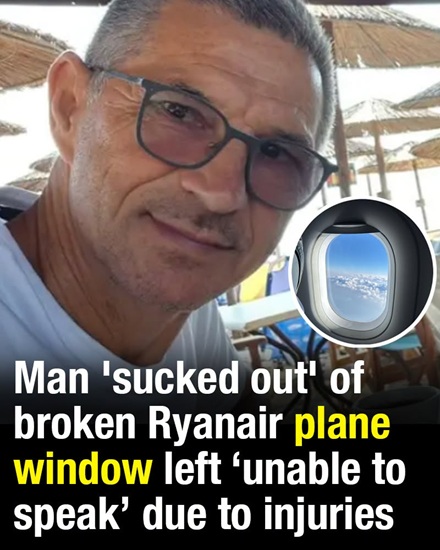
A Ryanair flight that departed from Thessaloniki, Greece, for Memmingen, Germany, turned into a frightening experience after an in-flight emergency forced the aircraft to return to its departure airport shortly after takeoff. According to statements released following the incident, a passenger window became dislodged during the flight, leading to a rapid loss of cabin pressure inside the aircraft. The unexpected event alarmed everyone on board, prompting the flight crew to initiate emergency procedures and safely return the aircraft to Thessaloniki.
Although the flight ended safely, the incident left passengers shaken and one traveler seriously injured, highlighting how quickly unexpected situations can develop even during routine commercial flights. Among those most directly affected was 61-year-old Serbian passenger Ljubiša Karović, who was seated next to the window involved in the incident. According to his wife, Svetlana Grković, the sudden decompression created an extremely dangerous situation that unfolded within seconds.
She later described the terrifying moments in interviews, explaining that the force created by the pressure difference pulled her husband toward the damaged window. Because he was wearing his seat belt correctly, he remained secured to his seat, a factor that may have prevented an even more serious outcome. Safety experts have long emphasized the importance of wearing seat belts whenever seated during a flight, and this incident serves as a powerful reminder of why that advice matters.
Svetlana recalled that the situation developed so rapidly there was little time to think before reacting instinctively. She said she immediately grabbed her husband’s legs in an effort to keep him from being pulled farther toward the opening created by the damaged window. Describing the emotional intensity of those moments, she explained that her only thought was staying with her husband regardless of what happened next. Her account illustrates the fear experienced by many passengers during sudden aviation emergencies, where quick decisions often have to be made under extraordinary stress and uncertainty.
According to Svetlana’s description of the incident, the decompression occurred immediately after the window became dislodged. Rapid decompression happens when cabin pressure drops suddenly, creating a strong movement of air as pressure attempts to equalize. Commercial aircraft are specifically designed with multiple safety systems to help crews respond to such situations, including emergency oxygen masks and procedures that allow pilots to descend quickly to safer altitudes if necessary. Aviation professionals train extensively for these rare events to maximize passenger safety.
While the emergency unfolded, other passengers also reacted quickly. Svetlana later expressed gratitude to several people seated nearby who came forward to help during the incident. She particularly mentioned one passenger whose assistance she said made an important difference while she struggled to hold onto her husband. Although she did not know the man’s identity, she publicly expressed her hope of meeting him again someday so she could personally thank him for helping during one of the most frightening experiences of her life. Stories like these often demonstrate how strangers can work together during emergencies to support one another.
Following the aircraft’s safe landing back in Thessaloniki, emergency medical personnel were already waiting on the ground. Medical teams evaluated the passengers, and Ljubiša was transported to a local hospital for further treatment. According to his wife, he suffered multiple injuries, including burns caused by friction, significant injuries to one of his hands, and severe emotional shock. She also explained that he was initially unable to communicate clearly and had little memory of the incident, suggesting that he may have lost consciousness several times during the emergency.
Medical professionals often note that traumatic events can temporarily affect both physical and cognitive function. Following severe stress, individuals may experience confusion, memory gaps, or difficulty speaking, particularly when accompanied by physical injuries. Recovery from such events may require not only treatment for visible injuries but also careful monitoring for possible psychological effects that sometimes follow life-threatening experiences. Healthcare providers routinely evaluate patients involved in aviation emergencies for both immediate and delayed symptoms.
As news of the incident spread, videos and photographs reportedly began circulating online showing apparent damage to one of the aircraft’s engines. Some images appeared to show a missing or damaged fan blade along with visible deformation inside part of the engine housing. Based on what she observed, Svetlana shared her personal belief that a piece from the engine may have struck the window next to her husband’s seat. However, it is important to note that this represents her account of what she believed occurred during the emergency and does not constitute an official finding regarding the cause of the incident.
Determining the exact cause of any aviation incident requires a detailed technical investigation carried out by qualified aviation authorities. Investigators typically examine the aircraft, review maintenance records, analyze flight data and cockpit voice recordings when available, inspect damaged components, and interview crew members and passengers before reaching conclusions. Because aviation investigations are highly technical, early reports often change as additional evidence becomes available. For that reason, experts caution against drawing final conclusions before investigators complete their work.
Ryanair later confirmed that the flight returned to Thessaloniki shortly after takeoff following an issue involving a passenger window becoming dislodged during the flight. The airline stated that the aircraft landed normally and that passengers safely returned to the terminal. Ryanair also confirmed that one passenger requested and received medical assistance after landing. To minimize disruption to travelers, the airline arranged a replacement aircraft, allowing passengers to continue their journey to Memmingen later that same morning.
For many passengers, aviation remains one of the safest forms of transportation in the world despite the attention that rare emergencies receive. Modern commercial aircraft are built with multiple redundant safety systems, and flight crews undergo continuous training to prepare for situations ranging from medical emergencies to technical malfunctions. Although incidents involving cabin decompression are uncommon, aviation authorities treat every occurrence seriously, carefully investigating each event to identify any contributing factors and improve safety standards across the industry.
The experience described by Svetlana also highlights the emotional impact that unexpected emergencies can have on families. While investigators continue gathering information about what happened, her focus remains on her husband’s recovery. She has spoken openly about the fear she experienced during the flight, the assistance she received from fellow passengers, and her gratitude toward the emergency responders and medical professionals who cared for her husband after the aircraft returned safely to the airport. Her account offers a deeply personal perspective on an incident that affected everyone aboard the flight.
Following the emergency landing, aviation authorities began the standard process of gathering information to determine exactly what happened during the flight. Every significant incident involving a commercial aircraft is carefully examined by investigators, whose goal is not only to identify the immediate cause but also to determine whether any maintenance issues, mechanical failures, or external factors contributed to the event. These investigations often take weeks or even months because specialists analyze damaged aircraft components, maintenance records, flight data, and crew reports before reaching official conclusions.
While passengers understandably looked for answers immediately after the incident, aviation experts consistently remind the public that early observations should not be treated as confirmed facts. Damage visible in photographs or videos may provide clues, but only trained investigators can determine the sequence of events through detailed technical analysis. For this reason, authorities generally avoid speculation until all available evidence has been reviewed. This careful approach has helped make commercial aviation one of the safest forms of transportation in the world.
Rapid decompression, although extremely rare on modern commercial aircraft, is an event for which airline crews receive extensive training. Commercial aircraft cabins are pressurized to provide passengers with a comfortable environment while flying at high altitudes where outside air pressure is far too low to support normal breathing. If cabin pressure suddenly decreases, pilots immediately follow established emergency procedures. These include communicating with air traffic control, initiating a controlled descent if necessary, and returning to the nearest suitable airport whenever conditions require it.
Cabin crew members also play an essential role during these situations. Flight attendants are trained to remain calm, assist passengers, monitor the cabin, and coordinate with the flight deck throughout the emergency. Their training includes handling decompression events, medical emergencies, evacuations, and numerous other scenarios that most passengers will hopefully never experience. Their ability to follow procedures under pressure contributes significantly to passenger safety during unexpected incidents.
One detail repeatedly highlighted in accounts of the emergency is the importance of wearing a seat belt. According to Svetlana Grković, her husband remained secured to his seat because his seat belt was fastened when the window became dislodged. Aviation authorities worldwide advise passengers to keep their seat belts fastened whenever they are seated, even if the seat belt sign has been turned off. Unexpected turbulence or other sudden events can occur without warning, and remaining properly restrained greatly reduces the risk of injury.
The emotional impact of such an experience can continue long after the flight ends. Survivors of aviation emergencies often describe feelings of shock, anxiety, confusion, or difficulty remembering portions of the event. Healthcare professionals recognize that these reactions are common following highly stressful situations. In addition to treating physical injuries, medical teams frequently monitor patients for emotional and psychological effects that may develop after experiencing a life-threatening incident.
According to Svetlana, her husband’s recovery has focused on both physical healing and overcoming the shock of what occurred. She explained that he suffered burns, injuries to his hand, and difficulty communicating immediately after the incident. Memory loss following traumatic events is not uncommon, particularly when someone experiences extreme stress or temporarily loses consciousness. Physicians generally continue observing patients until they can better assess both neurological and physical recovery.
Throughout the ordeal, Svetlana has repeatedly expressed gratitude toward the passengers who immediately came forward to help. She specifically recalled one individual who assisted both her and her husband during the emergency and said she hopes to thank him personally in the future. Incidents such as these often reveal remarkable examples of cooperation among complete strangers, with passengers supporting one another while flight crews work to manage the emergency according to established safety procedures.
Ryanair also acted to minimize disruption for the remaining passengers after the aircraft safely returned to Thessaloniki. According to the airline’s statement, travelers returned to the terminal while arrangements were made for a replacement aircraft. The substitute flight later departed for Memmingen, allowing passengers to continue their journey after the original aircraft was removed from service for inspection. Such contingency planning is a routine part of airline operations whenever unexpected mechanical issues prevent an aircraft from completing its scheduled flight.
Events like this also illustrate the multiple layers of safety built into modern commercial aviation. Aircraft undergo regular inspections, pilots receive recurrent simulator training, cabin crews participate in ongoing emergency preparedness programs, and airports maintain emergency response teams that can react within minutes when an aircraft declares an emergency. These overlapping safety measures are designed to reduce risk and ensure the best possible outcome even when rare technical problems occur.
As investigators continue their examination of the aircraft, the focus will remain on establishing the precise cause of the window failure and determining whether any additional safety recommendations should be made. It is common for aviation authorities to issue reports containing technical findings and, when appropriate, recommendations intended to improve future safety. These reports help manufacturers, airlines, maintenance organizations, and regulators continuously strengthen aviation standards around the world.
For passengers, the incident serves as a reminder of several important travel safety practices. Keeping a seat belt fastened while seated, paying attention to the safety briefing before takeoff, locating the nearest emergency exits, and following crew instructions during unexpected situations can all contribute to passenger safety. Although serious in-flight emergencies remain exceptionally uncommon, preparedness and adherence to safety procedures can make an important difference when every second counts.
Above all, the successful return of the aircraft to Thessaloniki demonstrated the effectiveness of modern aviation emergency procedures. While one passenger sustained serious injuries and the experience was understandably traumatic for everyone on board, the aircraft landed safely, emergency medical personnel responded immediately, and the remaining passengers were able to continue their journey later that day. As the official investigation progresses, the findings will provide a clearer understanding of exactly what occurred and may contribute to further improvements in aviation safety for future flights.

