
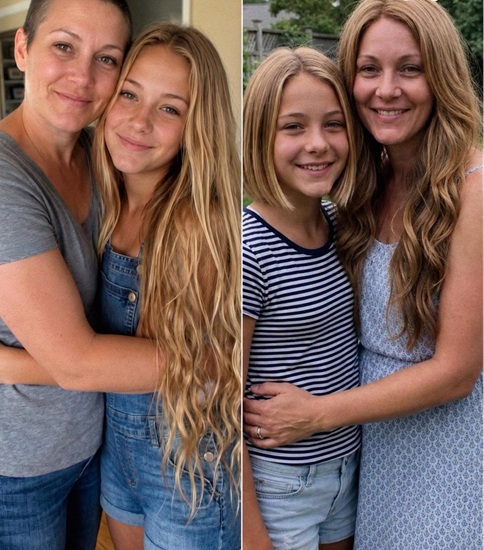
I thought heartbreak was standing beside a closed casket at twenty-nine years old while people I barely recognized whispered words of comfort that never reached my ears. I believed heartbreak was signing paperwork declaring the love of my life legally dead while struggling to keep my hand steady enough to write my own name. Later, I believed heartbreak became something quieter—a constant ache that settled into everyday life like background noise you eventually stopped noticing.
Then cancer arrived. At first, the diagnosis felt almost unreal. The doctors spoke gently, explaining treatment plans, medications, and survival rates. They told me that chemotherapy would be difficult but necessary. I nodded through every appointment, pretending I was absorbing every word, while inside I could think only about one thing. My daughter. Ava was only fifteen years old.
She had already grown up without her father. I couldn’t bear the thought of forcing her to watch her mother slowly disappear too. So I made a decision.
No matter how sick I became, I would never let her see me surrender.
Every morning I smiled before she left for school.
Every evening I asked about homework, teachers, and friends before mentioning anything about my own treatment.
If she noticed my exhaustion, she never complained.
Instead, she quietly began helping around the house without being asked.
She folded laundry.
She cooked simple dinners.
She reminded me to drink water after chemotherapy sessions.
Sometimes I caught her watching me when she thought I wasn’t looking.
She would quickly smile the moment our eyes met.
I knew that smile.
It was the same smile I used whenever I wanted to convince someone I was fine.
…
A few weeks after treatment began, my hair started falling out.
At first it was only a few strands in the shower.
Then handfuls appeared on my pillow each morning.
Eventually, brushing my hair became impossible without filling the sink.
One evening I stood in front of the bathroom mirror holding the brush in one hand and a fistful of hair in the other.
I stared at my reflection for several long minutes.
Cancer had finally become visible.
The next morning I asked my neighbor to drive me to a small salon across town.
I asked the stylist to cut everything short before I lost the rest myself.
She tried to hide the tears in her eyes.
I pretended not to notice.
When I returned home wearing a scarf, Ava looked at me for several seconds without speaking.
Then she smiled.
“You still look beautiful.”
I laughed softly.
“You’re legally required to say that.”
“No,” she replied.
“I’m saying it because it’s true.”
Her words stayed with me longer than she probably realized.
Over the following weeks, chemotherapy became increasingly difficult.
Some days I barely had enough strength to prepare breakfast.
Walking from the bedroom to the kitchen felt like climbing a mountain.
Even simple chores left me exhausted.
Yet Ava never complained.
Instead, she quietly adapted.
She packed her own lunches.
She cleaned the kitchen before I woke up.
She even started taking the bus home instead of asking me for rides.
She thought I didn’t notice.
I noticed everything.
One afternoon she came through the front door carrying a small gift box wrapped in silver paper.
“I have something for you,” she said.
I looked up from the couch.
“For me?”
She nodded.
“Open it.”
Inside was one of the most beautiful wigs I had ever seen.
It matched my natural hair almost perfectly.
For a moment I simply stared at it.
“Ava…”
She smiled nervously.
“I wanted you to have it.”
I looked at her in confusion.
“Honey… these are expensive.”
She slowly pulled back the hood of her sweatshirt.
My heart stopped.
Her beautiful long hair was gone.
She had shaved it nearly completely.
Before I could even speak, she hurried to explain.
“I donated most of it.”
“And I sold the rest.”
“The money helped pay for the wig.”
She looked down at the floor.
“I know you kept saying it didn’t matter…”
“But I knew it did.”
I crossed the room before I even realized I was moving.
I wrapped both arms around her.
Neither of us spoke for several minutes.
Sometimes love says everything without needing words.
That night, as I placed the wig carefully on my dresser, I realized something important.
Cancer had taken my strength.
It had taken my hair.
It had taken my confidence.
But it had not taken the family my daughter and I had built together.
Whatever happened next…
We would face it together.
Neither Ava nor I had slept much. Every time I closed my eyes, Daniel’s letter replayed in my mind. For fifteen years I had mourned a man I believed was dead. Now I was being asked to believe that he had disappeared willingly—not because he stopped loving us, but because he believed it was the only way to keep us safe.
Just after sunrise, two detectives arrived outside our house in an unmarked vehicle. They greeted us quietly, understanding that neither of us was ready for casual conversation. One officer carried a folder containing copies of the documents recovered from the school, while the other explained that they had already contacted local authorities in Marina Vale. They wanted everything to be handled carefully, especially if the investigation truly involved decades-old financial crimes.
The drive felt much longer than it actually was. Ava sat beside me in the back seat, holding Daniel’s letter tightly in both hands. Every few minutes she reread parts of it, almost as if she hoped new words would magically appear between the lines. I spent most of the journey staring out the window, trying to prepare myself for every possible outcome. I knew there was still a chance we would arrive only to discover another dead end.
About two hours later, the officers turned onto a quiet country road lined with old oak trees. In the distance stood a small white church with a weathered bell tower. Just beyond it sat a modest blue house exactly as Daniel had described. The place looked peaceful, almost untouched by time, with flower beds surrounding the porch and a wooden swing gently moving in the morning breeze.
One detective stepped out first and knocked softly on the front door. Several long seconds passed before it slowly opened. An elderly woman with silver hair looked at each of us carefully. Her eyes rested on Ava for a moment before moving to me.
“You must be Elena,” she said quietly.
My heart skipped a beat.
“You’re Rosa?”
She nodded.
“I’ve been expecting this day for a very long time.”
Those words immediately filled the porch with silence.
She invited us inside, where the small living room was decorated with family photographs, handmade quilts, and shelves filled with old books. Everything about the house felt warm and ordinary, making it difficult to imagine that it had become part of such an extraordinary story.
Rosa disappeared briefly into another room before returning with a worn leather folder.
“I prayed I would never need to open this,” she admitted.
She carefully placed the folder on the coffee table.
“Daniel left it here fifteen years ago.”
Ava looked at me with wide eyes.
“He really came here?”
Rosa smiled sadly.
“Many times.”
She explained that Daniel had uncovered evidence suggesting that charitable donations intended for vulnerable children had been diverted into private accounts for years. As he gathered documents, he realized influential people were involved. According to Rosa, he became convinced that exposing the truth too early would put his family in danger.
“He loved both of you more than anything,” Rosa said softly.
“He talked about you every single time he visited.”
Tears filled Ava’s eyes.
“He talked about me?”
“Every visit.”
Rosa reached into the folder and removed several photographs.
The first showed Daniel standing outside the same blue house years earlier.
Another showed him repairing Rosa’s fence.
A third showed him smiling while holding a birthday cake.
On the cake were the numbers ten and one.
Ava stared at it.
“My eleventh birthday.”
Rosa nodded.
“He celebrated every birthday here.”
“He never forgot.”
None of us spoke for several moments.
Then Rosa handed me another sealed envelope.
“He asked me to give you this only if investigators ever proved the truth.”
My hands trembled as I opened it.
Inside was another handwritten letter.
Elena,
If you are reading this, then someone finally believed the evidence.
I have imagined this moment thousands of times.
If I survived long enough to see you again, I wanted to explain everything myself.
If I didn’t, then please know there was never a single day that passed without thinking about you and Ava.
I watched birthdays from a distance.
I learned about school through people I trusted.
I celebrated every achievement quietly because it was the only way I believed I could keep you safe.
Not choosing you was never the truth.
Protecting you was.
I stopped reading.
The tears made the ink impossible to see.
Ava wrapped both arms around me.
For the first time in years, neither of us tried to hide our emotions.
One of the detectives quietly stepped outside to give us privacy.
Rosa waited patiently before speaking again.
“There is one more thing.”
She pointed toward an old wooden cabinet near the fireplace.
Inside sat dozens of carefully labeled boxes.
Each one contained birthday cards, Christmas gifts, newspaper clippings, school photographs, and handwritten notes Daniel had collected over fifteen years.
“He hoped one day,” Rosa whispered, “he would hand every one of these to Ava himself.”
Ava carefully picked up the first birthday card.
It was addressed simply:
To My Little Girl.
She pressed it against her chest before breaking into tears once again.
No amount of money, court documents, or investigations could replace the years they had lost.
Yet, for the first time since receiving the phone call from the school, hope no longer felt impossible.
The truth was finally beginning to emerge.
The investigation would continue.
Authorities still needed to identify everyone involved in the alleged fraud and determine exactly what had happened after Daniel disappeared. Many questions remained unanswered, and there was still no confirmation about where he was or whether he was even alive.
But one thing had become unmistakably clear.
The man Elena had mourned for fifteen years had never stopped loving his family.
And as mother and daughter drove home that evening, carrying boxes filled with letters, photographs, and memories, they understood something neither of them had believed possible only twenty-four hours earlier.
Sometimes the greatest gift is not finding all the answers.
Sometimes it is discovering that love had been quietly waiting for you all along.

