...

The First Animal You Notice May Reveal Something Surprising About Your Thinking Style

Optical illusions have fascinated people for centuries because they reveal something extraordinary about the human brain. They remind us that what we believe we see is not always an exact reflection of reality. Instead, our brains constantly interpret visual information, fill in missing details, and organize countless pieces of data before we even become consciously aware of what we are looking at. This remarkable process happens in fractions of a second and often leads different people to see completely different things in exactly the same image.

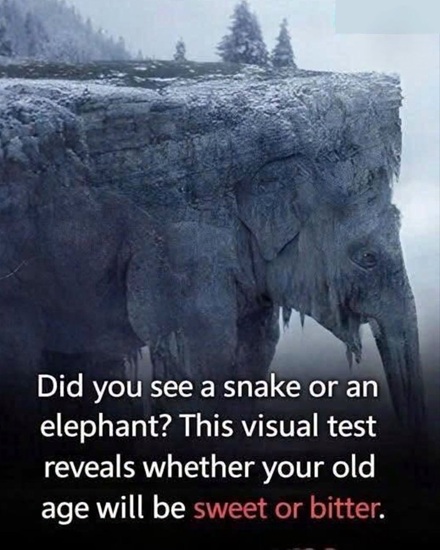
That is precisely why a new viral optical illusion has attracted millions of viewers across social media platforms around the world. At first glance, the image appears to show nothing more than a frozen rocky landscape covered with snow and ice. The scene seems peaceful and ordinary, resembling countless winter photographs taken in mountainous regions. However, after spending only a few seconds studying the picture, many people suddenly notice something unexpected hidden within the icy formations.

What initially appeared to be a simple nature scene quickly transforms into a fascinating visual puzzle that challenges perception and sparks endless discussion among viewers. The illusion has become especially popular because it presents two completely different interpretations within the same photograph. Some people immediately recognize the outline of a snake stretching across the frozen terrain. Others insist that the first thing they notice is the unmistakable profile of a large elephant seemingly carved into the snowy rocks. Interestingly, many viewers struggle to see both images at the same time. Once the brain locks onto one interpretation, it often becomes surprisingly difficult to recognize the other without careful observation.
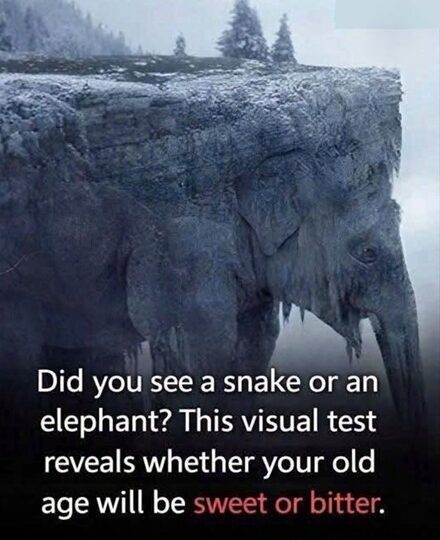
This phenomenon has fueled thousands of conversations online. Friends challenge each other to identify the hidden animal first, families compare their answers during gatherings, and countless users share screenshots explaining what they noticed immediately. The debate has become less about determining which answer is correct and more about understanding why different people experience the exact same image so differently. That question lies at the heart of why optical illusions continue to captivate audiences generation after generation.

Many social media posts claim that whichever animal you notice first reveals hidden aspects of your personality. According to these popular interpretations, seeing the snake first suggests that you are naturally observant, analytical, and detail-oriented. Spotting the elephant first, meanwhile, is often said to indicate that you focus more on the bigger picture, long-term planning, and emotional balance. These personality descriptions have been widely shared across platforms, encouraging even more people to participate in the visual challenge.

It is important, however, to separate entertainment from scientific fact. Although personality quizzes based on optical illusions are enjoyable and encourage self-reflection, there is currently no scientific evidence proving that noticing one image before another can accurately determine someone’s personality, intelligence, future, or psychological traits. Psychologists and vision researchers generally agree that these interpretations should be viewed as fun conversation starters rather than scientifically validated assessments.

Even without personality predictions, the illusion remains fascinating because it demonstrates how perception works inside the human brain. Every second, our eyes collect enormous amounts of visual information from the surrounding environment. Processing every detail individually would overwhelm the brain, so it relies on shortcuts. These shortcuts allow us to recognize familiar patterns almost instantly, helping us navigate daily life efficiently without consciously analyzing every object we encounter.

This pattern-recognition system explains why optical illusions can produce such dramatically different experiences. Rather than simply recording what our eyes receive like a camera, the brain actively interprets incoming information based on previous experiences, expectations, attention, and context. When visual information is ambiguous, the brain rapidly selects the interpretation that appears most likely according to its internal processing methods. As a result, two people looking at the same image can honestly report seeing completely different things.

Researchers who study visual perception have long understood that the brain constantly balances two different approaches to interpreting images. One approach focuses on individual details, examining small features before assembling the complete picture. The other emphasizes overall shapes and larger patterns before analyzing specific elements. Depending on numerous factors—including attention, experience, and visual habits—different individuals may naturally rely more heavily on one strategy than the other when confronted with an unfamiliar image.

This is one reason optical illusions have become valuable educational tools. Teachers often use them to demonstrate how perception differs from objective reality. Students quickly discover that vision involves far more than simply opening their eyes. The brain continuously interprets, organizes, predicts, and sometimes even corrects incoming information based on what it expects to see. Optical illusions provide a simple but powerful demonstration of these complex neurological processes.

Scientists have also found that many external factors can influence what people notice first. Fatigue, stress, mood, concentration, lighting conditions, previous visual experiences, and even cultural background may subtly affect perception. Someone examining the illusion after a long workday might notice different features than they would if viewing the same image while fully rested and focused. These small differences highlight just how dynamic and adaptable human perception truly is.

One of the reasons this particular illusion has spread so rapidly across the internet is its accessibility. Unlike complex scientific experiments requiring specialized equipment, anyone can participate simply by looking at a single image. Within seconds, viewers become personally invested in discovering what they see first and comparing their observations with those of friends and family. This interactive experience transforms an ordinary photograph into an engaging discussion about how the human mind works.

The illusion also serves as a reminder that different perspectives are not necessarily wrong—they are simply different. Two intelligent people may examine the exact same picture and arrive at entirely different conclusions because their brains prioritize different visual information. This insight extends beyond optical illusions into everyday life, reminding us that people often interpret situations, conversations, and experiences through the lens of their own unique perspectives.

As millions continue sharing the snake-or-elephant challenge online, the image demonstrates something far more meaningful than simply identifying hidden animals. It highlights the extraordinary complexity of human perception and reminds us that our understanding of the world is shaped not only by what our eyes see but also by how our brains interpret that information. While the illusion may not reveal secret personality traits, it certainly offers a fascinating glimpse into one of the most remarkable abilities the human mind possesses.

While millions of people continue debating whether they spotted the snake or the elephant first, vision experts emphasize that the true value of this illusion lies not in personality predictions but in what it teaches us about the incredible flexibility of human perception. Every visual experience is the result of countless neurological processes working together, often without us realizing how much interpretation is taking place behind the scenes. Optical illusions simply make those normally invisible processes easier to observe.

When the eyes capture an image, they send electrical signals to different regions of the brain responsible for recognizing shapes, colors, movement, depth, and patterns. Instead of processing every tiny detail individually, the brain rapidly combines this information into a meaningful picture. This process happens so quickly that people usually believe they are seeing reality exactly as it exists, even though the brain is actively making decisions about what deserves attention and what can safely be ignored.

In ambiguous images like the snake-or-elephant illusion, there is no single obvious answer waiting to be discovered. Instead, the visual information contains enough overlapping features that the brain can organize them into more than one recognizable pattern. Once one interpretation becomes dominant, the brain naturally continues reinforcing that version of the image until attention is deliberately redirected toward different visual clues.

Researchers studying perception have identified several psychological principles that explain why this occurs. One of the most important is known as pattern recognition, the brain’s ability to identify familiar shapes based on previous experiences. Humans have evolved to recognize meaningful objects extremely quickly because doing so once played an essential role in survival. Identifying animals, faces, or potential dangers within seconds often made the difference between safety and risk.

Another important factor involves selective attention. At any given moment, our surroundings contain far more information than the brain can consciously process. As a result, the mind constantly filters incoming data, choosing what seems most relevant while temporarily ignoring countless other details. Optical illusions exploit this natural filtering process by presenting information that can reasonably support multiple interpretations depending on where attention is focused first.

Previous experiences also influence perception more than many people realize. Someone who frequently spends time outdoors may naturally recognize animal shapes more quickly, while another individual with artistic experience may notice outlines, shadows, and negative space before identifying recognizable objects. Neither interpretation is more correct than the other; each simply reflects how different brains organize visual information based on years of accumulated experiences.

Lighting, screen size, viewing distance, and even fatigue can subtly affect what viewers notice first. A person looking at the illusion on a smartphone may initially focus on different features than someone viewing the same image on a large computer monitor. Similarly, changes in brightness or contrast may emphasize one hidden figure while making another less obvious. These environmental factors demonstrate how perception depends not only on the image itself but also on the conditions under which it is viewed.

The popularity of optical illusions also reflects people’s natural curiosity about how their minds function. In an era dominated by digital technology, these simple visual puzzles provide an engaging reminder that the human brain remains one of the most sophisticated information-processing systems ever known. Despite enormous advances in neuroscience, researchers continue discovering new insights into how perception, memory, and attention work together to shape everyday experience.

Although social media often attaches personality descriptions to illusions like this one, psychologists encourage people to enjoy these interpretations as entertainment rather than scientific evaluations. There is currently no reliable evidence demonstrating that seeing a snake before an elephant accurately predicts whether someone is analytical, emotional, creative, or logical. Human personality is shaped by countless biological, psychological, social, and environmental factors that cannot be determined by a single visual puzzle.

Even so, many people find these exercises valuable because they encourage self-reflection and conversation. Friends compare answers, families discuss different perspectives, and strangers exchange opinions online. In many cases, the discussions become more interesting than the illusion itself, highlighting how differently people observe and interpret the world around them. These conversations promote curiosity, open-mindedness, and appreciation for diverse perspectives.

Beyond entertainment, the illusion offers an important lesson that extends well beyond visual perception. In everyday life, people frequently examine the same events, conversations, or situations yet reach completely different conclusions. Just as the brain can interpret a single image in multiple valid ways, individuals often understand experiences through the lens of their own knowledge, expectations, emotions, and life history. Recognizing this can encourage greater empathy and patience when opinions differ.

Scientists continue using optical illusions to study attention, perception, memory, and decision-making because they reveal subtle aspects of brain function that might otherwise remain hidden. These experiments help researchers better understand neurological disorders, visual processing differences, and the remarkable adaptability of the human mind. What begins as an entertaining image on social media often reflects decades of scientific research into how people interpret the world around them.

The snake-or-elephant illusion has become one of the latest examples of how a simple picture can capture global attention. Millions of people have paused to examine the image, compare interpretations, and marvel at the realization that perception is far more complex than it initially appears. Whether viewers immediately notice the snake, recognize the elephant, or eventually manage to see both, the experience reminds us that seeing is not simply about vision—it is about interpretation.

Ultimately, perhaps the greatest lesson offered by this illusion is that reality is often more flexible than we assume. Two honest observers can examine the exact same scene and perceive it differently without either being mistaken. That remarkable ability reflects the extraordinary complexity of the human brain—a biological system capable of transforming patterns of light into meaningful experiences within fractions of a second.

The next time you encounter an optical illusion, remember that it is doing much more than testing your eyesight. It is offering a fascinating demonstration of how your brain processes information, recognizes familiar patterns, and constructs your understanding of the world. Whether you noticed the snake first, immediately saw the elephant, or needed several moments to recognize both, the illusion serves as a reminder that perception is one of the most extraordinary abilities humans possess—and one that continues to amaze scientists and casual observers alike.

Categories: News

Leave a reply

Your email address will not be published. Required fields are marked *