
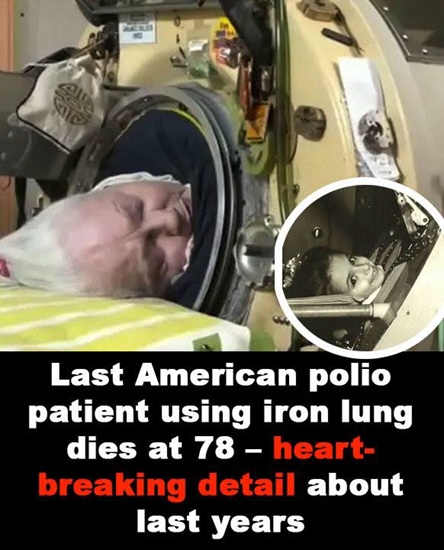
For most people born after the 1960s, the iron lung is little more than a medical artifact seen in history books or documentaries. Once considered one of the greatest lifesaving inventions of its time, the massive metal ventilator became a symbol of one of the most feared diseases in modern history—polio. While millions of Americans eventually forgot about the machine after vaccines nearly eliminated the disease, one woman continued to depend on it every single day of her life.
That woman was Martha Ann Lillard, whose remarkable journey became a living reminder of both the devastation caused by polio and the extraordinary resilience of the human spirit. Martha Ann Lillard died on June 26 at the age of 78 after spending more than seven decades relying on an iron lung to help her breathe. Her passing marked the end of a chapter in American medical history. She was believed to be the last person in the United States still dependent on the enormous mechanical ventilator that once saved thousands of lives during the height of the polio epidemics.
Although technology had advanced dramatically over the decades, Martha remained one of the very few people for whom modern alternatives simply could not provide the breathing support she required. Her story began in the summer of 1953, a year that remains one of the darkest periods of the polio epidemic in the United States. At the time, vaccines had not yet been introduced, and parents across the country lived with constant fear that their children could become the next victims of a disease that often struck without warning.
Hospitals dedicated entire wards to caring for patients who suddenly lost the ability to breathe on their own. Iron lungs lined hospital rooms, creating haunting images that would forever become associated with the fight against polio. Martha had been looking forward to celebrating her fifth birthday like any other child. Instead of presents and games, however, she woke up with unusual pain that immediately worried her family.
She later described the moment in interviews, remembering that the sun was shining outside while she struggled simply to lift her head from the pillow. At first, the symptoms appeared similar to those of many common childhood illnesses, including a stiff neck, sore throat, and general fatigue. Nothing suggested that within just a few days her entire life would change forever.
As her condition rapidly worsened, Martha lost the ability to move her arms and legs. Breathing became increasingly difficult until she eventually lost consciousness altogether. Her family rushed her to the hospital, where doctors diagnosed her with paralytic polio, one of the disease’s most severe forms. With her respiratory muscles no longer functioning properly, physicians had only one option available to save her life. She was placed inside an iron lung, a machine that used changing air pressure to force her lungs to inhale and exhale when her own body could no longer perform that vital task.
The enormous cylindrical machine surrounded nearly her entire body, leaving only her head outside through a sealed collar around her neck. Although intimidating to look at, the iron lung represented hope for thousands of patients during that era. For Martha, it became both her greatest lifesaver and her lifelong companion. Doctors initially believed she might survive only a short time despite the machine’s assistance. Many children with severe polio complications never recovered, while others remained permanently disabled for the rest of their lives.
During those first months, Martha spent nearly every hour inside the machine. She remained hospitalized for approximately six months while doctors closely monitored her progress. The adjustment was physically exhausting and emotionally overwhelming for such a young child. Every breath depended entirely on the rhythmic movement of the iron lung, leaving little room for independence. Yet even at an early age, Martha demonstrated remarkable determination. Family members would later recall that she rarely complained despite facing challenges most adults could scarcely imagine.
Medical professionals gave her family a grim outlook. According to her sister Cindy McVey, physicians believed Martha would likely never live beyond the age of twenty. At the time, such predictions were understandable given the severity of her condition and the limited medical knowledge available. Instead of accepting that prognosis, however, Martha gradually began proving everyone wrong. Her determination to survive became one of the defining characteristics of her life.
Over the following years, she slowly trained herself to breathe independently for short periods. It required extraordinary patience and perseverance, but she steadily built strength in the muscles that remained functional. Although paralysis permanently affected her right arm, she eventually regained enough mobility to walk again. Every small improvement represented another victory over a disease that had attempted to take away nearly everything. Her progress amazed both doctors and family members, who watched her accomplish goals many had considered impossible.
Education presented another major challenge. Because frequent attendance at school was impossible, Martha completed much of her education remotely through an intercom system that allowed her to participate in classes from home. Long before online learning became common, she demonstrated that determination and creativity could overcome enormous obstacles. She refused to let her medical condition define her intellectual abilities or prevent her from continuing her education alongside other students her age.
Despite her physical limitations, Martha developed a wide range of interests and talents that enriched her life. She loved reading, writing, composing poetry, and creating songs that reflected her unique perspective on life. Friends often described her as thoughtful, intelligent, and deeply compassionate. Rather than allowing years spent with medical equipment to isolate her emotionally, she built meaningful relationships and maintained a positive outlook that inspired those around her.
As decades passed, medical technology advanced dramatically. Smaller ventilators replaced iron lungs for nearly every remaining polio survivor. Hospitals gradually retired the giant machines that had once filled entire wards, placing many of them in museums as reminders of a disease that vaccines had largely defeated. Martha also tried numerous modern respiratory devices, hoping one might eventually replace the machine she had depended upon since childhood. Unfortunately, none of them provided the level of pressure her lungs required to function properly. She later explained that every alternative fell short of meeting her unique medical needs, leaving the iron lung as her only reliable option.
As the years passed, Martha Ann Lillard became something far more than a survivor of polio. She became a living piece of American medical history. While nearly every other patient who had once relied on an iron lung transitioned to newer forms of respiratory support or no longer needed mechanical assistance, Martha remained uniquely dependent on the same technology that had saved her life as a child. Her situation illustrated both the incredible advances in medicine and the reality that not every patient could benefit from modern alternatives in the same way.
Doctors repeatedly explored different options that might allow Martha greater mobility and independence. She willingly tested various ventilators and respiratory devices as technology improved over the decades. Although many of these machines worked well for other patients, none produced enough air pressure to meet her specific breathing requirements. Martha explained in interviews that she needed a pressure level far beyond what newer portable ventilators could safely provide. As a result, the iron lung remained the only device capable of supporting her breathing consistently and comfortably.
For many years, Martha adapted her life around the machine rather than allowing it to define her completely. During healthier periods, she only needed to sleep inside the iron lung at night. This allowed her to spend much of the day outside the machine, pursuing hobbies, maintaining friendships, and participating in community activities. Although daily life required careful planning, she found ways to preserve a remarkable degree of independence despite the limitations imposed by her condition.
Those who knew Martha often described her as creative, optimistic, and deeply compassionate. She loved writing poetry, composing songs, and expressing herself through art. She also devoted time to volunteering with local animal welfare organizations, particularly those focused on rescuing and caring for beagles, a breed she adored throughout her life. Friends recalled that her home was filled with books, music, and creative projects that reflected her curiosity and appreciation for life’s simple pleasures.
Despite facing extraordinary physical challenges, Martha rarely focused public attention on her own hardships. Instead, she frequently used interviews as opportunities to educate younger generations about polio and the importance of vaccination. Having lived through one of the most devastating disease outbreaks in American history, she understood firsthand the suffering that vaccines had prevented for millions of children born after the 1950s. Her story served as a powerful reminder of why widespread immunization transformed public health around the world.
One of the most frightening moments of Martha’s later life occurred during a severe ice storm that struck Oklahoma. The storm caused widespread power outages, including at her home, where the iron lung depended on electricity to operate. Although an emergency generator was available, it eventually failed as well. Suddenly, the machine that had sustained her breathing for decades stopped functioning properly. The terrifying experience left Martha struggling to breathe while trapped inside the metal chamber.
Years later, she vividly recalled those frightening moments during an interview with Radio Diaries. She described the overwhelming fear of lying inside a silent iron lung without adequate airflow, comparing the sensation to being buried alive. As her breathing became increasingly difficult, she consciously fought to remain calm, repeatedly telling herself that she was not going to die. Emergency assistance eventually restored power before the situation became fatal, allowing Martha to survive yet another life-threatening challenge.
Ironically, the greatest threat to Martha’s health during her final years was not polio itself but the COVID-19 pandemic. Having already lived with significantly reduced lung capacity for decades, she faced exceptionally high risks if infected with the virus. Before the pandemic, doctors estimated her lungs functioned at less than twenty-five percent of normal capacity. Even a relatively minor respiratory infection could pose serious complications for someone with such limited breathing reserves.
Unfortunately, Martha contracted COVID-19 twice during the pandemic. Although she survived the initial infections, the long-term effects permanently worsened her already fragile respiratory health. Her lung function declined dramatically, eventually forcing her to spend nearly twenty-four hours each day inside the iron lung once again. Activities she had previously managed independently became impossible, and she could no longer leave her home as she once had. The gradual loss of mobility represented one of the most difficult adjustments of her later years.
At the same time, another unexpected problem emerged. The iron lung itself, now more than seventy years old, began showing signs of age. Replacement parts were virtually impossible to find because the machines had disappeared from hospitals decades earlier. The engineers and technicians who once specialized in repairing iron lungs had long since retired or passed away. Martha’s family searched desperately for anyone capable of maintaining the aging machine, knowing that even a mechanical failure could place her life at immediate risk.
Her sister, Cindy McVey, later explained how difficult those final months had become. The family constantly worried about the machine breaking down while realizing there were almost no qualified specialists remaining in the country. What had once been standard medical equipment had become an obsolete piece of technology supporting the last person who still depended upon it. Martha’s unique situation highlighted the unexpected challenges faced by survivors of diseases that modern medicine had largely conquered.
Even while confronting these uncertainties, Martha maintained the resilience that had characterized her entire life. She continued giving interviews whenever her health allowed, sharing memories of the polio epidemic and encouraging people never to underestimate the importance of preventive medicine. Her calm, thoughtful manner left lasting impressions on journalists and audiences alike. Rather than dwelling on tragedy, she emphasized gratitude for the years she had been given despite doctors’ early predictions.
Martha eventually prepared for the inevitable with characteristic honesty and practicality. She even updated her own obituary, choosing to acknowledge the lasting impact COVID-19 had on her already compromised health. Although her official death certificate listed chronic pulmonary failure and post-polio syndrome among the primary causes of death, she believed the lingering effects of COVID-19 had significantly contributed to her decline during the final years of her life.
When Martha Ann Lillard passed away on June 26 at the age of seventy-eight, an extraordinary chapter in American history quietly came to an end. She had survived more than seven decades with a disease that once terrified families across the nation. Her life spanned the era before vaccines, the dramatic decline of polio following Jonas Salk’s breakthrough vaccine in 1955, and the complete disappearance of naturally occurring polio transmission in the United States by 1979.
Her passing was about far more than the loss of one remarkable individual. It symbolized the closing of an era when iron lungs filled hospital wards and thousands of families feared every summer outbreak of polio. Thanks to decades of scientific research, vaccination programs, and public health efforts, future generations may never experience the devastation that defined Martha’s childhood. Yet her story remains an essential reminder of the human cost behind those medical achievements.
Today, Martha Ann Lillard is remembered not only as the last American to depend on an iron lung but also as a woman whose determination inspired countless people. She refused to let illness define her identity, built a meaningful life despite extraordinary obstacles, and devoted her later years to educating others about one of history’s most feared diseases. Her legacy stands as a testament to courage, perseverance, and the life-changing power of modern medicine.

