
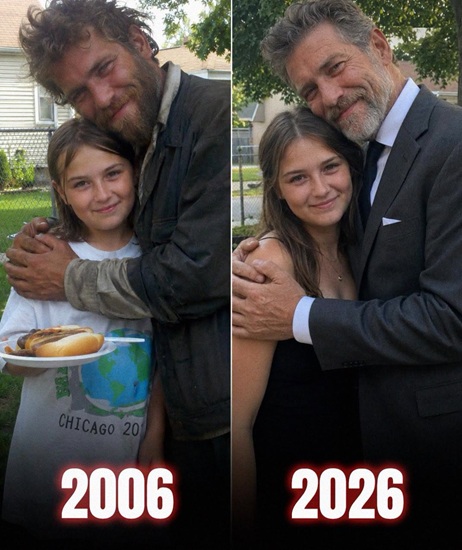
The morning after my mother’s funeral, the silence around her little house felt heavier than anything I had ever experienced. Every room carried memories of her gentle voice, her quiet routines, and the sacrifices she had made throughout her life. Family members had already returned home, the flowers were beginning to wilt, and sympathy cards covered the dining room table. Yet despite everything that had happened, one promise echoed louder than all the others.
Before she passed away, my mother had asked me to continue taking food to a homeless man named Victor. At the time, I couldn’t understand why she cared so deeply about someone I had always believed was simply a stranger living behind our property. Still grieving and confused, I honored her final request without knowing that it would completely change my understanding of my family. For nearly twenty years, Victor had lived behind our modest home in a shelter built from old tarps, discarded wooden boards, and anything else he could find.
Every afternoon, my mother carefully prepared three meals instead of two. One plate was for her, one was for me, and the third always went into a reused plastic container that she carried outside to Victor. Growing up, I never understood her unwavering commitment. We struggled financially ourselves. There were months when paying utility bills became a challenge, our clothes were patched instead of replaced, and every grocery trip required careful budgeting. Yet somehow, my mother never missed a single day of bringing Victor something warm to eat. As a child, I often believed she cared more about him than about improving our own difficult circumstances.
One memory remained especially vivid. I was only eleven years old when I finally voiced the frustration I had been carrying for years. Looking down at my worn-out sneakers covered with tape, I complained that Victor always seemed to receive the largest portion of every meal. My mother froze immediately. The expression on her face changed in a way I had never seen before. She calmly told me not to speak about Victor that way, insisting he needed help. Angry and too young to understand compassion beyond my own hardships, I argued that perhaps if we stopped feeding strangers every day, our own lives might become easier. Instead of responding with anger, she looked deeply hurt. Her voice trembled as she quietly told me that I had no idea what Victor had sacrificed.
Curious, I demanded to know who Victor really was. For one brief moment, I believed she was finally going to explain everything. She opened her mouth, hesitated, and tears formed in her eyes. Then, without another word, she handed me the food container and simply asked me to deliver it. The conversation ended there. Every time I attempted to ask again over the following years, she gently changed the subject. The mystery surrounding Victor only deepened, while my resentment quietly continued to grow.
Victor himself never behaved like someone who expected charity. Whenever I brought him food, he thanked me politely and always asked how my mother was doing. He spoke warmly about her cooking, especially her homemade chicken soup, calling it his favorite meal. His comments always confused me because they sounded deeply personal, almost as if they shared a history I knew nothing about. When I sarcastically reminded him that he barely knew my mother, he simply smiled sadly and replied that he knew her soup very well. At the time, I interpreted his words as strange and uncomfortable. Looking back now, I realize there was profound sadness hidden behind every conversation we shared.
As the years passed, I eventually moved away to begin building my own life. Although I visited my mother regularly, I deliberately avoided discussing Victor because every previous conversation had ended in silence or tears. Nevertheless, Victor remained part of our lives. During storms, someone mysteriously repaired broken fence posts and stacked firewood beside our porch before we woke up.
When a loose step became dangerous, it was quietly fixed overnight. After one particularly cold winter, I returned home to discover a pair of gently used boots waiting beside my backpack after mine had completely fallen apart. My mother insisted they had come from a church donation, but something about her explanation felt rushed. Through the kitchen window, I noticed Victor brushing snow away from our front steps without expecting thanks or recognition.
Everything changed when my mother became seriously ill. Cancer slowly transformed the energetic woman I had always known into someone physically fragile but emotionally determined. During one hospital visit shortly before she died, she reached for my hand with surprising strength and asked me to make a promise. Once again, it involved Victor. She pleaded with me to continue feeding him after she was gone. Unable to hide my frustration any longer, I finally asked why he had always mattered so much.
My mother looked at me with overwhelming sadness and quietly admitted she knew I believed she had chosen Victor over me. She apologized for making me feel that way but insisted it had never been true. Before I could ask more questions, she mentioned something else that seemed completely unrelated. She warned me that if my Uncle Mark ever came looking through her belongings after she died, I must not allow him to touch a blue box hidden inside the house.
Confused by her sudden warning, I asked what Uncle Mark had to do with Victor. My mother’s expression immediately filled with fear unlike anything I had ever witnessed. Instead of answering directly, she squeezed my hand tighter and whispered only a few heartbreaking words. She told me Victor had always been her safe place. Before I could ask what she meant, exhaustion overtook her. I promised to protect the mysterious blue box, never imagining that inside it lay the truth my mother had hidden for decades—a truth powerful enough to rewrite everything I thought I knew about Victor, my family, and the woman I believed I understood better than anyone.
After leaving Victor standing beside the black SUV, I rushed back into my mother’s house with my heart pounding. Every word he had spoken echoed in my mind. The silver locket he held was unmistakably hers. For years, she had insisted it had been lost forever when I was a child. Now Victor was holding it as though it had always belonged to him. His explanation—that he had given it to my mother many years earlier—made no sense. I remembered my mother’s final warning about the blue box, and suddenly it seemed more important than ever. I searched every closet, every shelf, and every storage container until I finally found an old blue box hidden beneath folded blankets exactly where she had left it.
The box looked ordinary, but inside it rested the answers my mother had been protecting for decades. Carefully arranged were old family photographs, handwritten letters, yellowed documents, and several small keepsakes from long ago. The very first photograph immediately caught my attention. It showed my mother as a little girl standing beside a young boy who looked remarkably familiar. They were smiling despite scraped knees and torn clothing. On the back, my mother’s handwriting read, “Victor walked me home again today.” I stared at the picture in disbelief. The resemblance between the young boy and the man who had lived behind our house for years was impossible to ignore. My hands trembled as I reached for the sealed envelope that carried my name.
The letter began with an apology. My mother explained that she had never found the courage to tell me the truth while she was alive because she feared what would happen if certain family members learned she had revealed the secret. She wrote that Victor had never been a stranger. He was her older brother. Growing up, he had protected her, walked her safely to school, shared food when there wasn’t enough for everyone, and sacrificed his own comfort whenever she needed help. She described him as the person who had always made her feel safe during difficult childhood years. Reading those words, I immediately remembered her final whisper in the hospital. Victor had always been her “safe place.” Now those words finally made sense.
As I continued reading, the painful history of our family slowly unfolded. My mother explained that during one especially harsh winter, Victor had attempted to sell one of their mother’s bracelets. He hadn’t done it for himself or out of greed. He had hoped to buy blankets because the family home had no heat, and everyone was freezing. Instead of understanding his intentions, several family members accused him of stealing. That single mistake followed him for the rest of his life. My uncle Mark repeatedly used the story to portray Victor as dishonest and irresponsible. Over time, the accusation became accepted as fact, even though few people remembered why Victor had taken the bracelet in the first place.
The letter revealed something even more heartbreaking. Years later, Victor developed serious personal struggles that caused him to become isolated from the rest of the family. Rather than helping him recover, relatives pushed him away. My mother wanted desperately to support her brother openly, but after I was born as a single parent with limited financial resources, Mark repeatedly warned her that maintaining contact with Victor could cause people to question her fitness as a mother. According to the letter, Mark convinced her that if authorities believed she exposed me to someone he described as unstable, she might lose custody of me. Terrified of that possibility, she made an impossible decision. She kept helping Victor in every quiet way she could while allowing me to believe he was simply a homeless stranger living nearby.
By the time I finished reading, tears blurred every page. Suddenly, memories from my childhood took on completely different meanings. The repaired porch steps, the neatly stacked firewood after every storm, the unexpected pair of winter boots, and the constant acts of quiet kindness had never come from anonymous generosity. They had come from my uncle Victor, a man who loved our family enough to remain close despite being forced to stay in the background. Even while living with almost nothing himself, he continued protecting us in every way he could. My resentment instantly transformed into overwhelming guilt. I realized I had spent most of my life judging someone whose sacrifices I had never understood.
Without hesitation, I carried the blue box to Mrs. Bell, the longtime neighbor who had always known both my mother and Victor. After quietly reading several of the letters, she confirmed everything my mother had written. She explained that Victor had once been a hardworking, caring young man who always looked after his younger sister. Family disagreements, financial hardship, illness, and years of misunderstanding gradually pushed him further away until he eventually found himself living without a permanent home. Despite everything, my mother never abandoned him. Every meal she prepared, every blanket she delivered, and every conversation they shared was her way of honoring the promise she had made to never stop caring for her brother.
When I returned to my mother’s house, Uncle Mark had already arrived and was sorting through her belongings. The blue box rested beside him on the table. This time, I wasn’t afraid to confront him. Holding my mother’s letter firmly in my hands, I told him I knew the truth. At first, he dismissed everything as emotional confusion caused by grief. But when I read portions of my mother’s own words aloud, the room fell silent. Other relatives who had gathered for the funeral listened carefully as decades of hidden family history finally came to light. Questions quickly followed. Several relatives admitted they had always believed Victor had died years earlier because that was what Mark had repeatedly told everyone.
Victor quietly entered the room a few moments later. For years he had remained outside, never crossing the doorway unless invited. This time, I walked directly toward him. Looking into his tired eyes, I addressed him for the first time the way he had always deserved. “Uncle Victor,” I said softly. The words seemed to surprise him. Tears filled his eyes as he looked toward the kitchen where my mother had prepared countless meals over the years. I placed two bowls of warm soup on the old kitchen table and invited him to sit with me. At first he hesitated, saying he could always eat outside like before. I gently shook my head. Those days were finally over.
For the first time in more than twenty years, Victor shared a family meal inside the house instead of behind it. As we talked, he shared stories about my mother’s childhood that I had never heard before. He described her determination, her kindness, and the countless moments when they had protected one another growing up. Listening to him, I realized how much of my mother’s strength had been shaped by the brother she had spent so many years trying to protect. Although nothing could erase the years we had lost, the truth allowed us to begin building something new.
My mother’s greatest secret had never been about charity. It had been about love, loyalty, sacrifice, and fear. She had spent decades protecting both her daughter and her brother in the only way she believed possible. Her final request had not simply been about delivering meals. It had been her way of bringing our broken family back together after years of silence. As Victor and I finished dinner at the same kitchen table where my mother had once served us both separately, I finally understood the promise I had made beside her hospital bed. It was never just about feeding a lonely man. It was about restoring a family that had been hidden in plain sight for far too long.

