
Few singers have built a career as distinctive and enduring as Bonnie Tyler. With her unmistakable raspy voice, powerful stage presence, and timeless rock ballads, she became one of the most recognizable artists of the late twentieth century. Songs such as Total Eclipse of the Heart, Holding Out for a Hero, and It’s a Heartache have remained popular for decades, introducing her music to new generations around the world. Although millions know her as Bonnie Tyler, the internationally acclaimed performer was born Gaynor Hopkins, and her remarkable journey began far from sold-out arenas and global success.
Bonnie Tyler was born on June 8, 1951, in Skewen, a village near Swansea in South Wales. She grew up in a council house as one of seven children in a hardworking family. Life was simple, and money was often limited, but the household was filled with music, laughter, and a strong sense of community. Like many children growing up in Wales during that period, Bonnie was surrounded by a close-knit neighborhood where everyone knew each other, and families supported one another through both joyful and difficult times. Those early experiences helped shape the humble personality that has remained one of her defining characteristics throughout her career.

Music became part of Bonnie’s life from an early age. She has often recalled carrying vinyl records in shopping bags to visit her aunt, where she and her cousins would spend hours listening to their favorite singers. Artists such as Elvis Presley, Tina Turner, Janis Joplin, and other rock and country performers inspired her long before she ever imagined becoming famous herself. Even as a young girl, she loved singing whenever she had the opportunity, although she never imagined that her voice would one day be recognized around the world.
As she entered her teenage years, Bonnie became increasingly determined to pursue music professionally. At the age of seventeen, she joined local bands and began performing regularly in rugby clubs, working men’s clubs, and small entertainment venues across South Wales. These performances gave her valuable experience performing before live audiences and helped her develop the confidence that would later define her stage presence. Rather than chasing immediate fame, she simply enjoyed singing and hoped to build a career performing with talented musicians.
Her breakthrough came almost unexpectedly. While singing in a club in Swansea, she caught the attention of Roger Bell, who worked for Chapel Music in London. Bell believed Bonnie possessed a unique voice that deserved greater recognition and introduced her to songwriters Ronnie Scott and Steve Wolfe. They invited her to London to record demonstration tracks, giving her the opportunity that would eventually change her life forever. Bonnie has often said that she never entered the music industry expecting international fame—she simply wanted the chance to sing professionally.

One of the earliest songs she recorded was “Lost in France,” released in 1976. The single became a commercial success and introduced Bonnie Tyler to audiences throughout the United Kingdom and Europe. Soon afterward, she made her first appearance on the legendary television music program Top of the Pops, an important milestone for any British recording artist. The exposure significantly increased her popularity and demonstrated that her powerful voice could stand out in an increasingly competitive music industry.
During the late 1970s, Bonnie continued building her reputation with a series of successful recordings. Songs including “More Than a Lover” and “It’s a Heartache” established her as one of Britain’s most promising female vocalists. It’s a Heartache became particularly significant, reaching the top of charts in numerous countries and introducing Bonnie to audiences in North America. Her distinctive vocal style—deep, emotional, and instantly recognizable—helped distinguish her from many other singers of the era. Critics praised her ability to communicate powerful emotion through every performance.
Perhaps the most defining moment of Bonnie Tyler’s career arrived in 1983 with the release of “Total Eclipse of the Heart.” Written by Jim Steinman and produced with dramatic orchestration, the song quickly became an international phenomenon. It reached No. 1 in both the United Kingdom and the United States, selling millions of copies worldwide. Decades later, it remains one of the best-known power ballads ever recorded and continues to receive extensive radio play, television exposure, and streaming success across multiple generations.

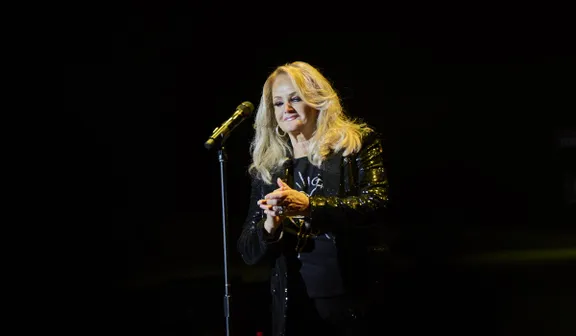
The enormous popularity of Total Eclipse of the Heart transformed Bonnie Tyler into one of the world’s leading recording artists. Concert tours expanded across Europe, North America, Australia, and Asia, introducing her to millions of fans. Her powerful live performances became legendary, with audiences praising not only her unmistakable voice but also the warmth and genuine appreciation she showed toward her supporters. Throughout her career, Bonnie has consistently emphasized that performing live remains one of the greatest joys of her professional life.
Away from the stage, Bonnie’s personal life remained remarkably stable compared with many other international stars. In 1973, before achieving worldwide fame, she married Robert Sullivan, a property developer and former Olympic judo competitor. Bonnie has frequently credited the strength of their marriage to the fact that they met long before fame transformed her career. Their relationship has remained one of the longest-lasting marriages in the entertainment industry, providing stability throughout decades of international touring, recording sessions, and public appearances.
As Bonnie Tyler’s international career continued to flourish throughout the 1980s and beyond, she found herself traveling constantly between recording studios, television appearances, and sold-out concert venues across the world. While the demands of touring were exciting, they also required long periods away from home. Despite the glamour associated with global success, Bonnie has often explained that she always looked forward to returning to places where she could enjoy a quieter pace of life. Those personal retreats became increasingly important as her career expanded, allowing her to recharge before returning to the stage.
One of the places that captured Bonnie Tyler’s heart was the Algarve region of southern Portugal. Her connection with the country began in the late 1970s while she was recording an album in Vale do Lobo, a coastal resort known for its beautiful beaches and relaxed atmosphere. During that visit, Bonnie fell in love with the region’s scenery, warm climate, and slower way of life. She has spoken fondly about evenings spent walking along the beach, enjoying fresh seafood, and appreciating the peaceful environment that contrasted with the demanding schedule of an international recording artist.
In the early 1980s, Bonnie and her husband, Robert Sullivan, decided to purchase a villa between Albufeira and Vilamoura. Over time, the couple transformed the property into a modern seaside retreat designed to maximize the spectacular ocean views that had first attracted them to the Algarve. Working with an architect, they rebuilt the home with spacious living areas, large windows, open terraces, and contemporary design elements that blended comfortably with the surrounding coastal landscape. Although the architecture attracted attention, Bonnie has often emphasized that it was the peaceful lifestyle—not the luxury—that made Portugal feel like a second home.
When she was not touring or recording, Bonnie enjoyed living much like any other resident of the Algarve. She and Robert spent time with local friends, dined in neighborhood restaurants, walked along the beach, and appreciated the relaxed rhythm of everyday life. She has frequently described Portugal as one of her favorite places in the world, praising not only its natural beauty but also the kindness and hospitality of the people she met there. These simple pleasures provided an important balance to the excitement and pressure of an international music career.
Despite her deep affection for Portugal, Bonnie has never hidden her love for her homeland of Wales. Throughout her career, she remained closely connected to her family and proudly celebrated her Welsh roots whenever she traveled abroad. In 1988, she and Robert purchased a historic home in Mumbles, near Swansea, overlooking the beautiful coastline of the Gower Peninsula. Originally built during the nineteenth century, the house underwent an extensive renovation that reflected the couple’s personal taste while preserving many traditional architectural features. Bonnie has often described the property as a place filled with warmth, family gatherings, and treasured memories.
Family has always remained central to Bonnie Tyler’s life. Although she and Robert did not have children together, she has spoken openly and honestly about that part of her personal journey. In interviews, she explained that they initially postponed starting a family because of her rapidly growing music career. Later, she experienced a miscarriage, an event she has described with great sensitivity and openness. Over time, Bonnie said she accepted that life had taken a different path, finding happiness through her close relationships with nieces, nephews, godchildren, and her large extended family. Their support has remained an important source of strength throughout her life.
Away from the spotlight, Bonnie has often described herself as someone who enjoys simple routines. When not performing, she likes spending time at home, relaxing with Robert, meeting family members and friends for lunch, and appreciating everyday moments away from public attention. Despite being recognized around the world, she has maintained a down-to-earth personality that many fans admire. Those who know her frequently describe her as warm, approachable, and grateful for the opportunities her career has provided.
Throughout the decades, Bonnie Tyler has continued recording new music and performing for audiences across Europe and beyond. In 2013, she proudly represented the United Kingdom at the Eurovision Song Contest with the song “Believe in Me,” introducing her powerful voice to a new generation of viewers. Although she did not win the competition, her participation demonstrated her continuing enthusiasm for performing and her willingness to embrace new challenges even after decades of international success.
Bonnie’s contributions to music have been recognized with numerous honors during her career. Among the most significant was her appointment as a Member of the Order of the British Empire (MBE) for services to music. Receiving this prestigious honor represented an emotional milestone for the singer, who has often reflected on how extraordinary it felt for someone who grew up in a modest council house in South Wales. She has spoken proudly about receiving the recognition while remaining deeply grateful to her fans, whose support made her remarkable career possible.
Today, Bonnie Tyler remains one of the most respected and recognizable voices in popular music. More than fifty years after beginning her professional journey, her songs continue to receive millions of streams, frequent radio airplay, and enthusiastic responses from audiences around the world. Classics such as “Total Eclipse of the Heart,” “It’s a Heartache,” and “Holding Out for a Hero” remain timeless favorites that continue introducing her music to new generations. From her humble beginnings in Skewen to international stardom, Bonnie Tyler’s story is one of perseverance, talent, and authenticity. Her enduring success reflects not only her extraordinary voice but also her unwavering dedication to music, her family, and the values that have remained constant throughout an unforgettable career.
