
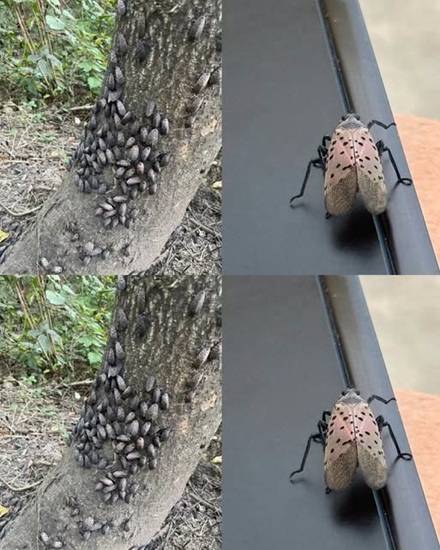
The spotted lanternfly (Lycorma delicatula) is an invasive planthopper insect originally native to parts of China, India, and Vietnam. It was first detected in the United States in Pennsylvania in 2014 and has since spread to several other states through human-assisted movement and natural dispersal. Despite its striking appearance, the insect is not dangerous to humans directly, as it does not bite or sting. However, it can cause significant agricultural and ecological damage by feeding on a wide range of plant species, particularly trees, vines, and ornamental plants.
One of the key reasons the spotted lanternfly is considered a serious agricultural pest is its feeding behavior. The insect uses specialized mouthparts to pierce plant tissue and consume sap from trunks, branches, and stems. While feeding, it excretes a sugary liquid known as honeydew. This substance itself is not toxic, but it can accumulate on leaves, bark, vehicles, and outdoor surfaces. Over time, honeydew promotes the growth of sooty mold, a black fungal layer that can cover leaves and reduce the plant’s ability to photosynthesize effectively.
Trees affected by heavy infestations may show signs of stress such as reduced vigor, dieback of branches, and decreased fruit or crop yield. Grapevines, in particular, are considered highly vulnerable, which is why vineyards in affected regions monitor and manage populations carefully. While healthy mature trees often do not die immediately from a single infestation, repeated or severe infestations can weaken plants over time and contribute to long-term decline.
The spotted lanternfly has a distinct life cycle that makes it easier to identify at different stages. In spring, eggs hatch into nymphs that are small, black, and marked with white spots. These early-stage nymphs are highly mobile and feed on a wide variety of plants. As they grow, they develop red pigmentation along with black and white markings in later nymph stages, typically during summer. Adult insects appear in late summer and fall, measuring about one inch in length. They have gray forewings with black spots and bright red hindwings that are visible when they fly or jump.
The insect’s egg masses are another important identification feature. Female lanternflies lay eggs in late fall on smooth surfaces such as tree trunks, stones, outdoor furniture, and vehicles. These egg masses are often covered with a gray, waxy coating that resembles dried mud. Each mass can contain dozens of eggs, which is one of the reasons the species can spread rapidly if not managed. Egg masses remain dormant through winter and hatch in the spring when temperatures rise.
Spotted lanternflies are considered strong hitchhikers rather than strong fliers. While adults can fly short distances, much of their long-range spread occurs through human activity. Eggs or insects can be transported on vehicles, shipping containers, firewood, outdoor equipment, and agricultural products. This method of spread has allowed the species to expand its range quickly across multiple regions, raising concerns among agricultural authorities and environmental agencies.
The primary host plant associated with spotted lanternfly populations is the tree of heaven (Ailanthus altissima), another invasive species introduced from Asia. This tree plays a key role in the insect’s life cycle, especially for egg-laying and aggregation. However, spotted lanternflies feed on many other plant species, including maple, walnut, willow, and various fruit trees. Because of this broad feeding range, they are considered a general agricultural pest rather than a species limited to one ecosystem.
Management strategies for spotted lanternfly populations rely on integrated pest management principles rather than a single method. Physical removal of egg masses is one of the most effective prevention techniques for small-scale control. Scraping egg masses into a sealed container with rubbing alcohol or hand sanitizer is commonly recommended by agricultural extension services to ensure the eggs are destroyed.
Trapping methods are also used in some settings. Sticky bands wrapped around tree trunks can capture nymphs as they climb. However, these traps must be installed carefully to avoid harming non-target wildlife such as birds, beneficial insects, or small mammals. Protective mesh coverings are often recommended to reduce unintended capture of animals.
Chemical control options exist but are generally used in managed agricultural or professional settings rather than casual home use. Systemic insecticides may be applied to certain high-risk trees, but these treatments should only be administered by licensed professionals or under guidance from local agricultural authorities. Improper use of pesticides can negatively impact beneficial insects and surrounding ecosystems.
Public reporting and monitoring are also essential components of managing the spread of spotted lanternfly populations. In regions where the insect is newly established, local departments of agriculture often encourage residents to report sightings. Early detection helps authorities track movement patterns and implement targeted control measures to slow further spread.
While the spotted lanternfly is a concerning invasive species, experts emphasize that management is possible with coordinated efforts. Public awareness, early intervention, and responsible control methods significantly reduce its impact over time. Complete eradication in heavily infested regions is difficult, but population reduction and containment strategies can protect agriculture, forestry, and residential landscapes.
In conclusion, the spotted lanternfly represents an example of how invasive species can disrupt ecosystems when introduced outside their native range. However, accurate identification and science-based management approaches allow communities to respond effectively without exaggeration or panic. Understanding its life cycle, behavior, and control methods is the most reliable way to reduce its impact and protect local environments.

