
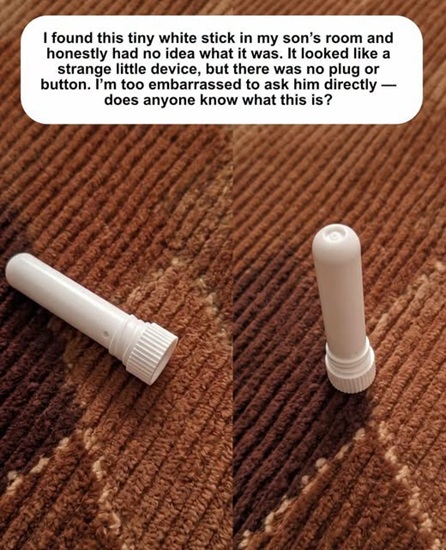
Finding an unfamiliar object in a teenager’s room can easily trigger anxiety for any parent. Adolescence is a stage where privacy increases, communication sometimes becomes limited, and everyday items are not always explained. In that space of uncertainty, even a harmless object can feel suspicious when there is no immediate context. In one common type of situation, a parent may notice a small, unlabelled item on a nightstand or desk and instantly feel concerned
The object might be simple in reality, but its appearance—especially if it is unfamiliar—can lead the mind toward worst-case scenarios. This reaction is not unusual, as parents often feel a strong responsibility to protect their children from anything potentially harmful. The emotional response in such moments is usually immediate. Before any questions are asked, the mind begins to search for explanations. When an item has no clear branding or obvious purpose, it can be misinterpreted as something more serious than it really is.
This is especially true in households where teenagers are beginning to manage more of their own belongings and personal space. What makes these situations more intense is the lack of immediate communication. A parent may hesitate to ask directly, or may feel uncertain about how to approach the subject. At the same time, curiosity and concern grow stronger, creating internal tension. This is how small misunderstandings can quickly feel much larger than they actually are.

In many cases, the object in question turns out to be something completely ordinary. Everyday personal care items, small accessories, or health-related products often have simple designs that are not immediately recognizable outside of their packaging. Without labels or context, even harmless objects can appear confusing.
Once the truth is discovered, the emotional shift is often immediate. Fear gives way to relief, and what once felt alarming becomes understandable. The object that seemed suspicious is revealed to have a completely normal purpose. This contrast between fear and reality often leaves a strong impression on parents, making the moment memorable long after it has passed.
However, the most important part of these experiences is not the object itself, but the reaction it triggers. It highlights how quickly assumptions can form when information is missing. The brain naturally tries to fill gaps in understanding, especially when something involves a loved one. In parenting, this instinct is often intensified by concern and responsibility.
Teenagers naturally begin to develop more independence as they grow older. This includes keeping personal items in their rooms, managing their own belongings, and sometimes not explaining every object they own. While this is a normal part of development, it can create moments of uncertainty for parents who are still adjusting to this new stage of trust and privacy.
Balancing concern with respect becomes an important part of parenting during the teenage years. On one hand, parents want to remain aware of their child’s wellbeing. On the other hand, teenagers need space to grow, explore independence, and maintain a sense of personal boundaries. Finding the middle ground between these two needs is not always easy.
Situations like discovering an unfamiliar object often become small but meaningful reminders of this balance. Instead of reacting immediately based on fear, taking a moment to pause and ask questions can prevent misunderstanding. Communication becomes the key factor in turning confusion into clarity.
When parents and teenagers are able to talk openly, even potentially alarming situations can be resolved quickly. A simple explanation is often enough to remove concern entirely. In contrast, assumptions without communication can create unnecessary tension that has no real foundation.
These experiences also reflect a broader truth about human perception. Fear tends to grow in silence, while understanding grows through information. When something is not immediately explained, the mind naturally fills in the gaps, often imagining scenarios that are more serious than reality.
For parents, this can serve as an important reminder that not every unfamiliar item is a warning sign. Sometimes, the simplest explanation is the correct one. Learning to approach situations with calm curiosity rather than immediate judgment can help maintain trust within the family.
Ultimately, parenting teenagers is a continuous process of adjustment. As children grow, the relationship evolves from supervision to guidance, and from certainty to trust. Moments of misunderstanding are natural, but they also provide opportunities to strengthen communication.
What begins as a moment of fear can become a lesson in patience. What initially feels like suspicion can turn into understanding. And what seems like a concerning discovery can end as a simple reminder that context matters more than appearance.
In the end, the most valuable takeaway from such situations is simple: before assuming the worst, it is always better to pause, ask, and listen. That small step can protect not only trust between parent and child, but also prevent unnecessary fear from turning into conflict.

