
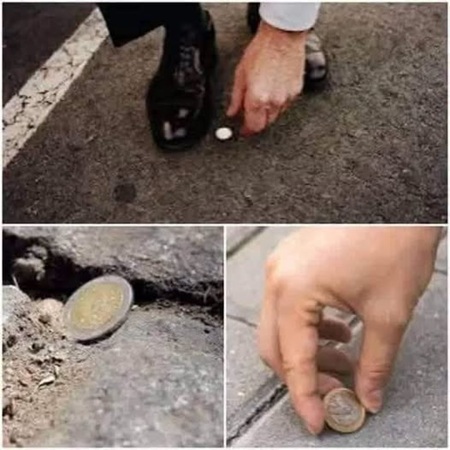
Walking through a busy street, it is common to overlook the smallest details of daily life. People are often absorbed in routines, thoughts, and responsibilities, moving quickly from one task to another. In such environments, small objects on the ground—such as coins—are frequently ignored or seen as insignificant. Yet, for many individuals, the simple act of finding a coin has been given meaning far beyond its material value. Across different cultures and time periods, people have attached symbolic interpretations to everyday occurrences.
A found coin is one of the most common examples of this phenomenon. While logically it is simply lost currency, many individuals have historically viewed it as a sign, reminder, or symbolic message tied to personal experience, emotion, or belief systems. Psychologists often explain this behavior through a concept known as pattern recognition. The human brain is naturally wired to search for meaning, even in random or unrelated events.
This tendency helped early humans survive by identifying patterns in nature, but in modern life it can also lead to symbolic interpretations of coincidence. When someone finds a coin at an unexpected moment, the brain may unconsciously link that event to recent thoughts, emotions, or life situations. For example, a person going through stress or uncertainty may interpret the discovery as comforting or meaningful, even if the event itself is purely accidental.
This does not make the experience less real on an emotional level. Instead, it highlights how humans naturally connect external events with internal states of mind. A small object like a coin can become a reflection of what someone is feeling at that moment in their life.
Cultural and Historical Symbolism of Coins
Throughout history, coins have carried symbolic meaning in various cultures. Because currency is associated with value, exchange, and survival, it often becomes a metaphor for fortune, opportunity, or transition. In folklore and traditions, found objects—especially coins—have sometimes been viewed as symbols of luck or change.
In some cultural beliefs, discovering money unexpectedly is interpreted as a positive sign or a reminder of abundance. In others, it may simply be seen as a coincidence without deeper meaning. These interpretations vary widely depending on cultural background, personal beliefs, and individual experiences.
Importantly, these meanings are symbolic rather than literal. They reflect how humans use objects in the physical world to represent abstract ideas such as hope, change, or emotional reassurance.
The Psychological Comfort of Small Positive Moments
In modern life, which is often fast-paced and stressful, people tend to seek small moments of relief or comfort. Something as simple as finding a coin on the ground can serve as a brief interruption to stress or routine thinking. This interruption can feel meaningful because it breaks the predictability of the day.
Even if the event is random, the emotional response it triggers is real. A small positive moment can shift attention, even briefly, away from anxiety or pressure. In this sense, the meaning of the experience comes not from the object itself, but from the emotional interpretation assigned to it.
This is similar to other small daily experiences that people find comforting, such as seeing a familiar number, hearing a meaningful song, or noticing something that reminds them of a memory. The importance lies in perception rather than external reality.
Coins as Symbols of Reflection and Awareness
Some people use symbolic interpretations of found coins as a reminder to pause and reflect. In this view, the act of noticing something small on the ground can encourage mindfulness. It can serve as a moment to slow down, observe surroundings, and become more aware of the present environment.
Mindfulness practices often emphasize attention to small details in everyday life. A found object, such as a coin, can unintentionally create that moment of awareness. Whether or not someone assigns deeper meaning to it, the act of noticing can still be beneficial in breaking automatic patterns of thinking.
This perspective shifts the focus away from supernatural explanations and toward psychological and emotional awareness. It frames the experience as an opportunity for reflection rather than a message from external forces.
The Role of Belief in Personal Interpretation
Belief plays a powerful role in how people interpret everyday experiences. Two individuals can witness the same event and assign completely different meanings to it. One may see a coin as insignificant, while another may see it as a symbol of encouragement or change.
This difference is shaped by personality, cultural background, and emotional state. People going through difficult periods may be more likely to attach meaning to small positive events, while others may interpret them purely as coincidence.
Neither interpretation is objectively “correct” in emotional terms, because meaning is often subjective. What matters most is how the interpretation affects the individual’s mindset and emotional well-being.
The Importance of Grounded Perspective
While symbolic thinking can be meaningful on a personal level, it is also important to maintain a grounded understanding of reality. Coins on the ground are physical objects that are lost, dropped, or forgotten. Their presence is explained by everyday human activity rather than intentional signals or external forces.
Balancing symbolic interpretation with practical understanding helps maintain a healthy perspective. It allows individuals to appreciate moments of meaning without attributing supernatural causes to ordinary events.
This balance is especially important in a world where information and interpretation can easily blend together. Understanding the difference between emotional symbolism and factual explanation helps support clearer thinking.
Finding Meaning Without Misinterpretation
People often look for meaning in small events because it helps them feel connected to their environment. This is a natural part of human psychology. However, meaning does not require supernatural explanations to be valuable.
A found coin can simply represent a moment of pause, a reminder to slow down, or a small interruption in a busy day. It can be appreciated as a coincidence that carries personal significance without needing to be viewed as a message from external forces.
This approach allows individuals to maintain both emotional richness and intellectual clarity. It supports a way of thinking that values experience while staying connected to reality.
The experience of finding a coin in everyday life may seem minor, but it often becomes meaningful through personal interpretation. Whether viewed as a symbol of luck, a reminder to pause, or simply a coincidence, the significance comes from human perception rather than the object itself.
Psychology, culture, and personal belief all influence how such moments are understood. While interpretations may vary widely, the underlying reality remains grounded in ordinary events and human behavior.
Ultimately, small moments like these highlight the human tendency to seek meaning in the world around us. Whether one views them as symbolic or simply random, they offer an opportunity to reflect, pause, and reconnect with the present moment in a busy and fast-moving world.

