
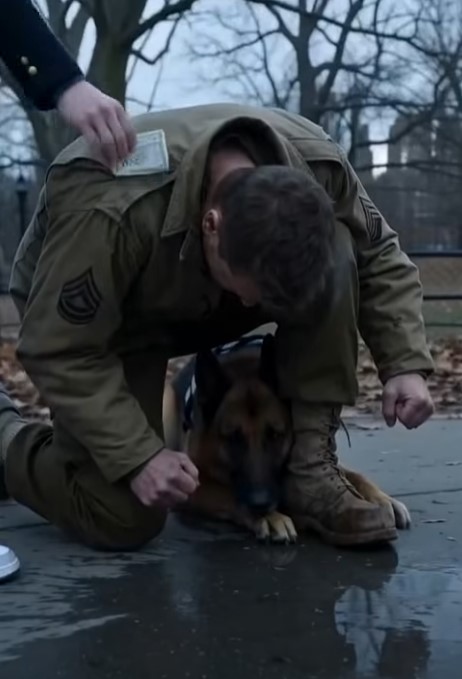
A quiet Sunday morning in a city park reportedly became the unexpected beginning of an incident that would later connect to a federal courtroom case involving serious criminal proceedings. The park was calm and lightly populated, with early visitors walking along paths, sitting on benches, or enjoying the peaceful surroundings. Among them was Arthur Caldwell, a federal judge and decorated military veteran, who was spending a rare moment of rest near a small lake with his service dog, Buster.
To most people passing by, Caldwell appeared to be an ordinary man enjoying a peaceful break outdoors. His casual appearance gave no indication of his professional role or the responsibilities he carried within the federal justice system. However, his calm morning routine was supported by the presence of Buster, a trained German Shepherd who played an essential role in his daily life.
Buster was not only a companion but also a certified service animal trained to assist Caldwell with the lingering effects of military-related trauma. Over the years, the dog had become a stabilizing force, helping him manage stress and maintain emotional balance. Their relationship was built on trust and consistency, formed through shared experiences and daily dependence on one another.
The situation reportedly changed when a group of teenagers walked through the park and passed near the bench where Caldwell was seated. What began as casual movement through the area allegedly escalated when one of the teenagers began making disrespectful comments toward the seated man. The tone of the interaction shifted from joking remarks to more aggressive behavior.
According to the account, one of the teenagers suddenly kicked Buster while the dog was lying quietly beside the bench. The action caused immediate distress, and the dog quickly moved closer to Caldwell for protection. Despite the emotional reaction such an incident could provoke, Caldwell reportedly maintained restraint, relying on his discipline as both a veteran and a federal judge to avoid escalating the situation.
Before the group left the area, Caldwell reportedly noticed the face of the teenager involved in the incident. At that moment, he did not yet understand the broader significance of the encounter, but the brief recognition would later become relevant in an entirely different context.
Concerned for his dog’s well-being, Caldwell took Buster to a veterinary clinic shortly after the incident. Medical staff reportedly confirmed bruising consistent with physical impact but found no fractures or severe injuries. While the physical condition was not critical, the emotional stress on both the dog and its owner was more significant.
Buster had long been an important part of Caldwell’s life, serving as a support system following his military service. The dog’s presence had helped him manage long-term psychological challenges, making the attack in the park particularly distressing on a personal level. The incident affected not only the animal’s physical comfort but also the sense of security built over years of companionship.
Later that same day, Caldwell reportedly reviewed documents connected to an upcoming federal sentencing case involving businessman Marcus Vance. The case involved serious financial crimes, including fraud and other related charges, and had drawn considerable public attention due to its scale and complexity. The sentencing hearing was scheduled to take place the following morning in federal court.
While examining the case materials, Caldwell reportedly made a connection between the teenager from the park and an individual referenced in the legal documents. The name identified was Tyler Vance, the son of the defendant in the upcoming sentencing hearing. This realization created an unexpected link between a personal incident and an active judicial matter.
Background information contained in the case file reportedly included references to prior behavioral concerns involving Tyler Vance. These records suggested repeated incidents of misconduct over time, though many of them had not resulted in formal consequences. The pattern described raised questions about accountability and how such behavior had been addressed previously.
At the same time, the defense team preparing for the sentencing hearing presented a very different portrayal of Tyler. Legal arguments emphasized strong academic performance, positive personal qualities, and the importance of family support. Supporting materials, including photographs and written statements, were used to present an image of stability and responsibility.
On the following day, the federal courthouse was filled with attorneys, journalists, court officials, and members of the public. The sentencing hearing for Marcus Vance marked the conclusion of a lengthy legal process involving extensive financial investigations and multiple affected parties. The atmosphere in the courtroom reflected the seriousness of the case.
The prosecution presented detailed arguments describing the financial harm caused by the defendant’s actions. Testimonies from victims highlighted the real-world impact of the crimes, including financial loss and long-term hardship. The prosecution emphasized the need for accountability in light of the severity and scope of the offenses.
In response, the defense focused on mitigating factors such as community contributions, charitable involvement, and family circumstances. A key part of their argument centered on Tyler Vance, who was described as a responsible and promising young individual. The defense stressed the importance of the father’s presence in guiding his son’s future development.
As the hearing progressed, the judge addressed the character evidence presented by the defense. At this stage, Caldwell reportedly referenced the incident from the previous day in the park. He described the encounter involving the teenager and the service dog, explaining the behavior he personally witnessed during that interaction.
The courtroom reportedly reacted with surprise as the connection between the individual in court and the teenager from the park became clear. This development introduced a direct contrast between the defense’s positive portrayal of character and the behavior described by the judge based on personal observation.
Further discussion during the hearing reportedly included additional background information suggesting a history of behavioral issues. These details contributed to a broader reassessment of the character claims presented by the defense and added complexity to the court’s evaluation process.
After considering all arguments, evidence, and victim statements, the judge delivered the final sentencing decision. Marcus Vance was sentenced to twenty years in federal prison, reflecting the seriousness of the offenses and the harm caused to those affected. The ruling concluded a significant phase of the legal proceedings.
Following the sentencing, the court also addressed the separate matter involving the incident with Buster. Because the dog was a registered service animal, the case was referred for further review under applicable legal protections related to service animal safety and interference incidents.
After the hearing concluded, Caldwell returned home where Buster continued recovering from the earlier injury. Although still healing, the dog showed steady improvement and remained closely connected to its owner. The end of the case marked the conclusion of a difficult and emotionally charged period.
The events, as described, illustrate how a brief and seemingly minor encounter can become connected to larger legal proceedings in unexpected ways. The situation also highlights themes of accountability, behavior, and how actions in public settings can have wider consequences when viewed in a legal context.

