
John Wayne stands as one of the most influential and recognizable figures in the history of American cinema. Over the course of a career spanning more than five decades, he became a defining symbol of the classic Hollywood Western and a representation of strength, endurance, and traditional heroism on screen. Born Marion Robert Morrison, he built his reputation gradually through early supporting roles before rising to become a leading figure in the film industry.
By the late 1970s, Wayne was already considered a cultural icon whose legacy extended far beyond film. He had appeared in nearly 200 movies and had become one of the most enduring stars in Hollywood history. However, in his later years, he faced serious health challenges, including previous battles with cancer and heart-related medical issues. Despite these difficulties, he continued to make occasional public appearances when his condition allowed.
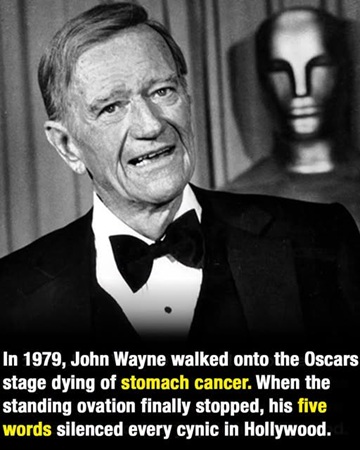
One of the most notable moments of his final years came during the Academy Awards ceremony held on April 9, 1979, at the Dorothy Chandler Pavilion in Los Angeles. At this stage of his life, Wayne’s health had significantly weakened, but he still accepted an invitation to attend the event. His appearance at the ceremony would become one of the most memorable moments in Oscar history.
Earlier that year, Wayne had undergone major surgery following a serious medical diagnosis. He had previously survived lung cancer in the 1960s, during which he underwent removal of a lung, and later experienced additional health complications, including heart surgery in the 1970s. These conditions left him physically weakened, but he remained determined to maintain public presence when possible.
His invitation to the Academy Awards came from longtime friend Bob Hope, who encouraged him to appear as a presenter. The invitation was seen within the industry as both a tribute to Wayne’s long career and a moment of respect for one of Hollywood’s most enduring figures.
When Wayne appeared on stage that evening, the reaction from the audience was immediate and emotional. The auditorium, filled with actors, filmmakers, and industry professionals, responded with a prolonged standing ovation. Many in attendance had grown up watching his films and recognized his importance to American cinema. The moment reflected both admiration for his career and awareness of his fragile health.
Although visibly weaker than in his earlier years, Wayne still carried the presence that had defined his screen persona for decades. His movement and demeanor reflected the same calm authority that audiences associated with his most famous roles. Even in a reduced physical condition, he remained a powerful symbolic figure in the room.
After the applause subsided, Wayne addressed the audience briefly. His remarks were simple and direct, consistent with his well-known communication style. He expressed appreciation for the reception and acknowledged the significance of the moment. One of the most remembered aspects of his appearance was his humility and the sincerity of his brief comments to the audience.
During the ceremony, Wayne participated in presenting the award for Best Picture, which was awarded to The Deer Hunter. Although his role that night was ceremonial, it held symbolic importance as it marked one of his final major appearances in the entertainment industry.
In the months following the Academy Awards, Wayne’s health continued to decline. He spent time receiving medical treatment and remained under care as his condition worsened. Despite this, he continued to be recognized publicly as one of the most important figures in Hollywood history, and his legacy remained strong even as his physical presence diminished.
His earlier work had already secured his place in cinematic history. Films such as Stagecoach and The Searchers played a major role in shaping the Western genre and establishing Wayne as its most iconic star. These films continue to be studied and referenced as important milestones in American film history.
In addition to his acting legacy, Wayne’s name later became associated with medical research and cancer awareness efforts. Following his passing, his family supported the creation of the John Wayne Cancer Institute, which continues to contribute to cancer research and treatment development today.
John Wayne passed away on June 11, 1979, at the age of 72. His death marked the end of an era in Hollywood, and it was widely acknowledged across the film industry as the loss of one of its most iconic figures. Tributes highlighted his long career, his influence on cinema, and his role in shaping the image of the American film hero.
In the years following his death, his final Academy Awards appearance has remained one of the most discussed moments of his later life. It is often remembered as a symbolic event representing both his career achievements and his resilience in the face of serious illness.
He was laid to rest at Pacific View Memorial Park in Newport Beach, California, overlooking the Pacific Ocean. For a period of time, his gravesite was kept private in order to protect the family’s privacy, and it later became a quiet place of remembrance for fans and historians of cinema.
Today, John Wayne’s legacy continues to hold a significant place in film history. His performances, particularly in Western films, helped define an entire genre and influenced generations of actors and filmmakers. His final public appearance at the 1979 Academy Awards remains a meaningful moment in Hollywood history, representing both the end of an era and the lasting impact of a legendary career.

