

The Lincoln Memorial Reflecting Pool in Washington D.C. has recently drawn public attention after reports of water quality changes following a renovation project. The iconic landmark, located between the Lincoln Memorial and other historic sites, is one of the most visited and recognizable memorial areas in the United States. After maintenance work was completed, the pool became the subject of discussion due to unexpected changes in the appearance of its water.
Soon after the renovation, the water in the reflecting pool reportedly turned green, which raised questions among visitors and online observers. According to environmental explanations commonly reported in similar situations, this type of discoloration is often linked to algal blooms. These occur when microscopic organisms in the water grow rapidly under certain conditions, including warm temperatures, sunlight exposure, and nutrient presence in the water.
In response to the issue, maintenance crews were seen working on-site to address the water condition. Reports indicated that treatment methods such as hydrogen peroxide applications were being used as part of efforts to reduce algae growth and restore the pool’s clarity. These types of treatments are sometimes applied in controlled environments as part of water management and restoration procedures for public water features.
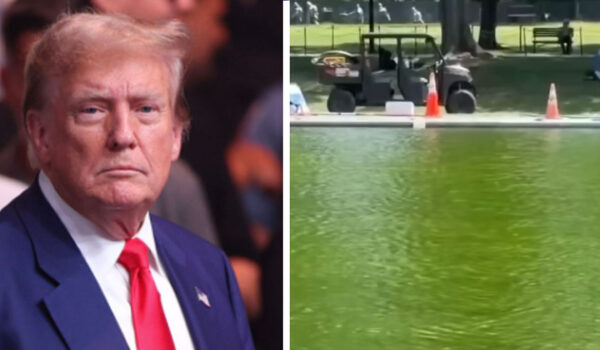
At the same time, public discussion increased after comments made by former U.S. President Donald Trump on his social media platform, Truth Social. In his remarks, he suggested that vandalism may have contributed to the problems affecting the reflecting pool after its renovation. His statements quickly circulated in media coverage and generated debate among political commentators and online users.
Trump’s comments included claims that individuals had intentionally attempted to damage or interfere with the newly completed work. He described the situation as deliberate disruption and suggested that external actions were responsible for the issues observed. These statements were widely shared and interpreted in different ways depending on political perspectives and media reporting.
He also stated that investigations were taking place and expressed confidence that any damage would be repaired in a short timeframe. According to his post, the condition of the pool was improving, and efforts were underway to restore it to its intended appearance. These remarks added further attention to an already widely discussed public issue.
However, environmental experts and specialists have generally explained the discoloration as a natural occurrence rather than intentional interference. Algal blooms are a known biological process in aquatic environments and can occur when conditions allow algae to multiply rapidly. This can temporarily change the color of the water, especially in shallow or still bodies of water exposed to sunlight.
Officials responsible for maintenance and preservation of the site have stated that ongoing restoration work is being carried out. Standard water treatment and maintenance techniques are commonly used in such public landmarks to ensure water quality and visual appearance are maintained. These efforts are part of regular management practices for large outdoor monuments and public spaces.
A White House spokesperson also commented on the situation, noting that maintenance operations were actively addressing the issue. The statement highlighted ongoing efforts to manage the reflecting pool while also referencing broader discussions about infrastructure maintenance across different administrations. This added a political layer to what is also a technical environmental matter.
Despite claims made in public statements, there has been no verified evidence confirming vandalism as the cause of the water discoloration. Environmental specialists continue to attribute the change primarily to natural algal growth, which is a common and well-understood phenomenon in similar conditions. The situation remains under observation as maintenance efforts continue.
The Lincoln Memorial Reflecting Pool remains an important national landmark and a major attraction for both residents and tourists visiting Washington D.C. Because of its symbolic location and historical significance, any changes to its condition often receive significant public and media attention. This makes it a frequent subject of discussion whenever maintenance or environmental issues arise.
In conclusion, the situation surrounding the reflecting pool reflects both environmental processes and public debate. While scientific explanations point toward natural algae growth as the primary cause of the water change, political commentary has introduced alternative interpretations. Ongoing maintenance efforts continue with the goal of restoring and preserving the landmark for public use and historical significance.

