
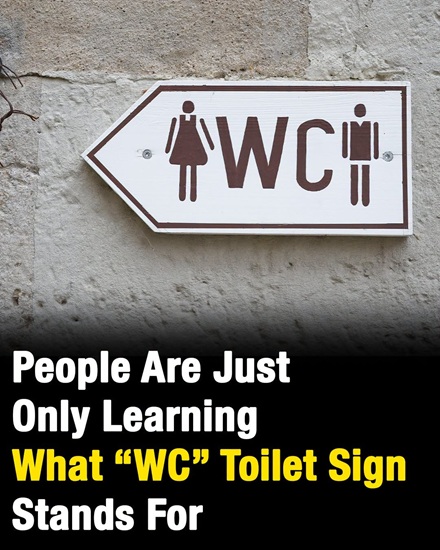
If you’ve ever noticed the letters “WC” on a sign outside a public restroom, you’re certainly not the only one who has paused to wonder what it means. Around the world, people encounter a wide range of words for the same essential facility, including bathroom, restroom, toilet, washroom, lavatory, and WC. The abbreviation “WC” is especially common in Europe and in international places such as airports, train stations, hotels, and tourist areas. Although it may seem unusual at first glance, the meaning is quite simple and comes from the early history of indoor plumbing and sanitation systems.
The term “WC” stands for “Water Closet,” a phrase that originated during the early development of modern plumbing. Originally, a water closet referred to a small enclosed space that contained a flush toilet. The word “water” refers to the flushing system that uses water to remove waste, while “closet” was used in older English to describe a small private room. Over time, as plumbing technology advanced and homes modernized, the term remained in use, particularly in technical descriptions and international signage.
In earlier centuries, especially before the late 1800s, indoor toilets were not common in most homes. Many people relied on outdoor toilets or shared facilities, while indoor rooms were often dedicated only to bathing. Toilets and bathing areas were usually separate. As urban infrastructure improved and sewage systems became more widespread in the 19th and early 20th centuries, indoor toilets gradually became standard in households. This development eventually led to the modern bathroom that combines both bathing and toilet functions in one space.
As public sanitation improved, different cultures began using different polite or practical terms to describe toilet facilities. In the United States, words like “bathroom” and “restroom” became widely used, even though they do not always match their literal meaning. In the United Kingdom and several other regions, people often use “toilet” or informal terms like “loo.” In Canada, “washroom” is commonly used. These variations show how language changes based on culture, tradition, and social preference.
The abbreviation “WC” became popular across Europe and other parts of the world because it is simple, neutral, and easily understood across languages. Unlike other terms that are tied to specific cultures or dialects, “WC” works well in international environments where travelers from many countries need clear signage. That is why it is frequently seen in airports, train stations, hotels, and public buildings, where clarity and universal understanding are important.
The evolution of bathroom-related language also reflects historical attitudes toward privacy and hygiene. In earlier times, discussing toilet use was often considered inappropriate or sensitive, which led to the creation of indirect or more polite expressions. Words like “restroom” were introduced as softer alternatives, while “bathroom” originally referred only to a place for bathing. Over time, these expressions expanded in meaning and became commonly used for toilet facilities as well.
In architectural terms, “water closet” is still sometimes used today to describe a separate small room that contains only a toilet, often located next to or inside a larger bathroom. This design is particularly common in parts of Europe, where separating the toilet from the bathing area is seen as more practical or hygienic in shared households. In some cases, these small WC rooms may also include a sink for handwashing, making them functional and self-contained.
Different languages and regions continue to use a variety of terms, which can sometimes be confusing for travelers. However, despite the differences in wording, all of these expressions refer to the same basic idea: a room that contains toilet facilities. Whether someone says bathroom, restroom, washroom, toilet, or WC, the purpose is universally understood. These variations simply reflect how language adapts to local customs and communication styles.
Today, “WC” remains one of the most widely recognized international symbols for public toilets. It is especially useful in multilingual settings because it avoids cultural misunderstandings and remains clear regardless of language background. Even though modern signage often includes icons or symbols instead of words, “WC” continues to be used in many countries as a simple and effective label.
In conclusion, the term “WC” may seem unfamiliar at first, but it has a straightforward origin rooted in early plumbing history. From meaning “water closet” in the early days of indoor sanitation to becoming a global sign for restroom facilities, it has remained a practical part of everyday language. No matter which term is used—bathroom, restroom, washroom, toilet, or WC—the purpose is always the same: a necessary and universal space found in every society.

