
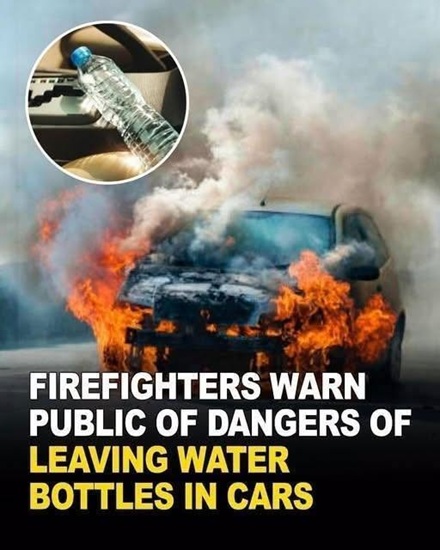
On a hot summer afternoon, many drivers leave their vehicles parked under direct sunlight while running errands or working. It is also very common to leave behind everyday items such as a half-empty plastic water bottle in the cup holder or seat pocket. At first glance, this seems completely harmless, something most people do without a second thought. However, over the years, a viral claim has circulated online suggesting that a simple water bottle inside a parked car can act like a magnifying glass and potentially start a fire.
This idea has been widely shared on social media, often supported by dramatic warnings and images. While there is a small scientific basis behind the claim, the real-world risk is far more limited than many posts suggest. When a vehicle is left in direct sunlight, its interior temperature rises quickly due to the greenhouse effect. Sunlight passes through the windows and becomes trapped inside, gradually heating surfaces such as the dashboard, seats, and steering wheel.
A clear plastic bottle filled with water can bend light due to refraction. In theory, the curved surface of the bottle and the water inside can concentrate sunlight into a small focal point, similar to how a lens works. Under very specific conditions, this focused light could slightly increase the temperature of a surface it lands on.
However, in real-world situations, this effect is inconsistent and weak. Cars are constantly exposed to shifting sunlight angles, vibrations, and changing shadows. Because of this instability, the concentrated beam rarely stays fixed long enough or becomes intense enough to ignite common interior materials.
Why the Water Bottle Fire Story Became Popular
The idea that a water bottle can start a car fire gained attention through viral posts and exaggerated online warnings. These stories often describe extreme scenarios such as melting dashboards or burning seats caused directly by sunlight passing through a bottle.
While these claims are based on a real physical principle, they often leave out important scientific limitations. Fire safety experts and vehicle investigators generally agree that car fires are overwhelmingly caused by electrical faults, fuel system issues, or mechanical failures—not passive sunlight refraction through objects left inside the vehicle.
The persistence of this myth is largely due to the way it blends truth with exaggeration. Because the lens effect of water is real, the story sounds believable, even if the actual risk is extremely low.
The Real Concern: Extreme Heat Inside Vehicles
Although the water bottle fire scenario is highly unlikely, there is still a genuine safety issue that should not be ignored: the extreme heat buildup inside parked cars during summer.
On hot days, the interior temperature of a car can rise rapidly and reach levels above 60°C (140°F). In some cases, it can become even hotter depending on weather conditions and how long the vehicle is exposed to the sun.
These high temperatures can affect both the car and the items left inside it. Plastic materials may soften or warp, adhesives can weaken, and electronic devices may overheat or degrade. Even non-electronic items like food or drinks can spoil quickly under such conditions.
Items That Are More Sensitive to Heat Than Water Bottles
While water bottles are generally harmless, other common items left inside cars can present more realistic risks when exposed to extreme heat.
Pressurized containers such as aerosol sprays or deodorants can become unstable in high temperatures due to internal pressure buildup. Similarly, lighters can expand and leak under prolonged heat exposure.
Devices powered by lithium-ion batteries, such as smartphones or power banks, are also sensitive to heat. Extended exposure to high temperatures can reduce battery lifespan, cause swelling, or in rare cases contribute to safety hazards if the battery is already damaged.
Compared to these items, a simple water bottle poses minimal risk in typical conditions.
Can Sunlight Still Cause Localized Damage?
Although ignition from a water bottle is highly unlikely, concentrated sunlight can still have minor effects under rare conditions. In certain cases, reflective or transparent objects inside a vehicle may cause small areas of intensified heat or light exposure.
This may lead to minor cosmetic effects such as faint marks, discoloration, or surface warming on sensitive materials like leather or plastic. However, such outcomes are not common and usually do not result in permanent or severe damage.
Most modern vehicle interiors are designed with materials that can withstand normal sunlight exposure, even during hot weather.
What Fire Investigations Actually Show
Professional fire investigations consistently show that vehicle fires are rarely caused by passive environmental factors like sunlight passing through objects. Instead, the most common causes include electrical system failures, short circuits, overheating engine components, or fuel leaks.
This means that while the water bottle theory is scientifically interesting, it is not considered a significant or documented real-world hazard in typical driving conditions.
Still, it serves as a reminder that heat inside vehicles can interact with objects in unexpected ways, especially when combined with neglect or unsafe storage habits.
Practical Ways to Reduce Summer Car Risks
Even if the water bottle scenario is largely a myth in terms of fire risk, there are still practical steps drivers can take to improve safety and preserve their vehicle’s condition during hot weather.
Parking in shaded areas or using covered parking can significantly reduce internal temperature buildup. A reflective windshield sunshade is also highly effective at limiting direct sunlight from heating the dashboard and interior surfaces.
Removing unnecessary items from the vehicle is another simple but effective habit. Keeping the cabin free of clutter reduces heat retention and prevents potential issues with heat-sensitive objects.
Myth vs. Real Risk
The story of a water bottle causing a car fire is a mix of scientific fact and online exaggeration. While it is true that water can bend and focus sunlight, the conditions required for ignition inside a vehicle are extremely unlikely in real-world situations.
However, the broader message behind this viral warning is still useful. Cars can become dangerously hot environments during summer, and leaving unnecessary or heat-sensitive items inside them is never a good idea.
In the end, the real lesson is not about fearing water bottles, but about understanding how heat affects our surroundings. By staying aware of what we leave inside our vehicles and taking simple precautions, we can avoid damage, improve safety, and keep our cars in better condition throughout the hottest months of the year.

