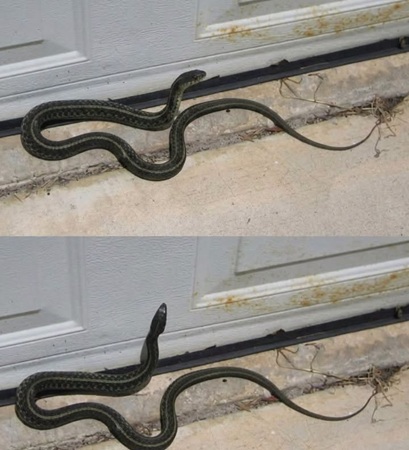
The sudden sight of a snake, whether in a dream or in a real physical space such as a home, often triggers a strong emotional reaction in people. This response is not only based on fear, but also on long-standing cultural symbolism and instinctive human psychology. For centuries, snakes have been viewed as powerful symbols connected to danger, transformation, and mystery, which is why their appearance often feels meaningful even when the situation has a simple natural explanation.
In real-world environments, snakes typically appear for practical reasons related to survival. They are not driven by symbolic intent, but by natural needs such as searching for food, water, warmth, or shelter. When they enter homes, it is usually due to environmental conditions that allow access, such as small gaps in walls, open doors, or structural cracks. These situations are natural wildlife behaviors rather than intentional actions.
Despite this biological explanation, snakes have played a significant role in human culture and storytelling for thousands of years. Many societies have associated them with both positive and negative meanings, ranging from danger and deception to healing and renewal. One of the reasons for this symbolism is the snake’s ability to shed its skin, which has often been interpreted as a metaphor for transformation and rebirth in various cultural traditions.
When it comes to dreams, a snake is often seen as a symbolic image created by the subconscious mind. From a psychological perspective, dreams are the brain’s way of processing thoughts, emotions, and experiences. A snake appearing in a dream does not predict real-world events, but it may reflect inner feelings such as stress, fear, change, or unresolved emotional situations. The meaning can vary greatly depending on the individual’s personal experiences and mindset.
Modern psychological understanding suggests that dream symbols are highly subjective. A snake in one person’s dream may represent anxiety, while in another person’s dream it may represent transformation or personal growth. These interpretations are not fixed truths but reflections of how the human mind organizes emotions and memories during sleep.
In contrast, encountering a snake in a physical environment, such as inside a house, requires a practical and safety-focused response. The most important step in such situations is to maintain distance and avoid direct interaction. Snakes can behave unpredictably when they feel threatened, so professional assistance is usually the safest option for removal and relocation.
The presence of a snake in a home is generally an indicator of environmental conditions rather than symbolic meaning. It may suggest that there are access points or surrounding factors that allow wildlife to enter living spaces. Addressing these conditions, such as sealing openings and maintaining outdoor areas, is an effective way to reduce the likelihood of future encounters.
Human reactions to snakes are also influenced by natural evolutionary instincts. Many researchers believe that humans developed a heightened awareness of snakes as a survival mechanism over time. This instinctive response explains why people often react quickly or emotionally when they see a snake, even if it poses no immediate danger.
At the same time, it is important to recognize that most snake species are not aggressive toward humans unless they feel directly threatened. In many ecosystems, snakes play an important role in maintaining balance by controlling populations of rodents and other small animals. Their presence in nature is part of a larger ecological system.
Across different cultures, snake symbolism varies widely. In some traditions, snakes are seen as symbols of wisdom, protection, or transformation, while in others they are associated with danger or caution. These meanings are cultural interpretations rather than scientific facts, shaped by history, mythology, and shared human experience.
From a psychological point of view, symbols like snakes in dreams are not external messages but reflections of the subconscious mind. They are shaped by personal memory, emotional state, and life circumstances. This means that there is no universal interpretation that applies to every individual.
Ultimately, whether a snake appears in a dream or in real life, the most important response is awareness and calm observation. In physical situations, safety and practical action should always come first, while in symbolic or dream-related contexts, reflection and self-awareness may provide personal insight.
In conclusion, snakes carry both biological and symbolic significance depending on context. They are real animals with natural behaviors, but they are also powerful symbols shaped by human culture and psychology. Understanding the difference between these two perspectives allows for a more balanced and rational response to their appearance.
