
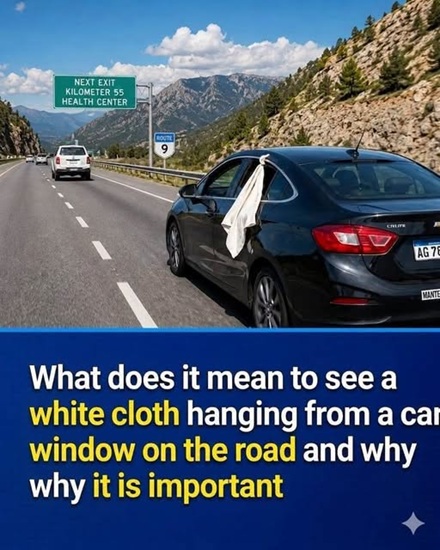
A white cloth hanging or waving from a car window is often noticed by other drivers as something unusual, and it can quickly raise questions about what is happening inside the vehicle. Although it is not an officially recognized universal traffic signal in most countries, it is sometimes interpreted as a possible sign that the occupants are experiencing trouble or that the vehicle is not functioning normally. Because of its visibility and simplicity, even a small piece of fabric can change how other drivers react on the road.
On highways and busy roads, drivers constantly rely on visual information to understand what surrounding vehicles are doing. When something unexpected appears, such as a white cloth hanging from a window, it naturally draws attention. The human brain is trained to notice irregularities in movement and environment, especially in fast-moving traffic situations. As a result, many drivers instinctively become more cautious when they see something out of the ordinary.
In different driving cultures and regions, informal signals sometimes develop over time, especially among drivers who spend long hours on the road. A white cloth may be associated by some people with a request for caution or a possible breakdown situation, but this interpretation is not standardized or legally defined. Because of this, its meaning can vary widely depending on local habits, personal experience, and awareness of informal road practices.
In some cases, people may assume that a vehicle displaying a white cloth is dealing with mechanical problems, such as engine failure, overheating, or other issues that prevent it from continuing safely. Others may interpret it simply as a way of making the vehicle more visible in a stressful or uncertain situation. However, these are general assumptions rather than official traffic rules, and they should not be treated as guaranteed meanings.
It is important to emphasize that a white cloth does not give any special legal status to a vehicle. It does not transform a private car into an emergency vehicle, and it does not grant any permission to ignore traffic lights, speed limits, or road regulations. All standard traffic laws remain fully in effect regardless of any objects displayed inside or outside a vehicle.
When drivers encounter an unusual situation like this, the safest response is always caution and awareness. Reducing speed slightly, keeping a safe distance, and carefully observing the vehicle’s behavior can help prevent misunderstandings or potential accidents. Quick or aggressive reactions are unnecessary and may increase risk, especially in high-speed traffic environments where space and time are limited.
If a vehicle appears to be stopped or if there are signs that someone inside may need assistance, the most responsible action is to contact emergency services. Providing clear information such as the exact location, direction of travel, and visible circumstances allows trained responders to handle the situation properly. This ensures that help is delivered safely without putting other drivers in danger.
Traffic safety experts often highlight that informal signals should never replace official road communication systems. While drivers may develop personal interpretations based on experience, it is always important to prioritize established traffic laws and safe driving practices. Misreading a situation on the road can easily lead to confusion or unsafe decisions, particularly in fast-moving traffic.
At the same time, unusual signs like a white cloth can serve as a reminder that every vehicle on the road represents real people with different situations. Some may be traveling under normal conditions, while others might be facing unexpected difficulties or stress. This awareness encourages patience and encourages drivers to behave more carefully and respectfully toward others.
Ultimately, the most important principle in such situations is safety and caution rather than assumption. Whether the white cloth indicates a breakdown, a precaution, or simply an unrelated object, other drivers are not required to interpret it in a fixed way. Instead, they should focus on maintaining control, following traffic rules, and responding calmly to what they observe.
In conclusion, a white cloth hanging from a car window is not an official global emergency signal, but it is still something that can attract attention and influence driver behavior. Its meaning is not fixed or legally defined, and it should not replace proper emergency procedures or traffic regulations. The safest approach on the road is always to remain alert, drive responsibly, and rely on official channels when assistance is truly needed.

