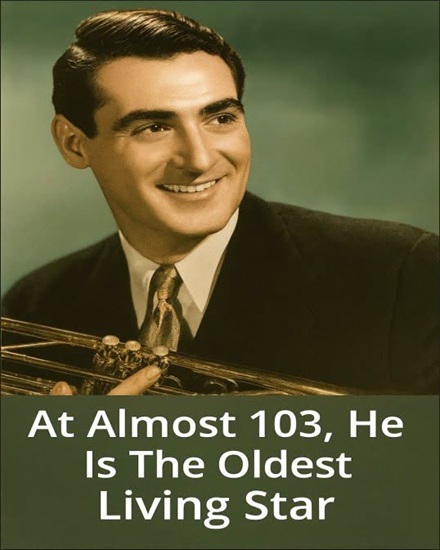
In the dazzling and often fast-changing world of Hollywood, where fame can appear and disappear within a single season, true longevity is something rare and deeply remarkable. Most performers are remembered for a brief peak in their careers, a moment when their talent aligned perfectly with public attention. Yet, there exists a small group of extraordinary individuals whose lives stretch across entire eras of entertainment history. They are living connections between the early days of radio and big band orchestras and the modern age of digital streaming and global media.
Among these rare figures stands Ray Anthony, a legendary American bandleader and trumpeter whose life spans more than a century, making him one of the last living links to the golden age of music and cinema. To fully appreciate the significance of such a life, it helps to reflect on the environment in which artists like him first emerged. The early and mid-20th century demanded discipline, endurance, and genuine musical mastery.
Success was not achieved through viral moments or instant exposure, but through relentless touring, live performances, and years of dedication to craft. Musicians traveled constantly, performing in ballrooms, theaters, and radio broadcasts that shaped public taste. Ray Anthony rose through this demanding world as a skilled trumpeter and eventually became a respected bandleader, carrying forward the traditions of the Big Band era with precision and style.
What makes his story especially meaningful is not only his professional success, but the historical span of his experience. Over the course of his long life, he has witnessed dramatic transformations in entertainment and society itself. He has seen music evolve from live orchestras to recorded vinyl, from television broadcasts to digital platforms accessible instantly around the world. Few individuals have experienced such a sweeping cultural transition firsthand. In that sense, his life becomes more than a biography—it becomes a living archive of modern entertainment history, shaped by decades of change and innovation.
Unlike many public figures who gradually step away from the spotlight with age, Ray Anthony has remained a symbol of continuity and passion. His presence represents a time when performance was not only about fame, but about discipline, elegance, and connection with an audience. The Big Band era emphasized collective harmony, where every instrument played a role in creating a unified sound. That philosophy still echoes in his legacy today. Even in advanced age, his association with music continues to inspire both listeners and younger artists who seek authenticity in their craft.
One of the most inspiring aspects of such long-lived artists is their ability to challenge modern assumptions about aging. In today’s world, people often associate aging with withdrawal or decline, especially in highly competitive fields like entertainment. However, figures like Ray Anthony quietly contradict that idea. Their lives demonstrate that creativity does not have to diminish with time. Instead, experience can deepen artistic expression, giving it greater emotional richness and perspective. Remaining mentally engaged, connected to passion, and active in purpose can contribute to a meaningful and fulfilling later life.
There is also a broader cultural importance to preserving the legacy of artists from earlier generations. In an era where much of today’s music is shaped by digital production tools and automated processes, the human touch of live performance carries special value. Big Band leaders like Ray Anthony represent a time when music was performed collectively, often in a single take, with all the imperfections and spontaneity that made it feel alive. That authenticity continues to influence modern musicians who study the structure, rhythm, and emotional depth of earlier compositions.
Beyond music itself, his life reflects the power of adaptability. Over many decades, he has witnessed shifts not only in entertainment, but also in society, communication, and global culture. From the rise of television to the internet age, each transformation required adjustment and resilience. Yet his identity as an artist remained consistent. This ability to evolve without losing core purpose is one of the defining characteristics of individuals who achieve lasting relevance across generations.
Public admiration for such longevity also reveals something deeper about human nature. People are naturally drawn to stories that defy time, especially in industries built on youth and constant reinvention. Seeing someone remain connected to their passion well beyond a typical career span offers a sense of continuity and reassurance. It suggests that purpose does not expire at a certain age and that contribution to culture can extend far beyond conventional expectations.
In the broader context of entertainment history, Ray Anthony stands as more than just a performer. He represents a living bridge between eras, carrying forward the traditions of orchestral music while witnessing the rise of entirely new genres and technologies. His life reminds us that artistic expression is not confined to a specific period but can evolve continuously alongside the world itself. Each generation builds upon the foundation laid by those before it, and figures like him make that connection visible.
Ultimately, his story is not only about music or fame, but about endurance, passion, and the human capacity to remain creatively alive over time. It highlights the idea that a meaningful life is not measured solely by achievements or recognition, but by sustained engagement with what brings purpose and joy. In that sense, Ray Anthony’s journey becomes a reflection of something universal: the desire to remain relevant, inspired, and connected, no matter how much time passes.
As audiences continue to discover and rediscover the roots of modern music, his legacy endures as a reminder that greatness is not defined by speed or momentary success. Instead, it is shaped by consistency, dedication, and love for the craft. Ray Anthony’s presence in the history of entertainment serves as a quiet but powerful testament to the idea that true artistry does not fade—it evolves, deepens, and continues to resonate across generations.
