
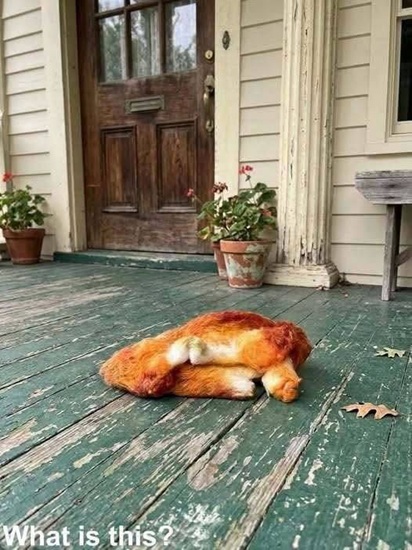
For several long moments, everything around me felt strangely slowed, as though time itself had paused while I stood motionless on my porch. My attention was completely fixed on an unfamiliar shape resting just outside the doorway on the wooden boards. At first sight, it resembled a small animal curled tightly into itself, its reddish-brown fur standing out against the pale, slightly worn surface beneath it. The form looked as if it had arrived quietly during the night and simply settled there, untouched by the early morning world beginning to stir around it.
However, despite that first impression, something about the scene felt unsettlingly wrong. The stillness was too absolute, too complete to match the idea of a living creature simply resting. The surrounding environment, usually filled with faint sounds of morning activity, seemed unusually quiet and heavy in that moment. My focus narrowed entirely to that single point in front of me, and I found it difficult to shift my gaze away. The rest of the world seemed distant, replaced by a growing sense of uncertainty and unanswered questions about what I was actually looking at.
As I carefully continued to observe, I tried to find any small sign that would confirm it was just a sleeping animal. I looked for subtle breathing movements, a slight twitch, or any indication of life responding to the environment. Each passing second only deepened the tension. The object remained completely still, showing no reaction or movement at all. The silence around it seemed to grow heavier, turning the familiar space of my home into something more uncertain and unfamiliar.
A quiet feeling of concern began to develop as I stood there, unsure whether to move closer or keep my distance. Encounters with wildlife are not unusual in areas where human spaces overlap with natural surroundings, but finding something that appears lifeless right at your doorstep creates a different kind of emotional reaction. It brings a mix of curiosity, hesitation, and instinctive caution. In that moment, even my own surroundings felt slightly changed, as though the ordinary had shifted into something unpredictable.
Eventually, I gathered the courage to step closer for a better look. What had initially seemed like a complete animal slowly began to reveal a different reality. The texture and structure of what I was seeing no longer matched the appearance of a living creature. Instead, it became clear that it was not an intact animal at all, but rather a piece of fox fur and skin that had been separated from the rest of the body. The realization immediately changed the emotional tone of the moment, replacing confusion with understanding.
It was likely that the remains had been left behind after a nighttime encounter with a predator. In many areas where wildlife and human environments overlap, animals such as coyotes often move silently through neighborhoods or open spaces during the night. These predators are highly adaptable and can pass through unnoticed while searching for food. In some cases, they leave behind traces of their activity, especially when a hunt or scavenging event takes place out of sight. The object on my porch appeared to be one of those leftover traces of natural activity.
The emotional response to this realization was mixed and difficult to separate into a single feeling. On one hand, there was relief in knowing that no injured animal was suffering in front of me. On the other hand, there was a quiet sadness in recognizing that a life had ended somewhere nearby, even if I had not witnessed it directly. It served as a reminder that nature continues its processes regardless of human awareness, following cycles of survival that are not influenced by human comfort or expectations.
Standing there, I became more aware of how modern life often creates a sense of separation from the natural world. Buildings, roads, and organized spaces can easily give the impression that nature exists only in distant forests or protected areas. Yet in reality, wildlife frequently moves through and around human environments without being noticed. Animals follow patterns shaped by instinct, not boundaries drawn by people, and their presence is often closer than we assume.
This experience highlighted how closely connected human living spaces remain to natural ecosystems. Even when unseen, processes such as hunting, survival, and movement continue continuously in the background. Encounters like this gently challenge the idea that human environments are separate from nature, reminding us that both exist side by side within the same shared world.
As the moment passed, the initial shock gradually faded, replaced by a more reflective understanding. What had first felt like a disturbing mystery turned into a reminder of coexistence between human life and the natural environment. The remains on the porch were not just an isolated incident, but a small indication of the larger ecological systems constantly in motion around us.
In the end, the experience became less about fear and more about awareness. It showed how easily the natural world can appear unexpectedly, even in the most ordinary spaces. And when it does, it quietly reminds us that life beyond human control continues all the time—sometimes unseen, sometimes revealed in fragments, but always present just beyond the edge of daily life.

