
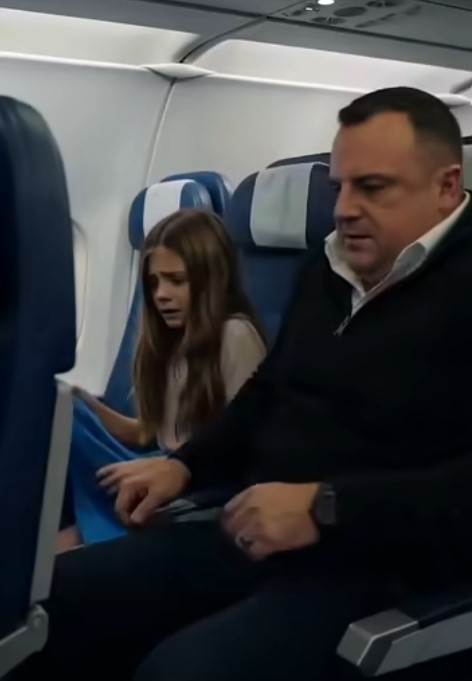
Commercial flights are usually uneventful experiences. Most passengers board the aircraft, find their seats, and spend the journey reading, watching movies, sleeping, or simply waiting to arrive at their destination. Yet from time to time, situations arise that capture the attention of those nearby and remind everyone how important awareness and compassion can be. One such account describes an overnight flight where a teenager’s visible distress prompted concern among fellow travelers.
According to reports shared about the incident, an adult man identified as Raymond boarded the aircraft alongside a fourteen-year-old girl named Maya. To casual observers, they appeared to be traveling together as family members. They moved through the airport quietly and settled into their assigned seats without attracting any immediate attention. Most passengers were focused on their own travel plans and saw nothing unusual about the pair.
Among the travelers was Julian Ross, a commercial architect returning home after a business trip. Julian, who was profoundly deaf, had spent much of his life relying heavily on visual observation. Because he could not depend on sound in the same way as others, he often paid close attention to facial expressions, body language, and subtle changes in behavior. Shortly after boarding, he reportedly began noticing details that caused concern.
According to the account, Maya appeared unusually withdrawn. She avoided eye contact, rarely spoke, and seemed uncomfortable throughout the boarding process. Julian also observed that she appeared nervous whenever Raymond moved or addressed her directly. While many factors can influence a person’s behavior during travel, including stress, fatigue, grief, or anxiety, the combination of signals left Julian with an uneasy feeling.
During the early part of the flight, a flight attendant reportedly stopped by to check on the pair. Raymond explained that Maya had recently experienced emotional difficulties and was having a challenging time. Such explanations are not uncommon during travel, and the attendant reportedly accepted the explanation before continuing her duties elsewhere in the cabin.
However, Julian continued observing the situation. According to the story, Maya’s body language suggested more than ordinary travel fatigue. Her posture remained tense, and she appeared constantly alert despite looking exhausted. Observers often note that body language alone cannot reveal the full reality of a situation, but it can sometimes encourage people to remain attentive when something feels unusual.
As the flight progressed, another passenger reportedly became aware of Maya’s condition. Sarah Jenkins, an intensive care nurse traveling home after a trip, noticed signs that she believed indicated significant emotional stress. Through observation, she reportedly concluded that the teenager appeared deeply anxious and uncomfortable. According to the account, Sarah and Julian eventually shared their concerns and agreed to continue paying attention to the situation.
The story claims that events became more troubling later in the journey. According to reports, Raymond removed a prescription medication bottle and encouraged Maya to take several pills. Observers stated that the teenager appeared reluctant and hesitant before eventually complying. While prescription medications are commonly carried by travelers for legitimate medical reasons, Maya’s reaction reportedly increased concern among those watching.
Following the medication, Maya allegedly appeared increasingly tired and struggled to stay alert. Sarah, drawing upon her medical background, reportedly became worried about the teenager’s condition. However, neither she nor Julian wanted to jump to conclusions without sufficient reason. Instead, they continued observing carefully while considering the best way to respond responsibly.
According to the account, Julian eventually found an opportunity to communicate with Maya through a discreet handwritten note. The message reportedly reassured her that someone had noticed her distress and encouraged her to signal if she needed assistance. Such gestures can sometimes provide comfort to individuals who feel isolated or unable to speak openly about their circumstances.
The report states that Maya later acknowledged the note and appeared relieved that someone was paying attention. For Julian, that reaction reinforced his belief that something was wrong. The situation remained tense as the flight continued toward its destination, with several passengers quietly monitoring developments.
At some point during the journey, concerns reportedly escalated further. According to the narrative, Maya’s behavior suggested she wanted help but was struggling to communicate openly. This eventually drew greater attention from nearby passengers and airline personnel. What had started as a quiet concern among a few travelers gradually became a matter that warranted closer examination.
The account claims that airline staff responded by carefully assessing the situation while maintaining order inside the cabin. Flight crews receive training designed to help them respond appropriately when passenger welfare becomes a concern. Their responsibility includes balancing caution with fairness while gathering information about what may be occurring.
As the aircraft approached its destination, the story states that authorities on the ground were notified. Upon landing, law enforcement officers and medical personnel reportedly met the aircraft to evaluate the situation further. At that stage, responsibility shifted to investigators and professionals tasked with determining the facts and ensuring everyone’s safety.
One reason stories like this attract attention is that they highlight the importance of awareness. Many people move through busy environments focused primarily on their own responsibilities and destinations. Yet occasionally, paying attention to those around us can make a meaningful difference. Remaining observant does not mean assuming the worst; it means recognizing when a situation may deserve additional attention.
The account also emphasizes the value of compassion. Both Julian and Sarah reportedly chose not to ignore what they believed were warning signs. Instead, they approached the situation thoughtfully and sought appropriate ways to respond. Their actions reflected concern for another person’s well-being rather than a desire to create conflict or draw attention to themselves.
Experts often encourage people to report genuine safety concerns through proper channels rather than attempting to manage situations entirely on their own. Airline personnel, security professionals, medical teams, and law enforcement officers are trained to evaluate circumstances carefully and take appropriate action when necessary. Their involvement helps ensure that concerns are addressed responsibly and professionally.
While every situation is unique and facts must ultimately be established through proper investigation, stories such as this serve as reminders of the role ordinary individuals can play in promoting safety. Awareness, empathy, and responsible action can sometimes help identify circumstances that might otherwise go unnoticed.
In the end, many readers are drawn to accounts like this because they illustrate a simple but powerful lesson. Small acts of attention can have a significant impact. Whether traveling by air, train, bus, or simply moving through daily life, noticing when someone appears distressed and responding appropriately can make a meaningful difference. Sometimes the most important action a person can take is refusing to look away when another human being may need help.

