
Human perception is one of the most intriguing areas of psychology and neuroscience. When different people look at the same image, they often do not focus on the same element first. Some may immediately notice a shape, others may see human figures, while some interpret abstract forms in a completely different way. This variation is not random; it is influenced by how the brain processes visual information, past experiences, attention levels, and emotional states.
Scientists who study cognitive psychology have explored how humans interpret visual input for decades. The brain does not function like a camera that simply records reality. Instead, it actively filters, organizes, and interprets what the eyes see. Because of this, what someone notices first in an image may reflect how their attention is directed, although it should not be considered a definitive measure of personality.
Online, these types of visuals are often referred to as “optical illusion personality tests.” They are popular because they are engaging and encourage curiosity about human perception. However, psychologists clarify that these interpretations are not scientifically validated personality assessments. They are better understood as entertaining demonstrations of how differently people can experience the same visual information.
How the Brain Processes What We See
The human brain receives an enormous amount of visual data every second, far more than it can consciously process. To handle this complexity, it relies on perceptual shortcuts that help quickly identify familiar shapes, objects, and patterns.
This is why different individuals may focus on different parts of the same image first. Some people are drawn to larger structures or overall composition, while others notice smaller details immediately. These differences are related to attention and cognitive processing rather than fixed personality categories.
Perception is strongly influenced by experience, memory, and even cultural background. The brain prioritizes what seems most meaningful or recognizable based on previous learning. As a result, two people can look at the same picture and genuinely interpret it in different ways.
Why People See Different Elements First
When viewing ambiguous images, people often report different first impressions. Some focus on general shapes, while others immediately recognize specific objects or figures. This difference is linked to how attention is distributed rather than any deep psychological classification.
For example, individuals who naturally focus on details may first notice specific elements such as lines or textures. Others who process information more holistically may first perceive the overall structure or scene.
It is important to understand that these reactions do not define personality traits in a strict scientific sense. Instead, they reflect momentary attention patterns that can change depending on mood, focus, or context.
The Popular “Tree or People” Visual Example
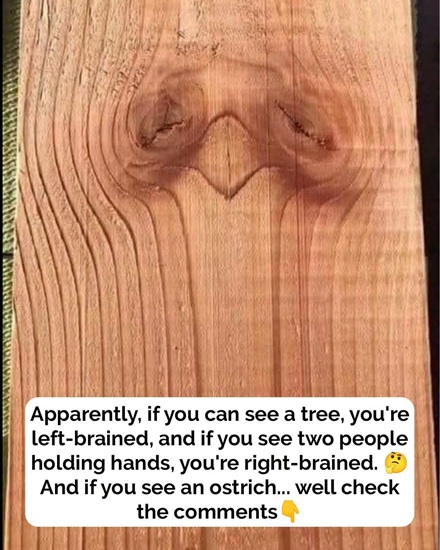
One of the most widely shared optical illusion examples shows an image where viewers may first see either a tree or two people holding hands. Online explanations often suggest that this choice reveals personality traits such as being analytical or emotional.
However, from a scientific perspective, this interpretation is overly simplified. There is no reliable evidence that identifying one element over another can determine personality characteristics.
If someone notices a tree first, it may simply be because the structure, contrast, or shape stands out more clearly to their visual system. If another person notices human figures first, it may be due to the brain’s natural tendency to recognize human-like forms quickly, a phenomenon known as pareidolia.
Pareidolia refers to the psychological tendency to perceive familiar patterns, especially faces or human shapes, in unclear or random visual stimuli. This is why people often see images in clouds, shadows, or abstract designs.
The Brain’s Natural Pattern Recognition Ability
The human brain is designed to detect patterns quickly and efficiently. This ability developed as an evolutionary advantage, helping early humans recognize threats, identify resources, and distinguish other humans in their environment.
Because of this, the brain continues to search for meaningful patterns even in abstract or ambiguous images. Optical illusions work by activating this natural tendency, causing different viewers to interpret the same image in different ways.
Modern neuroscience describes perception as a combination of sensory input and predictive processing. The brain constantly makes predictions about what it expects to see and adjusts based on incoming visual information. This system is highly efficient, but not always perfectly accurate.
Entertainment Value vs Scientific Accuracy
Although optical illusion personality tests are entertaining and widely shared, they should not be used as scientific tools for evaluating personality. Professional psychology relies on structured methods, long-term behavioral observation, and validated assessments rather than single-image interpretations.
However, these visuals still have educational value. They highlight how subjective human perception can be and demonstrate that people do not always experience the world in the same way. This can lead to interesting discussions about attention, cognition, and visual interpretation.
Perception Reflects the Mind, Not Personality Labels. What a person notices first in an image is influenced by attention, experience, and visual processing rather than fixed personality traits. While online interpretations often suggest deeper meanings, the reality is that perception is a complex and dynamic process.
Instead of revealing hidden personality secrets, these images mainly show how uniquely each brain processes visual information. This diversity in perception is a natural and fascinating aspect of human cognition.
So when viewing optical illusions, it is best to enjoy them as a demonstration of how perception works, rather than as a strict definition of personality.

