
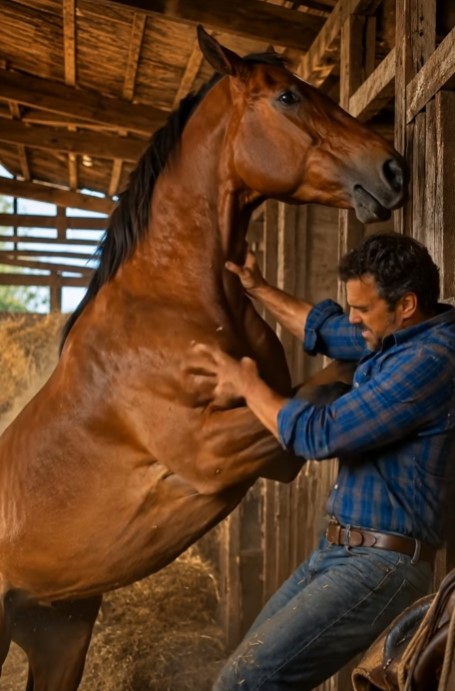
Life on a ranch is often built around routine. The animals become part of the family, daily responsibilities follow a familiar pattern, and each morning begins much like the one before. For Thomas, one of the most important parts of that routine involved caring for Thunder, a powerful stallion that had shared his life for many years. Their connection had been formed through patience, trust, and countless experiences together. Thunder was not simply a horse living on the property;
he was a loyal companion who had been by Thomas’s side through many chapters of life. Every morning, Thomas followed the same schedule. As sunlight spread across the fields and the ranch slowly came to life, he would prepare feed and walk toward the barn. Thunder usually recognized his approach before he even reached the stall. The horse often greeted him with a familiar neigh and would eagerly move forward to accept food and attention.
Their relationship was based on years of mutual trust, which made the events of one particular morning seem almost impossible to believe. When Thomas approached the barn that day, everything appeared ordinary at first. The weather was pleasant, the ranch was quiet, and there was nothing to suggest that anything unusual was about to happen. Carrying a bucket of feed, he opened the barn door expecting the same warm welcome he had received countless times before. Instead, he was immediately struck by Thunder’s unusual behavior.
The stallion appeared restless and uncomfortable. Rather than standing calmly near the front of the stall, he paced back and forth with visible tension. His ears were pinned back, his breathing seemed heavier than normal, and his eyes remained fixed on a specific area of the barn. Thomas paused for a moment, sensing that something was wrong.
Concerned, he spoke softly in an attempt to calm the horse. Thunder had always responded positively to his voice, and Thomas expected the familiar reassurance to ease whatever anxiety the animal was experiencing. However, the stallion’s agitation only intensified. He pawed repeatedly at the ground and released loud, anxious calls that echoed throughout the barn.
At first, Thomas assumed there might be an external cause. Horses are sensitive animals and can react strongly to unfamiliar sounds, wildlife, sudden weather changes, or disturbances in their surroundings. Hoping to identify the source of the problem, he slowly stepped closer. What happened next left him stunned.
Without warning, Thunder reared onto his hind legs and struck the nearby wall with tremendous force. The sound of hooves hitting wood filled the barn and caused Thomas to step back immediately. The stallion continued moving anxiously, positioning himself between Thomas and one section of the floor as though he were trying to block access to a particular area.
To anyone observing the situation, the horse appeared aggressive and unpredictable. Thomas had never seen behavior like this before. The calm and dependable animal he had known for years suddenly seemed like a completely different horse. Every attempt to move toward the far side of the barn was met with another display of nervous resistance.
Feeling increasingly uneasy, Thomas eventually left the barn and closed the door behind him. It was the first time he had ever felt uncertain about approaching Thunder. The experience left him confused and concerned, especially because he could not identify a reason for the sudden change.
Later that day, ranch workers gathered to discuss what had happened. Everyone knew Thunder’s reputation as a well-behaved and reliable horse. The reports of aggressive behavior seemed difficult to believe. Some suggested that the stallion might be suffering from an illness, while others wondered if an injury was causing him pain and distress.
To eliminate possible medical concerns, a veterinarian was asked to examine the horse. After a thorough evaluation, no significant health problems were found. Thunder appeared physically healthy. Yet despite the reassuring medical assessment, his unusual behavior continued. Whenever someone approached the same section of the barn, the horse reacted with visible anxiety.
Over the next two days, the situation remained unchanged. Thunder refused to settle down and continued blocking access to the area that had captured his attention. As time passed, Thomas began considering difficult possibilities. If the horse truly posed a threat to people working on the ranch, serious decisions might need to be made.
The thought weighed heavily on him. Thunder had been part of his life for years, and the idea of losing him was heartbreaking. Nevertheless, safety had to remain a priority. Thomas struggled with the possibility that the horse he loved might no longer be safe to keep around others.
Before making any final decision, Thomas chose to spend one more quiet morning at the barn. He arrived before sunrise while the rest of the ranch remained asleep. The air was still, and the property was silent except for the distant sounds of animals beginning a new day.
As he approached the barn, Thunder once again began calling anxiously. Yet amid the familiar sounds, Thomas noticed something he had overlooked before. Beneath the horse’s nervous behavior was another noise, one so faint that it was easy to miss.
He stopped and listened carefully.
The sound seemed to be coming from somewhere below the floor.
Curious and concerned, Thomas moved closer and began examining the area Thunder had been guarding so intensely. Near one corner of the barn, he noticed slight gaps between several aging floorboards. The wood appeared older and weaker than the surrounding structure.
Determined to investigate further, he retrieved tools and carefully began removing the boards. As the planks came loose, a hidden space beneath the barn gradually became visible. What he discovered left him speechless.
Below the floor was an old, forgotten well that had been concealed for years. Looking into the darkness, Thomas saw a small child sitting several feet below ground level. The boy appeared frightened, exhausted, and desperately in need of help.
The child had been missing for two days.
Search efforts had taken place throughout the surrounding area. Volunteers had searched fields, roads, nearby woods, and neighboring properties. Nobody had considered that the missing child might be trapped beneath the barn itself.
At that moment, Thunder’s behavior finally made sense.
The horse had never been trying to attack anyone.
Instead, he had been desperately attempting to draw attention to the trapped child.
Every anxious neigh, every strike against the floor, and every effort to block access had been a form of communication. Thunder had sensed the danger long before any person realized what had happened. His unusual actions were not signs of aggression but attempts to protect both the child below and the people walking above weakened flooring.
Emergency responders were contacted immediately. Working carefully, they rescued the child from the well and reunited him with his family. Relief spread quickly throughout the community as everyone learned the outcome of the search.
Perhaps the most remarkable part of the story came afterward.
Once the child was safely rescued, Thunder’s behavior changed completely. The nervous pacing stopped. The loud calls disappeared. The stallion returned to his familiar calm demeanor as if the source of his concern had finally been resolved.
Thomas entered the barn later that day and approached the horse quietly. For several moments, he simply stood there, reflecting on everything that had happened. He realized how close he had come to misunderstanding the animal that had been trying so hard to help.
What had appeared to be threatening behavior was actually an urgent warning.
What seemed like aggression was concern.
What looked like danger was protection.
Standing beside Thunder, Thomas felt an overwhelming sense of gratitude. The horse he had nearly doubted had played a crucial role in saving a child’s life. It was a powerful reminder that animals often perceive things humans fail to notice and that trust built over many years should not be abandoned too quickly.
Stories involving animals continue to inspire people because they highlight the unique connections that can develop between humans and the creatures they care for. While every situation is different, many animal owners have experienced moments when instinctive behavior revealed something important that otherwise might have been missed.
Thunder’s actions became a lasting lesson for everyone involved. They demonstrated the importance of patience, observation, and keeping an open mind when faced with behavior that seems unusual or difficult to understand.
Years later, people still spoke about the incident. Not because of the fear it initially created, but because of the remarkable outcome that followed. The story served as a reminder that first impressions can sometimes be misleading and that understanding often comes only after the full picture is revealed.
For Thomas, Thunder would always be remembered as more than a horse. He was a trusted companion whose instincts helped save a life and whose actions demonstrated extraordinary awareness. The stallion’s determination became a symbol of loyalty, intelligence, and the remarkable bond that can exist between humans and animals.
Sometimes the most important warnings do not come through words. Sometimes they come through actions that seem confusing at first but later reveal a much deeper purpose. Thunder’s story remains a powerful example of how trust, patience, and understanding can uncover the truth behind even the most unexpected behavior.

