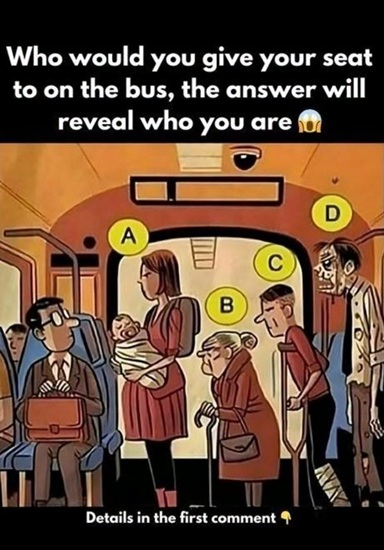
The Bus Seat Dilemma: What Everyday Choices May Reveal About Human Behavior. Have you ever stopped to think about how small, everyday decisions might reflect deeper aspects of your personality? Many psychologists and behavioral researchers suggest that human beings constantly reveal subtle patterns of thought through ordinary choices. The “Bus Seat Dilemma” is a simple reflective exercise designed to explore how people prioritize empathy, urgency, fairness, and social awareness in everyday situations.
Imagine stepping onto a crowded bus after a long and exhausting day. The atmosphere inside is tight, noisy, and filled with movement. People are standing close together, holding onto rails for balance, while others silently wait for space to open up. In this setting, there is only one available seat left in the entire bus.
At the same time, you notice four individuals who all appear to need the seat for different reasons. Each person represents a different type of human need, and your instinctive decision becomes a reflection of how you interpret social responsibility in that moment. The purpose of this scenario is not to judge right or wrong, but to explore instinctive human behavior.
The first individual is a mother holding her baby. She appears physically tired and emotionally focused on caring for her child. The situation represents both responsibility and vulnerability, as she is managing her own stability while also ensuring the safety of an infant in a crowded environment.
If your instinct is to offer the seat to the mother, it may suggest that you naturally respond to emotional and caregiving situations. People who resonate with this choice often demonstrate empathy and emotional sensitivity toward others. They tend to notice vulnerability quickly and prioritize comfort and support in social situations.
The second individual is an elderly woman standing near the aisle. Her presence reflects age, life experience, and a long personal history of navigating the world. In many societies, respecting and assisting elderly individuals is considered an important social value that reflects cultural and ethical awareness.
Choosing to offer the seat to the elderly woman may indicate a personality that values tradition, respect, and structured social norms. Individuals who identify with this choice often think carefully before acting and tend to consider long-established principles of courtesy and respect. They may also place importance on honoring experience and wisdom.
The third individual is a man using crutches. His condition suggests physical difficulty and immediate practical need for support. Unlike other situations, this scenario introduces urgency based on mobility limitations and physical strain, making the need for assistance more direct and visible.
If you choose to help the man on crutches, it may reflect a personality that is action-oriented and responsive to immediate needs. People who lean toward this choice often trust their instincts and prefer practical solutions over extended deliberation. They tend to be adaptable and willing to assist in situations where help is clearly required.
The fourth individual is a man who appears visibly ill. His condition suggests discomfort and possible weakness, even if the severity is not immediately measurable. This scenario introduces a different type of urgency, one that requires judgment about health, distress, and priority.
If your choice is to offer the seat to the sick man, it may suggest that you are attentive to signs of distress and sensitive to situations involving health or well-being. People who resonate with this choice often evaluate situations carefully and tend to prioritize what they perceive as the most critical need in a given moment.
What makes the Bus Seat Dilemma interesting is not the specific choice itself, but the way it highlights different value systems. Each option reflects a different approach to interpreting human needs, whether emotional, social, physical, or urgent. These responses are shaped by personal experiences, upbringing, cultural background, and emotional sensitivity.
In real life, people constantly make similar micro-decisions without even noticing. We decide who to help, how to respond in public situations, and what we prioritize when multiple needs compete for attention. These small decisions may seem insignificant, but together they form patterns that reflect personality tendencies.
Behavioral psychology suggests that human decision-making is often influenced by instinct rather than deliberate reasoning in everyday situations. When time is limited, individuals tend to rely on internal values and emotional responses rather than structured analysis. This is why thought experiments like the Bus Seat Dilemma can be useful for self-reflection.
It is important to understand that such scenarios are not scientific personality tests. Instead, they are reflective tools that encourage individuals to think about how they respond to social environments. Human behavior is complex and cannot be fully defined by a single choice or situation.
Context also plays a significant role in decision-making. The same person may respond differently depending on mood, stress levels, cultural environment, or personal experiences. This means that personality is not fixed in one moment but expressed differently across different situations.
The purpose of this exercise is to encourage awareness of how we interpret responsibility and empathy in everyday life. It allows individuals to consider whether their instincts align with their personal values and how they approach social interactions in general.
Small decisions often reflect broader principles about how people view fairness, responsibility, and care for others. While the Bus Seat Dilemma simplifies these choices into a single scenario, real-world situations are often more complex and require balancing multiple factors at once.
Ultimately, what this thought experiment reveals is that human behavior is guided by a combination of empathy, logic, experience, and instinct. Each person develops a unique balance of these traits over time, influenced by life experiences and personal growth.
In conclusion, the Bus Seat Dilemma is not about identifying a correct answer, but about understanding how different individuals prioritize values in everyday life. Whether one responds with empathy, respect, urgency, or practicality, each choice reflects a different aspect of human nature and decision-making.
By reflecting on such scenarios, individuals can gain a better understanding of themselves and the subtle ways they interact with the world around them. Even the simplest decisions can reveal meaningful insights about personality, priorities, and perspective.
