
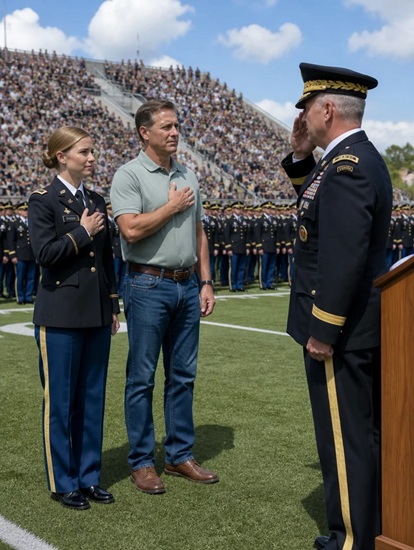
A Father’s Journey to His Daughter’s Commissioning Ceremony and the Weight of Memory I spent the better part of the night driving an old freight truck across long, quiet highways, carrying more than just distance between me and my destination. The road stretched endlessly ahead, lit only by scattered headlights and fading reflections on asphalt. My destination was Tennessee, where my daughter Emma Carter was about to be commissioned as a United States Army officer, marking a milestone that had been years in the making.
The journey was not an easy one, but it was meaningful in a way that only long-distance travel can be. Hours passed in silence, interrupted only by the hum of the engine and the rhythm of tires on the road. I thought about Emma often during the drive, remembering her determination, discipline, and the path she had chosen for herself. Every mile felt like a step closer to something important.
By the time I arrived, the morning light had already begun to soften the edges of the world around me. I stepped out of the truck still wearing my work clothes, aware that I stood out among the families dressed in formal attire. There was a brief moment where I felt disconnected from the setting, but that feeling faded as I reminded myself of the reason I had come.
The ceremony grounds were filled with quiet anticipation. Families gathered together, speaking softly, taking photographs, and sharing moments of pride and reflection. The atmosphere carried a sense of respect and significance, as if everyone understood they were witnessing a turning point in many lives at once.
When I finally saw Emma, everything else seemed to fade. She stood in her uniform with a calm and steady presence that reflected both training and personal strength. When her eyes met mine, she smiled in a way that made the long journey feel insignificant in comparison to the moment we were sharing.
She approached me with a quiet confidence, thanking me for coming despite the distance and the difficulty of the trip. There was pride in her voice, but also warmth and familiarity. In that brief exchange, years of effort, sacrifice, and support seemed to come together in a single, meaningful moment.
On my wrist, I wore an old leather band that had been with me for many years. It was worn and simple, showing signs of age and use. To most people, it would have appeared unremarkable, but to me it represented something far deeper. It was connected to memories of service, comradeship, and experiences that shaped my understanding of responsibility.
As the ceremony began, formal speeches filled the space with reflections on duty, leadership, and sacrifice. Lieutenant General Daniel Mercer addressed the audience, speaking about the responsibilities carried by those who serve and the unseen contributions made by their families. His words were steady and respectful, grounding the event in meaning beyond ceremony.
Throughout the proceedings, I noticed moments where the general’s attention seemed to move across the audience. It was not unusual in such settings, where leaders acknowledge families and guests, but at one point, his gaze briefly settled in our direction before returning to the podium.
After the ceremony concluded, we were approached by one of his aides, who asked if I would be willing to speak with the general. I assumed it would be a brief exchange, a formality connected to the occasion. I did not expect anything beyond polite conversation or acknowledgment.
When the ceremony ended, Emma and I met briefly among the crowd before being guided toward the general. He first congratulated Emma on her commissioning, speaking with professionalism and respect. Then his attention shifted toward me, and his focus settled on the leather band around my wrist.
He asked me where I had obtained it. The question was simple, but the tone behind it carried recognition rather than curiosity. For a moment, I considered giving a short answer, but instead I chose to be direct and honest.
I told him that the band had belonged to Sergeant Holloway.
At that moment, the general paused. The name clearly carried weight for him. There was a shift in the atmosphere, subtle but noticeable, as if something long stored in memory had been brought back into focus. What followed was no longer a formal exchange, but a shared recollection.
He explained that during earlier operations, there had been situations marked by confusion, separation, and incomplete records. Some details were never fully documented due to the chaotic nature of those circumstances. Like many events in active service, not everything had been captured in official reports.
As we continued speaking, fragments of memory began to align. Photographs, names, and past experiences were gradually connected through conversation. The purpose of the discussion was not to revisit conflict, but to clarify memory and ensure that those involved were remembered accurately.
Emma stood quietly beside us during this exchange. She listened without interruption, observing a side of military life that she had not previously seen in detail. For her, this was not just a professional moment, but a personal insight into her father’s past.
There were parts of my service I had rarely spoken about. Not because I wanted to hide them, but because some experiences are difficult to translate into everyday language. Certain memories are carried quietly, not out of avoidance, but out of respect for their complexity.
The general spoke about those who had served alongside us, including individuals whose names were no longer widely recognized. He emphasized that service is often remembered not through public recognition, but through the shared memory of those who were present.
In that moment, the conversation moved beyond rank and structure. It became about responsibility, memory, and the quiet bonds formed in difficult circumstances. There was a shared understanding that the past was not being judged, but acknowledged.
Before the conversation ended, the general presented an old unit photograph. It was slightly worn with time, but the faces remained visible. Some individuals had continued long careers, others had moved into different paths, and some were no longer present.
Looking at the photograph, I was reminded that service is rarely defined by recognition or visibility. Most experiences remain within the memory of those who lived them, passed on quietly rather than publicly displayed. The weight of those moments often stays with individuals long after the events themselves.
The general thanked me for the conversation, and I returned the sentiment with appreciation for the recognition of shared history. No further words were needed at that point. The understanding had already been established without the need for elaboration.
As Emma and I walked back toward the truck, she began asking questions she had never asked before. Her curiosity was thoughtful and sincere, focused not on achievements, but on experiences, relationships, and the human side of service.
She asked about friendships formed during service, about responsibility, and about the individuals in the photograph. These were questions that required reflection, not quick answers. For many years, I had carried those memories privately, not because they were hidden, but because they were personal.
That evening, something shifted. I began to share those memories more openly, not because the past had changed, but because the moment allowed for understanding to be passed forward. My daughter was beginning her own journey of service, and certain lessons naturally move from one generation to the next.
The ceremony itself had honored a new beginning, marking the start of Emma’s official role as an officer. But the conversation that followed reminded me that every beginning is built upon layers of history, experience, and shared responsibility.
As we left the grounds, I understood something more clearly than before. Service is not defined by a single event or achievement. It is shaped by memory, continuity, and the relationships formed in moments that often go unrecognized but are never forgotten.

