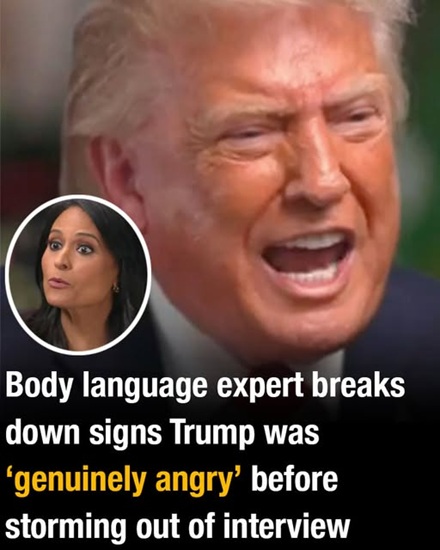
A recent interview between former U.S. President Donald Trump and NBC journalist Kristen Welker on Meet the Press has drawn significant attention across media platforms and social networks. The segment quickly became widely discussed after a tense exchange led to Trump ending the interview earlier than expected. Clips from the conversation circulated online, prompting widespread debate about both the tone of the discussion and the political issues raised during the broadcast.
According to reports of the interview, the conversation covered several sensitive political topics, including Trump’s continued claims regarding the 2020 U.S. presidential election. These claims have remained controversial and heavily debated in public discourse for several years. During the interview, Welker asked Trump to clarify and support his statements with evidence, a line of questioning that contributed to a noticeably more intense atmosphere between the two.
As the discussion progressed, Trump defended his position by stating that his conclusions were based on what he had observed and believed to be credible information. Welker responded by challenging the sufficiency of those claims, emphasizing the importance of verifiable evidence when discussing election integrity. The exchange reflected a broader ongoing disagreement in U.S. political discourse regarding election-related narratives.
The tone of the interview became increasingly firm as both sides maintained their positions. Trump expressed frustration with the direction of the questioning, while Welker continued to pursue clarification on the topics being discussed. At several points, the conversation appeared to become more confrontational, drawing attention from viewers who were watching the interview unfold.
Reports indicate that Trump made strong remarks criticizing media institutions during the exchange, while also expressing dissatisfaction with how the interview was being conducted. Welker attempted to continue guiding the discussion back to the original questions, but the interaction became progressively more heated as both participants maintained their stance.
Eventually, the interview came to an abrupt end when Trump decided to conclude the conversation and leave the set. The moment was widely shared online, with many viewers focusing on the sudden nature of his exit. The clip quickly gained traction across multiple platforms, becoming a trending topic and generating widespread commentary from political observers and the general public.
Following the broadcast, the interview became the subject of extensive online discussion. Social media users offered a range of interpretations, with some focusing on the content of the political debate and others analyzing the manner in which the exchange unfolded. As often happens with high-profile political interviews, public reaction was divided along different viewpoints and interpretations.
In addition to public reaction, media commentary and analysis also emerged shortly after the interview aired. Some reports referenced observations made by body language analysts, including Darren Stanton, who provided interpretations of visible physical cues during the conversation. These included comments on facial expressions, posture, and hand movements observed throughout the exchange.
According to such analyses, certain expressions such as narrowed eyes and changes in facial tension were interpreted as potential indicators of frustration or heightened emotion. Some commentary also suggested that gestures and body positioning reflected an attempt to assert control or emphasize points during the discussion. However, these interpretations are subjective in nature and should be understood as observational analysis rather than definitive conclusions.
Other commentary noted that Kristen Welker maintained a consistent line of questioning throughout the interview, continuing to address the same topics despite the growing tension. Some observers viewed this as standard journalistic persistence, while others saw it as contributing to the increasing intensity of the exchange. These differing perspectives highlight the subjective nature of media interpretation in high-profile political interviews.
Welker later addressed the interview in remarks referenced by media outlets, acknowledging that the conversation had included challenging moments. She noted that both sides recognized difficulties during the recording process and indicated that further discussion between the parties had been considered for a later date. These comments suggested that the interview was part of an ongoing media engagement rather than a one-time interaction.
The interview has since continued to generate discussion among political analysts, journalists, and viewers. Much of the debate centers on the role of the media in questioning political figures, particularly when addressing controversial or disputed topics. Some commentators emphasize the importance of accountability in interviews, while others focus on the challenges of maintaining balanced and productive dialogue in highly polarized environments.
Beyond the immediate exchange, the incident has also contributed to broader conversations about political communication in the digital age. Short video clips and selective excerpts shared online have played a significant role in shaping public perception of the interview. As a result, different audiences have formed varying interpretations based on the portions of the exchange they have seen.
Media experts often note that political interviews involving high-profile figures tend to generate strong reactions, particularly when they involve contentious subjects. The combination of live questioning, public scrutiny, and social media amplification often intensifies the impact of such moments. This interview between Trump and Welker is another example of how quickly political discussions can become widely debated public events.
In the aftermath of the broadcast, the interview remains a topic of discussion in political media circles. While interpretations of the exchange differ, it has clearly resonated with audiences and continues to be referenced in commentary about media relations and political discourse in the United States.
Ultimately, the interview highlights the complex dynamics that can emerge during political journalism, especially when sensitive topics are addressed in a high-pressure environment. The interaction between interviewer and subject, the expectations of accountability, and the reactions of the public all contribute to how such moments are understood and remembered.
As discussions continue, the interview serves as a reminder of how quickly political media events can evolve into broader debates about communication, trust, and interpretation. It remains one of many recent examples illustrating the intersection between politics, journalism, and public perception in today’s media landscape.
