
A busy morning at a major city transit terminal took an unexpected turn when a routine security patrol turned into a critical emergency response. The South Terminal was filled with commuters moving quickly through gates, cafés, and waiting areas, while Officer David Vance and his K9 partner, Rook, carried out standard surveillance duties across the crowded facility. At first, everything appeared completely normal. Travelers rushed with luggage, announcements echoed through the halls, and the usual rhythm of a busy transport hub continued without interruption.
There were no visible signs of disturbance, and nothing suggested that the morning would turn into anything out of the ordinary. That changed abruptly when Rook, a four-year-old Dutch Shepherd trained for tracking and detection work, suddenly halted mid-patrol. His posture shifted instantly from relaxed to fully alert. The dog locked his attention toward a seating area near Gate 4 and began pulling hard against his leash.
Officer Vance immediately recognized the significance of the reaction. This was not random behavior or distraction. Rook had clearly identified something specific in the environment. Even after being commanded to maintain position, the dog refused to comply, showing unusual urgency.
Within seconds, Rook broke forward into the crowd. Passengers reacted with confusion as the dog moved rapidly toward a bench where an elderly woman was sitting alone. The sudden movement caused panic among nearby travelers, who had no idea what the dog was reacting to.
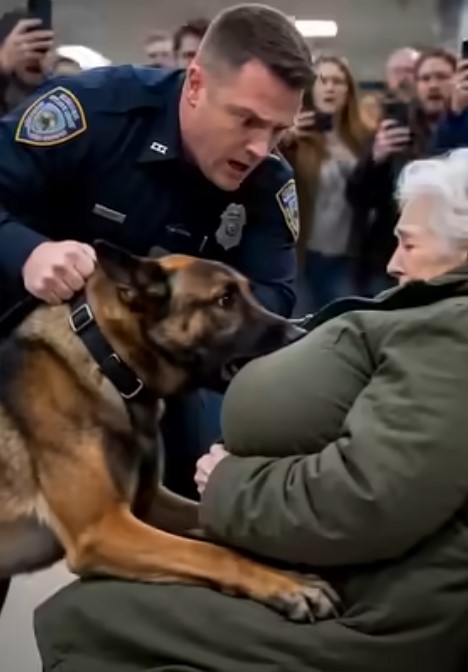
Rook reached the woman and positioned himself firmly beside her, using controlled body pressure to hold her in place. The woman reacted in fear, shouting as the surrounding crowd immediately assumed the dog had become aggressive. The situation escalated quickly as multiple people began filming and calling for the officer to intervene.
Despite the chaos, Officer Vance remained focused. He observed closely and noticed something important—Rook was not behaving aggressively. There was no biting, no frantic barking, and no uncontrolled movement. Instead, the dog maintained steady pressure while staring intently at the woman’s thick winter coat.
The coat itself stood out as unusual. The terminal was warm, yet the woman was wearing a heavy green parka zipped tightly to her neck. She held it closed with both arms, showing signs of tension and protectiveness that drew further attention from the officer.
As Vance watched more carefully, subtle movement became visible beneath the fabric. The coat shifted slightly in a way that suggested something was concealed inside. Rook responded immediately by pressing his nose near the zipper and letting out a low, persistent whine.
At that moment, the officer recalled a recent Amber Alert briefing involving a missing three-year-old girl named Maya. The child had disappeared from daycare, and investigators believed she had been taken during a custody dispute. Intelligence suggested she might be moved through crowded transit locations to avoid detection.
Authorities had warned officers to carefully monitor terminals and public transport areas. One key identifying detail in the alert was a bright pink cochlear implant worn by the child on her right ear.
The situation in the terminal continued to escalate as bystanders grew increasingly hostile. Many people assumed the officer had lost control of his K9 partner. Captain Miller arrived shortly after and ordered Vance to remove the dog immediately to prevent further escalation.
The pressure on the officer increased significantly. If he was wrong, the incident could result in disciplinary consequences. If he was right, a missing child could be in immediate danger. Despite the chaos around him, Rook remained completely focused on the woman’s coat.
Then, suddenly, a faint sound broke through the noise of the terminal. It was not movement or protest—it was the soft cry of a child coming from beneath the fabric.
The entire atmosphere changed instantly.
The woman’s expression shifted as tension filled the space. The crowd fell silent as everyone realized something serious was happening. Officer Vance carefully stepped forward, maintaining control while preparing for what he might find.
After a brief pause, the woman slowly unzipped her coat.
Inside was a small child secured in a padded carrier strapped tightly against her chest. The toddler appeared weak and disoriented under the harsh terminal lighting.
On the child’s right ear was a bright pink cochlear implant.
It was Maya.
Silence swept through the entire terminal. Moments earlier, the crowd had been shouting in anger, but now there was only shock and disbelief. Phones lowered, and no one spoke as the reality of the situation became clear.
Emergency responders were immediately called. Officers secured the woman while paramedics rushed in to examine the child. Rook calmly stepped back and remained beside Officer Vance, showing no aggression or distress as the situation shifted from confrontation to rescue.
Maya was carefully taken for medical evaluation as the crowd slowly parted to allow emergency crews through. The emotional tension that had filled the terminal only minutes earlier was replaced with relief and disbelief.
Captain Miller stood nearby without argument. It was clear that the outcome spoke for itself. Rook’s instincts had led directly to the discovery of the missing child in a critical moment.
Officer Vance stayed with his K9 partner as the scene settled. Rook remained calm and steady, as if the intensity of the situation had never affected him. His behavior reflected focused training and instinct rather than chaos or aggression.
What began as a tense public misunderstanding ended as a life-saving intervention. In a crowded terminal filled with confusion and pressure, the trust between a handler and his K9 partner proved essential in locating a missing child.
In the end, the incident became a powerful reminder that sometimes instinct and training can see what human judgment initially overlooks, and that decisive action in uncertain moments can change the outcome of a life forever.

