
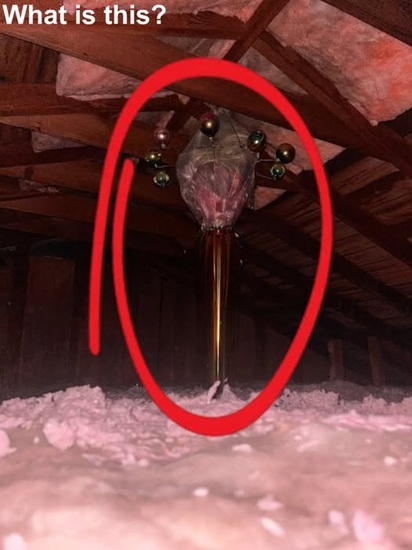
Attics have a unique psychological effect on people. They are often quiet, dimly lit spaces filled with forgotten belongings, old furniture, and long-unused storage boxes. Over time, they become places where memory and neglect mix together, creating an environment that feels slightly unfamiliar even to those who own the house. The combination of silence, dust, and limited light can easily transform ordinary objects into something that appears strange or even unsettling at first glance.
This is not because the objects themselves are unusual, but because the environment changes how the human mind interprets them. When people enter an attic, they often experience a heightened sense of awareness. Every sound seems louder, every shadow deeper, and every object more ambiguous. This reaction is natural and closely linked to how the human brain processes unfamiliar or low-visibility environments. In conditions where details are unclear, the brain attempts to fill in gaps using assumptions.
This can lead to misinterpretations, where everyday items appear distorted or unfamiliar simply because they are partially hidden or covered in dust. Many objects stored in attics remain untouched for years or even decades. Over time, environmental factors such as heat, cold, humidity, and dust accumulation gradually alter their physical appearance.
Wood can warp, fabrics can fade or tear, and metals may oxidize or rust. Plastic materials may become brittle or discolored. These natural processes of aging can dramatically change how an object looks compared to when it was originally placed in storage. As a result, even familiar household items can become difficult to recognize.
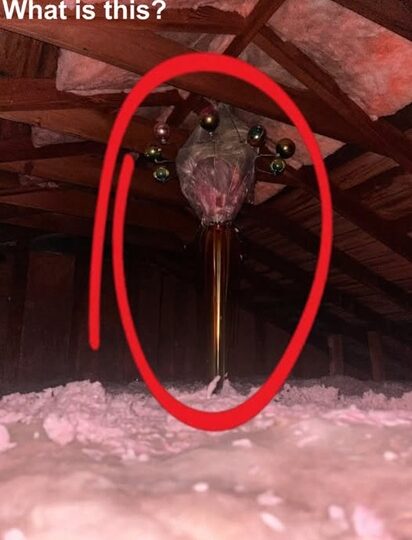
A simple household object, such as a piece of furniture or an old appliance, may appear completely different after years of storage. Dust layers can obscure shapes, while shadows created by poor lighting can exaggerate certain features. When combined with limited visibility, these factors can cause confusion and lead to misinterpretation. What might once have been clearly identifiable can now appear abstract or even unrecognizable without close inspection.
Another important factor is the psychological effect known as pareidolia. This is the human tendency to see familiar patterns, shapes, or even faces in unrelated or random stimuli. In attic environments, where lighting is uneven and objects are partially hidden, this effect becomes stronger. A bundle of wires may resemble something organic, or a covered object might appear to have human-like form. This is not unusual; it is a normal cognitive response to uncertainty and limited information.
Attics also carry emotional associations that influence perception. Because they are often used for storage of old belongings, they are closely linked to memory, nostalgia, and the past. This emotional context can amplify imagination, making people more sensitive to what they see. A forgotten toy, an old photograph, or a broken item can trigger memories that further influence how the object is interpreted in the moment. This blend of emotion and uncertainty can easily create a sense of mystery where none actually exists.
In most cases, careful observation resolves the confusion. When a person takes time to examine an object closely, using proper lighting and a steady approach, details that were not initially visible begin to emerge. Materials, shapes, textures, and structural features often provide clear clues about the object’s identity. What initially seemed strange or unexplainable is usually revealed to be something ordinary that has simply aged or been stored in unusual conditions.
Modern technology has also made attic discoveries much easier to understand. With access to online research tools, image searches, and historical databases, people can now identify unfamiliar objects more efficiently than in the past. Items that once caused confusion can often be matched with documented examples from previous decades or even centuries. Many attic discoveries turn out to be specialized tools, outdated household devices, or discontinued consumer products that are no longer widely recognized today.
For example, objects that appear strange or mechanical might actually be early versions of everyday tools or appliances. Items that look decorative or symbolic may have had practical uses in earlier time periods. Without historical context, these objects can seem mysterious, but with proper research, their purpose becomes clear. This process often transforms initial fear or confusion into curiosity and appreciation for historical design and craftsmanship.
The attic itself plays an important role in shaping perception. As one of the least frequently visited areas of a home, it naturally feels unfamiliar. The combination of isolation, silence, and darkness can heighten emotional responses. Humans are instinctively cautious in environments where visibility is limited, which can increase sensitivity to shapes and sounds. This evolutionary response is designed for safety, but in modern settings like attics, it often leads to unnecessary concern.
Despite their eerie reputation, attics are not inherently dangerous or mysterious. They are simply storage spaces affected by time and environment. Most of the “strange” discoveries found inside them are the result of natural aging processes and lack of context. When approached calmly and methodically, these spaces often reveal stories about the history of the home and the people who lived there before.
In many cases, attic items provide valuable insight into past lifestyles. Old furniture styles, discontinued household goods, handwritten documents, and personal belongings all contribute to a broader understanding of earlier generations. These objects serve as physical records of history, preserved unintentionally through storage rather than display. What may first appear confusing can ultimately become meaningful once its background is understood.
The process of exploring an attic can therefore be seen as a form of quiet historical discovery. Each object, no matter how ordinary or worn, represents a moment in time. Dust and decay may obscure its appearance, but they do not erase its significance. With patience and careful observation, even the most puzzling attic finds can be understood in context.
Ultimately, the key to navigating attic discoveries is a combination of curiosity and rational thinking. Fear often arises from uncertainty, but uncertainty decreases when information is gathered. By observing carefully, researching thoughtfully, and avoiding immediate assumptions, most mysterious attic objects can be explained logically. What initially seems strange usually has a simple and grounded explanation.
In the end, attics remind us that time changes everything—not just physically, but perceptually. Objects do not lose meaning; they simply wait to be understood again. When we take the time to look closely rather than assume the worst, we transform confusion into knowledge. And in doing so, we turn a dark, forgotten space into a place of quiet discovery and historical understanding.

