
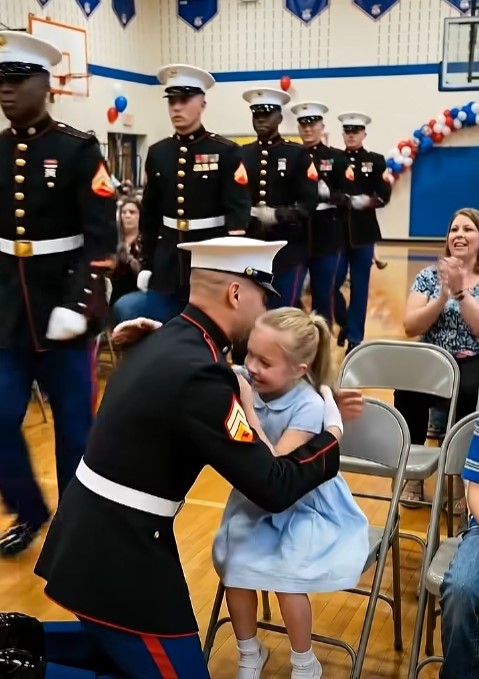
The elementary school gym was transformed into a warm, glowing space for the annual father–daughter dance. Paper lanterns and soft string lights hung from the ceiling, casting a gentle glow over the polished wooden floor. Tables along the walls were filled with snacks, drinks, and small decorations prepared by volunteers. The sound of laughter, music, and footsteps filled the room, creating an atmosphere of excitement and celebration that brought families together for one special evening.
Children in colorful dresses twirled across the floor, many holding hands with their fathers as they attempted simple dance steps. Some parents laughed at their own clumsiness, while others simply enjoyed watching their daughters smile. Cameras flashed occasionally as families captured memories of the night. For most, it was a joyful tradition, a simple school event that symbolized bonding and shared happiness. But for one child, the evening felt very different.
Eight-year-old Emma Carter sat quietly on the edge of the bleachers, her small hands resting in her lap. Her pale blue dress stood out softly under the gym lights, but she did not seem to notice it. Her eyes followed the movement of other children dancing with their fathers, but she remained still, withdrawn from the energy around her.
Only a few months earlier, Emma’s father, Captain Ryan Carter, had died during military service overseas. The loss had left a deep silence in her life, one that no celebration could easily fill. He had been the person she turned to for comfort, encouragement, and safety. Without him, even ordinary events now felt heavier and harder to face.
Her mother sat beside her, quietly observing her daughter’s struggle. She had encouraged Emma to attend the dance, hoping that being surrounded by other families might help her feel included rather than isolated. But as the evening unfolded, it became clear that grief does not disappear simply because an event is joyful.
Emma leaned closer to her mother and spoke softly, her voice barely audible over the music.
“Mom… can we go home? It’s not the same without Dad.”
Her mother felt those words deeply. She gently placed a hand on Emma’s shoulder, trying to steady her emotions while searching for the right response. She understood that no reassurance could fully replace the absence Emma was feeling. Still, she wanted her daughter to know she was not alone in her pain.
“You are never alone,” she said quietly. “Not in this room, and not in life.”
Around them, the dance continued. Laughter echoed, music played, and children moved across the floor. But Emma felt separated from it all, as if she were watching life from a distance rather than participating in it. The contrast between her sadness and the surrounding joy made her feel invisible, even in a crowded room.
As the minutes passed, Emma lowered her gaze, holding back tears. She wondered if anyone truly noticed how she felt, or if she was simply another quiet face in the background of a busy evening.
Then, suddenly, the atmosphere in the gym changed.
The main doors at the far end of the room opened, and a group of uniformed Marines entered in organized formation. Their presence immediately drew attention. Conversations stopped, music lowered, and the entire gym turned toward the entrance in silence. At the center of the group stood a decorated general, his presence calm but commanding.
The Marines moved forward with measured steps and positioned themselves near the center of the gym. The shift in energy was immediate. What had been a casual school event suddenly felt more formal, more serious, and deeply significant.
The general then began walking toward the bleachers.
His attention was focused, his steps steady, as he moved past families and children who watched quietly. When he reached Emma, he gently lowered himself so that he was at her eye level. The noise of the room seemed to fade further as all attention turned toward this quiet interaction.
“Emma,” he said softly, “I’ve been looking for you.”
She looked at him with confusion and uncertainty.
“Who are you?” she asked.
The general offered a calm, reassuring expression.
“I’m here because of your father,” he replied. “He spoke about you. He made sure we knew how important you are to him.”
Emma froze for a moment. Hearing her father mentioned so directly made her emotions surface all at once. She had not expected his name to appear in a place like this, on a night that already felt difficult for her.
The general continued speaking gently.
“Your father served with honor. He cared deeply about you. And he made sure we would never forget that you are part of his legacy.”
Behind him, two Marines stepped forward. One carried a folded American flag with great care, while another held a small white flower. They placed them respectfully near Emma as a sign of remembrance and honor.
The entire gym remained silent. Teachers, parents, and children all watched without interruption. The moment was not loud or dramatic, but deeply emotional in its simplicity.
The general looked at Emma again.
“Your father would want you to be proud tonight,” he said. “Even when it feels hard.”
Emma’s eyes filled with tears. She nodded slowly, struggling to find words.
“I miss him,” she whispered.
“I know,” the general replied. “And it’s okay to miss him.”
For the first time that evening, Emma did not feel completely alone in her grief. The recognition of her father’s service and the respectful acknowledgment of her loss created a sense of connection she had been missing.
As the moment settled, the general stood and stepped back. The atmosphere in the gym remained quiet, but something had shifted. Emma’s posture slowly changed. She lifted her head slightly, no longer hiding at the edge of the bleachers.
Soft music began playing again, more gentle than before. One of the Marines approached Emma and extended his hand, inviting her to join the dance floor. After a brief pause, she accepted.
At first, her steps were hesitant. She moved carefully, unsure of herself, still carrying the weight of emotion from earlier. But gradually, as she began to move with the music, her confidence grew. The space that once felt distant and overwhelming began to feel more welcoming.
Other children slowly joined her. The dance floor, once filled with separation and observation, became a shared space of inclusion and quiet support. Emma was no longer sitting alone. She was part of the movement, part of the evening, part of something larger than her sadness.
For the adults watching, the moment carried deep meaning. It reminded them that grief in children is often silent and easily overlooked, especially in public settings filled with celebration. Emma had not needed grand speeches or dramatic gestures. She needed acknowledgment, respect, and the feeling that her father’s memory still mattered.
As the evening continued, the Marines formed a respectful line and offered a final salute before leaving. The general gave Emma one last look of encouragement.
“Your father would be proud of you,” he said.
Emma returned to her mother’s arms, this time with a faint smile mixed with tears.
“I felt him there,” she said softly. “I really did.”
Her mother held her tightly.
“He never left you,” she replied. “He’s part of you.”
The dance eventually came to an end, but the impact of the evening remained. Emma had entered the gym carrying grief that felt heavy and isolating. She left with something she had not expected: a sense of recognition, connection, and quiet strength.
The experience did not erase her loss, nor was it meant to. Instead, it helped her understand that love does not disappear with absence. It continues in memory, in respect, and in the way others choose to honor it.
For Emma, that night became more than a school event. It became a moment of healing—not because the sadness was gone, but because she finally understood she was not carrying it alone.

