
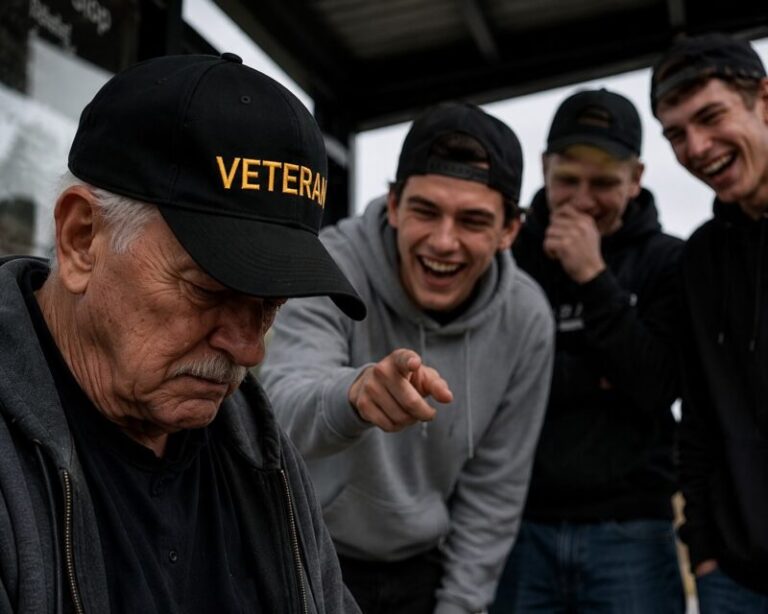
It was an early morning like many others in the city, where the streets slowly woke up under a dull gray sky. A light drizzle had recently passed, leaving the pavement slightly wet and reflective, while the wind carried a noticeable chill through the air. People moved quickly, most of them focused on their routines, their destinations, and the rhythm of a normal weekday beginning. At a small bus stop near a busy intersection, an elderly man sat quietly on a metal bench, waiting patiently for public transport that seemed delayed.
He did not appear rushed or anxious; instead, he seemed accustomed to waiting as part of his daily life. His presence was quiet, almost blending into the background of the city’s movement. The man wore a simple, worn jacket and a faded cap that carried the word “Veteran” stitched across the front. It was not a decoration he wore for attention, but rather a part of his identity that remained from years earlier. Beneath his trousers, partially visible when he shifted his position, was a prosthetic leg.
It was a quiet reminder of a life shaped by service, sacrifice, and events that had permanently changed his physical condition. Over the years, he had grown used to how people reacted when they noticed it—some with brief sympathy, others with discomfort, and many simply pretending not to see it at all. For him, the reactions of strangers had become predictable, almost routine, and no longer surprising.
A Life After Service That Became Smaller and Quieter
Before his injury, his life had been structured around duty and responsibility. He had served in difficult environments where discipline and endurance were required every day. Those years had left him with memories that he rarely spoke about, and experiences that shaped both his physical and emotional state. After returning to civilian life, the transition had not been easy.
The structure he once depended on was gone, replaced by uncertainty and isolation. Over time, relationships faded, and his social circle gradually disappeared. What remained was a quieter life, defined by simplicity, routine, and long stretches of solitude. The bus stop had become one of many places where he spent time alone.
An Ordinary Morning Turns Uncomfortable
On this particular morning, the calm atmosphere began to shift when a group of three young men arrived at the bus stop. They were loud, energetic, and visibly engaged in their own conversation, laughing and speaking over one another. At first, they did not notice the elderly man sitting nearby. However, once they did, their attention quickly focused on his prosthetic leg.
A brief pause followed, then one of them made a comment that led to laughter among the group. What may have started as a careless remark soon developed into repeated jokes directed at the veteran, growing louder and more noticeable with each exchange. The tone of the moment shifted from casual noise to something uncomfortable for those nearby.
The Beginning of Public Mockery
As the young men continued speaking, their comments became more direct, and their laughter more persistent. The veteran did not respond. He remained still, looking forward, as if waiting for the bus and ignoring the situation around him. His silence, however, did not stop the behavior; instead, it seemed to encourage it further. The group appeared more confident as no one intervened.
A few passersby noticed what was happening but quickly looked away or continued walking without saying anything. The atmosphere at the bus stop grew tense, even though most people pretended not to feel it. It was a moment where silence from others allowed the situation to continue unchecked.
A Man Observes the Situation From a Distance
Among those present was another man who had been standing a short distance away near the edge of a storefront. At first, he was simply waiting like everyone else, but as he observed the interaction unfolding, his attention became fixed on the group. His expression gradually changed from neutral to serious. He appeared to be assessing the situation carefully rather than reacting immediately.
Dressed simply and standing calmly, he gave the impression of someone who understood when to act and when to remain still. As the mockery continued, he stepped closer, signaling that he was no longer just an observer.
The Intervention That Changed the Atmosphere
When the man finally approached the group, the change in energy was immediate. The laughter began to fade, replaced by uncertainty. Standing directly in front of them, he addressed their behavior in a calm but firm tone. His words were not shouted, but they carried weight. He asked them directly if they were not ashamed of how they were behaving. The question created an immediate shift in attention, forcing the group to reconsider the situation they were in. The confidence they had moments earlier began to disappear, replaced by hesitation and discomfort.
A Lesson Delivered Without Violence or Escalation
The man continued speaking, explaining that respect for others is not optional and that mocking someone’s physical condition reflects poorly on those who do it. He emphasized that humor should never come at the expense of another person’s dignity. His message was direct but controlled, avoiding aggression while maintaining authority in his tone. The group attempted to respond defensively at first, suggesting they were only joking, but the explanation they received made it clear that their actions were not harmless. The difference between humor and harm was made explicit in a way that could not easily be dismissed.
The Veteran Remains Silent but Acknowledged
Throughout the entire exchange, the veteran remained seated and did not participate in the confrontation. His silence was not weakness, but rather a reflection of long-term endurance and emotional restraint. He had likely experienced similar moments in different forms throughout his life. However, this time, the difference was that someone else chose to speak on his behalf. For the first time during the incident, he was not completely alone in the experience. The attention of others had shifted toward understanding rather than ignoring what was happening.
A Shift in Behavior and Awareness
As the intervention continued, the young men gradually became quieter. Their earlier confidence faded, replaced by visible discomfort. One of them looked away, avoiding eye contact, while another shifted his posture as if uncertain how to respond. The energy that had filled the space moments earlier was gone. The man who had intervened did not escalate the situation further but made his point clearly before stepping back. The interaction had reached its natural conclusion, not through conflict, but through reflection and awareness.
The Bus Stop Returns to Silence
Shortly afterward, the bus arrived. The atmosphere returned to its usual state of quiet movement and waiting. The veteran stood up slowly and prepared to board, his routine continuing as before. The group of young men remained silent, no longer engaging in conversation or laughter. The moment had passed, but its effect remained present in the behavior and expressions of those who had witnessed it. Even without further words, the experience left a lasting impression on the environment.
A Reflection on Respect and Human Behavior
Situations like this highlight how quickly public behavior can shift depending on whether people choose to intervene or remain silent. In many cases, small acts of disrespect can go unchecked simply because bystanders choose not to engage. However, as seen in this moment, a single calm intervention can change the direction of an entire interaction. It does not always require confrontation or aggression, but rather clarity and the willingness to speak when others do not. The veteran’s experience, though brief in this setting, reflects broader themes of dignity, awareness, and human responsibility.
Final Thought
In the end, the bus stop returned to its normal rhythm, but the meaning of what had happened remained with those who witnessed it. The veteran continued his day as he always had, carrying his history quietly with him. The bystander who intervened did not seek recognition, and the young men were left with a moment of reflection that may influence future behavior. It was a simple encounter in an ordinary place, yet it served as a reminder that respect is not automatic—it is a choice made in real time.

