
In one quiet household, far from public attention, a seventy-year-old woman lived a life shaped by routine, responsibility, and deep family ties. She had already endured many of life’s challenges, but nothing could prepare her for the night that would redefine her entire future. It was shortly after midnight when a sharp knock echoed through her front door. The silence of the night was broken by the presence of two police officers standing outside.
Their expressions carried the kind of seriousness that instantly signals irreversible news. They informed her that her only son had been involved in a fatal car accident. The road conditions had been poor, and in a tragic moment of loss of control, his life had ended instantly. For the grandmother, the world seemed to stop. The grief was immediate and overwhelming, a shock that no parent ever fully recovers from. But in the midst of mourning, another reality was quietly forming—one that would soon place two young children in her care.
The Unexpected Arrival of Responsibility
Just three days after the funeral, while the family was still processing the loss, a new and unexpected moment unfolded. Her daughter-in-law, Claire, arrived at the home without prior notice. With her were two small boys—twins named Hugo and Luc—only two years old. They stood quietly, dressed in simple pajamas, unaware that their lives were about to change permanently. Alongside them was a single bag containing their belongings. The message was unspoken but clear.
Without emotional discussion or long explanation, Claire expressed that she could no longer continue in her current role as a parent. She stated her intention to leave the children in the grandmother’s care and move forward separately. Within moments, she walked away and left the property. The grandmother, still grieving her son’s death, suddenly became the primary caregiver of two very young children.
A New Life Built on Sacrifice
The transition was not easy. Overnight, her life shifted from retirement-age stability to full-time parenting. The twins required constant attention, care, and emotional stability. Nights became shorter, days became longer, and financial pressure increased. Despite her age, she refused to place them in institutional care or separate them. She worked tirelessly. Taking on long hours wherever possible, she ensured the children had food, clothing, education, and a stable home environment.
There were moments of exhaustion, but also moments of deep emotional connection that strengthened the family bond. As time passed, she began creating additional income through small-scale work. She started preparing homemade tea blends and selling them at local markets. What began as a small effort to survive gradually developed into a stable and growing business. Her dedication not only supported the household financially but also created a structured environment where the children could grow safely and consistently.
A Decade of Stability and Growth
Over the next ten years, life settled into a rhythm. Hugo and Luc grew from toddlers into school-aged children and eventually into early teenagers. They developed strong emotional attachment to their grandmother, seeing her as both caregiver and parental figure. She ensured they attended school regularly, received emotional support, and lived in a structured environment. Despite the absence of their biological mother, their upbringing was stable and filled with consistent care.
During this time, there was no contact from Claire. The family adapted fully to their new reality, building a life around stability, routine, and mutual dependence. The grandmother often described her greatest achievement not as her business success, but as the safe and loving home she had created for her grandsons.
A Sudden and Unexpected Return
After more than a decade of silence, Claire reappeared unexpectedly. Her return was not gradual or emotionally driven—it was legal in nature. She arrived accompanied by legal representation and presented formal documents requesting full custody of the twins.
For the first time in years, the family was confronted with a direct challenge to the life they had built. The situation escalated quickly. Rather than initiating a slow emotional reconnection or attempting to rebuild trust with the children, the focus remained on legal custody proceedings.
A Difficult Proposal Behind Closed Doors
In addition to the custody claim, a private conversation occurred between Claire and the grandmother. During this discussion, Claire presented a conditional proposal. She suggested that she would withdraw her custody claim if she were given a controlling financial share in the grandmother’s small business.
The request placed the grandmother in a deeply conflicted position. The business represented years of sacrifice, hard work, and survival. At the same time, the custody case represented the future of the children she had raised. She declined the offer.
The Courtroom Battle Begins
The case moved to court, where both parties presented their arguments.
Claire’s legal position focused on her biological connection to the children and concerns raised about the grandmother’s age and long-term caregiving capacity. Her argument suggested that the children should be raised by a younger parent with potentially longer-term stability.
On the other side, the grandmother’s defense emphasized the emotional, physical, and developmental stability the children had experienced over the past ten years. Evidence was presented regarding school performance, home stability, and emotional wellbeing.
The courtroom atmosphere was tense, as both legal and emotional factors were weighed carefully.
The Emotional Turning Point
As the proceedings continued, an unexpected moment occurred.
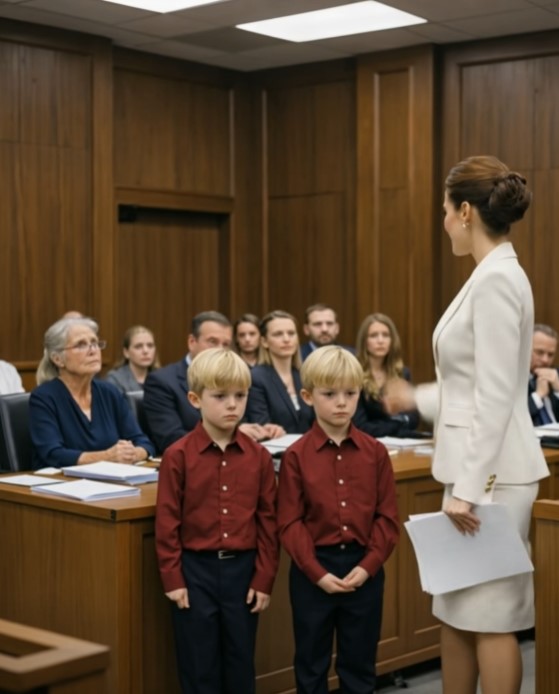
Hugo, typically quiet and reserved, stood up in the courtroom. His younger brother Luc followed beside him, offering silent support.
Despite their nervousness, Hugo spoke clearly and directly about their lived experience.
He described their home life, their bond with their grandmother, and the sense of safety they had grown up with. He expressed that they did not want to leave the only home they truly remembered.
Luc then added his own words, reinforcing the emotional message. He emphasized that their grandmother had raised them with care, patience, and consistency, and that she was the only parental figure they truly recognized.
The courtroom fell silent.
The Judge’s Consideration
The judge carefully considered all factors presented in the case.
Legal parentage, emotional stability, long-term caregiving history, and the expressed wishes of the children were all weighed in the final decision.
Particular attention was given to the fact that the children had spent the majority of their lives under the grandmother’s care and had developed strong emotional bonds within that environment.
The Final Decision
After thorough evaluation, the court ruled in favor of maintaining custody with the grandmother.
The decision emphasized continuity, emotional stability, and the best interests of the children as central considerations.
It recognized that despite biological ties, the environment in which the children had been raised for a decade provided the most stable foundation for their development.
An Emotional Aftermath
Following the ruling, the courtroom atmosphere shifted from tension to relief.
The children immediately embraced their grandmother. The emotional release reflected years of shared struggle, sacrifice, and unconditional care.
The grandmother, visibly overwhelmed, held them close as the reality of the decision settled in.
A Reflection on Family and Stability
This case highlights an important principle often seen in custody disputes: the best interest of the child is not defined solely by biology, but by emotional stability, care, and continuity.
It demonstrates how long-term caregiving relationships can shape identity, trust, and emotional security.
More than a legal dispute, this was a story about resilience, sacrifice, and the deep bonds formed through years of consistent love and responsibility.
Moving Forward
With the legal process concluded, life for the family continues in the home they built together.
The grandmother remains the central figure in the children’s lives, and the household continues to function with stability and structure.
While the legal battle created emotional strain, it ultimately reinforced the strength of the family bond that had developed over a decade.

