
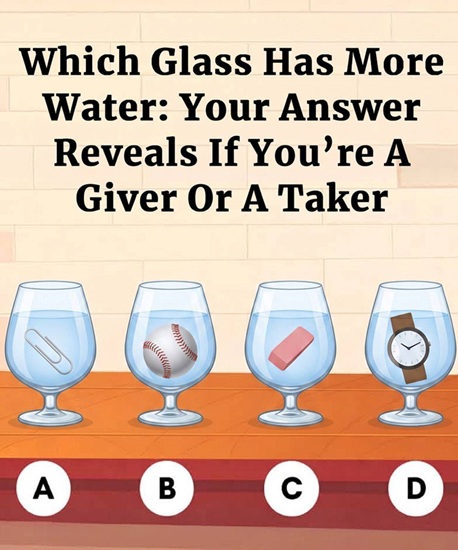
At first glance, this visual puzzle appears extremely simple and almost effortless to solve. Four transparent glasses labeled A, B, C, and D are shown, each filled to the same visible water level. Inside each glass is a different object, but nothing immediately seems unusual or complicated. The arrangement looks balanced, symmetrical, and fair, which is exactly why most people assume the answer must be straightforward. The question asks a simple but deceptive challenge: which glass contains the most water?
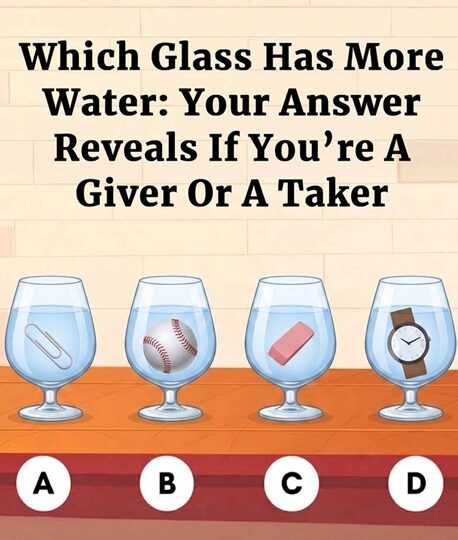
Because all four glasses appear visually identical in water level, most people instinctively assume that the amount of water must also be equal. This is where the puzzle begins to mislead the human brain, relying on visual perception rather than physical reasoning. Inside each glass, however, is a different object: Glass A contains a paperclip, Glass B contains a baseball, Glass C contains an eraser, and Glass D contains a wristwatch. At first, these objects may seem like irrelevant details, but in reality, they are the key to solving the puzzle correctly.
Understanding the Principle of Displacement
The correct way to solve this puzzle is by understanding a basic principle in physics called displacement. Displacement refers to the amount of space an object occupies when placed inside a liquid. When an object is submerged in water, it pushes the water aside and reduces the available volume that the water can fill.
This means that even if two glasses appear to have the same water level, the actual amount of water inside them may be different depending on the size of the object placed inside. The larger the object, the more space it takes up, and therefore, the less water can physically remain in the glass.
This principle is often demonstrated in basic science experiments, but in visual puzzles like this one, it becomes a subtle trick that challenges perception. The brain tends to focus on surface level information rather than hidden volume differences.
Breaking Down Each Glass
When analyzing Glass B, which contains a baseball, the displacement becomes significant. A baseball is relatively large compared to the size of the glass, meaning it takes up a substantial portion of the internal volume. As a result, even though the water level appears equal to the others, the actual amount of water is much lower.
Glass D, containing a wristwatch, also displaces a noticeable amount of space. Watches are not as large as a baseball, but they still occupy considerable volume inside the glass, reducing the total water capacity.
Glass C, which contains an eraser, represents a moderate level of displacement. An eraser is smaller than both a baseball and a wristwatch, but it still reduces the amount of water present in comparison to very small objects.
Glass A, however, contains a paperclip, which is extremely small in volume. Because it takes up minimal space, it displaces the least amount of water among all four objects. This is the critical detail that determines the correct answer.
The Correct Answer Explained
The correct answer to the puzzle is Glass A. Although all four glasses appear equally filled at first glance, Glass A contains the greatest actual amount of water because the paperclip displaces the least volume.
This outcome often surprises people because it contradicts initial visual assumptions. The puzzle is not about what looks equal, but about what is physically happening inside each container. It demonstrates how appearances can be misleading when important hidden variables are not considered.
The key takeaway is that visual equality does not always equal physical equality. Two containers can look identical on the surface while holding different amounts of liquid depending on what is placed inside them.
Why the Puzzle Tricks So Many People
This puzzle is effective because it exploits a natural cognitive shortcut in human thinking. The brain is designed to process visual information quickly in order to make fast decisions. However, this speed often comes at the cost of missing small but important details.
When all four glasses appear identical in water level, the brain immediately assumes equality. It does not automatically calculate the effect of displacement unless prompted to do so. This is why many people answer incorrectly on their first attempt.
Puzzles like this highlight the difference between perception and reality. What we see is not always the full truth, and sometimes critical information is hidden from immediate view.
Beyond the Puzzle: A Lesson in Thinking
Although this puzzle is simple, it teaches a broader lesson about critical thinking. In everyday life, people often rely on surface-level information when making judgments. However, important details are frequently hidden beneath what is immediately visible.
This principle applies not only to science puzzles but also to decision-making in general. Whether analyzing situations, solving problems, or interpreting information, it is important to consider what may not be immediately obvious.
The puzzle encourages a shift from instinctive thinking to analytical reasoning. Instead of accepting appearances at face value, it encourages deeper evaluation and questioning.
Why These Puzzles Go Viral
Visual puzzles like this spread quickly online because they are simple to understand yet challenging to solve correctly. They create an instant reaction of curiosity and surprise, especially when people discover they answered incorrectly.
They also encourage discussion, as people compare answers and reasoning. This social element helps increase engagement and makes the puzzle more memorable.
Most importantly, they give people a sense of discovery when they finally understand the hidden logic behind the solution.
Final Conclusion
The glass puzzle demonstrates a simple but powerful scientific idea: displacement determines the true amount of water inside each container, not just the visible water level.
Glass A is the correct answer because the paperclip displaces the least amount of space, allowing it to contain the most water despite appearances.
Ultimately, the puzzle is a reminder that reality is not always what it seems at first glance. Careful observation and logical thinking are often required to uncover the truth hidden beneath the surface.

