
A forest ranger who had spent many years working deep inside a remote wilderness reserve had become accustomed to solitude. After a difficult chapter in his personal life marked by loss and emotional distance, he chose a lifestyle far removed from cities and crowds. His daily routine revolved around long patrols through dense forest trails, monitoring wildlife activity, and ensuring that visitors remained safe in unpredictable natural conditions. The forest had become both his responsibility and his quiet refuge.
His small wooden cabin stood near the outer edge of the reserve, surrounded by tall pines and heavy winter snow during colder months. Communication with the outside world was minimal, and days often passed in silence broken only by wind, wildlife movement, or the crackling of ice and branches. While the isolation was challenging at times, it gave him a sense of stability and purpose that he had struggled to find elsewhere.
One of the most dangerous areas under his supervision was a large frozen lake located deep within the forest. During winter, the lake often appeared completely solid, creating an illusion of safety. However, beneath the snow-covered surface were weak layers of ice that could collapse without warning. The ranger had seen enough incidents involving careless visitors to know that appearances could be deceiving in extreme cold conditions.
Because of this risk, he regularly inspected the lake even during harsh weather. He understood that wildlife also used the area, and that natural instincts often brought animals close to water sources regardless of danger. Still, most of his concern centered around human activity, as tourists occasionally ignored warning signs and ventured too far onto the ice.
On a particularly cold winter morning, the forest felt unusually still. There was no wind, no bird activity, and even the usual distant sounds of movement seemed absent. This unnatural silence immediately caught the ranger’s attention, as experienced outdoorsmen often associate such stillness with unusual environmental behavior.
As he walked along one of the familiar patrol routes, he suddenly paused. In the distance, he heard a faint sound carried through the frozen air. It was not immediately identifiable—somewhere between a distressed call and a low, repetitive sound that suggested struggle. He stood still for several seconds, focusing his attention entirely on the direction of the noise.
The sound repeated again, slightly louder this time, confirming that it was not random. Without hesitation, the ranger adjusted his direction and began moving quickly through the snow-covered terrain toward the frozen lake. His training and experience told him that any repeated distress sound in such an environment required immediate attention.
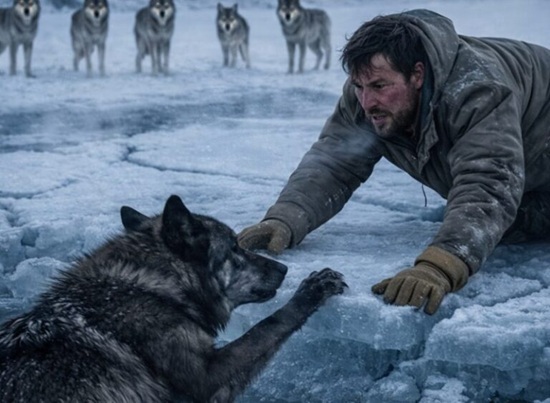
When he reached the edge of the lake, the situation became clear. A large she-wolf was trapped in a section where the ice had broken apart, leaving her submerged in freezing water. The surrounding ice had fractured into sharp, unstable pieces that made escape extremely difficult. Each attempt she made to climb out caused further collapse, dragging her back into the freezing water.
The ranger immediately noticed that the animal was heavily pregnant. This detail significantly changed the urgency of the situation, as her physical condition made it even harder for her to escape the water. The cold temperatures combined with exhaustion meant that survival time was rapidly decreasing.
He carefully analyzed the environment before moving closer. He knew that approaching a wild predator in distress carried significant risk, especially when the animal was frightened and in pain. However, leaving it trapped was not an option he could accept. He slowly stepped onto the ice, distributing his weight to avoid creating further cracks.
As he approached, the she-wolf reacted instinctively. She exposed her teeth briefly in a defensive response, her survival instincts triggered by the presence of a human nearby. However, her strength was fading quickly, and she could not sustain aggressive movement for long.
The ranger spoke softly, not expecting understanding but attempting to reduce panic. He then carefully extended his arms, aiming to grasp the thick fur around her shoulders. The ice beneath them groaned under pressure, and cold water splashed as he made contact.
With controlled effort, he began pulling her toward a more stable section of ice. The resistance was significant, and the freezing water made movement even more difficult. At one point, the ice cracked again, forcing him to pause and adjust his position to avoid falling in himself.
After several intense moments, the she-wolf finally began to move upward. Slowly, she was dragged from the broken waterline onto firmer ice. With one final effort, the ranger pulled her completely out of the water. Both human and animal collapsed briefly from exhaustion, lying on the frozen surface as they recovered.
The silence of the forest returned once again, but it did not last long. The ranger soon noticed movement near the tree line. Several wolves had appeared, standing at a distance and observing the scene. They remained still and silent, watching both the ranger and the injured she-wolf.
The atmosphere shifted immediately. The presence of the pack created tension, as wild animals often react strongly to perceived threats involving members of their group. The ranger understood that any sudden movement could trigger aggression, so he remained calm and carefully observed their behavior.
One of the wolves stepped forward, followed by another. Their movements were slow but deliberate, and the situation became increasingly tense. The ranger slowly rose to his feet, avoiding any sudden gestures that could be misinterpreted as hostile.
For several seconds, everything remained frozen in place—man, injured animal, and approaching pack. Then suddenly, one wolf broke into a quick advance toward the ranger. The moment became critical.
Before the situation escalated further, the injured she-wolf forced herself up. Despite her weakened condition, she positioned her body between the ranger and the advancing wolf. Her stance changed completely from vulnerability to protection, and she released a low warning growl.
The advancing wolf stopped immediately. The confrontation shifted into a silent standoff, with both animals assessing each other. After several tense moments, the energy in the group changed.
Gradually, the wolves began to retreat. One by one, they backed away toward the forest, eventually disappearing into the trees. The immediate danger passed, leaving only silence once again across the frozen lake.
The ranger remained still for a while, processing what had just occurred. He had acted on instinct to save a life, but what followed was something he had not anticipated. The animal he helped had, in return, prevented potential harm from its own pack.
As he carefully made his way back through the snow toward the forest, he reflected on the experience. Life in the wilderness often presented unpredictable moments, but few carried the emotional weight of what he had just witnessed.
The forest around him remained unchanged, yet something within his understanding of nature had shifted. It was a reminder that survival, instinct, and unexpected bonds could intersect in ways that defied simple explanation.
And in that silent winter landscape, a single act of compassion had created a moment neither the ranger nor the wilderness would forget.

