
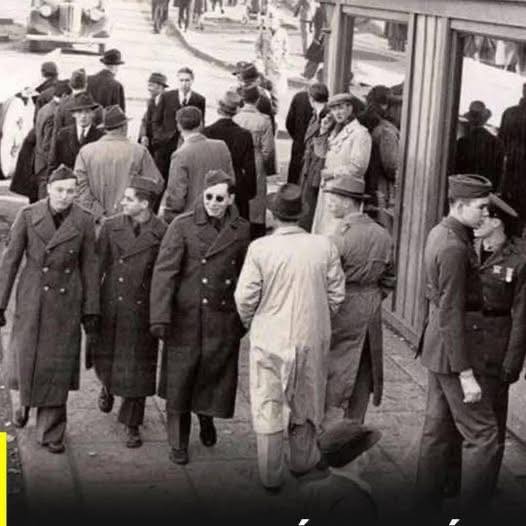
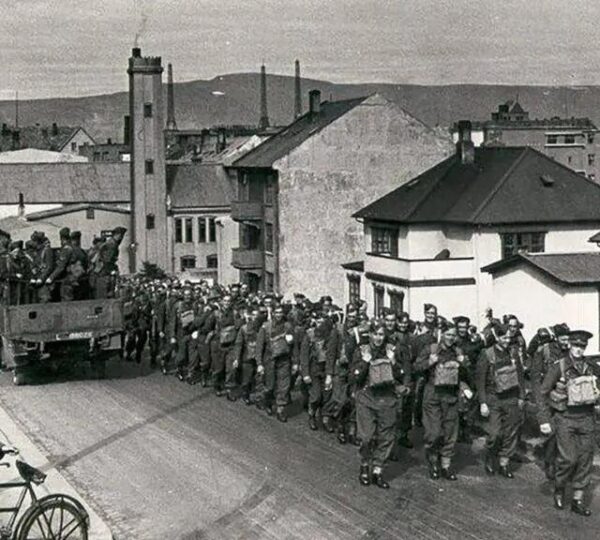
A black-and-white photograph taken in Reykjavík, Iceland, in 1943 continues to attract attention decades after it was captured, mainly because of a small visual detail that modern viewers find strangely familiar and thought-provoking.
The image resurfaced widely on the internet in 2016, when users on social media platforms began sharing it with comments suggesting that the man in the photograph appears to be holding an object similar to a modern mobile phone.
At first glance, the scene looks ordinary and typical of wartime photography. A man stands near a building, dressed in civilian clothing, with a relaxed posture that contrasts with the more rigid and formal poses often seen in historical archives.
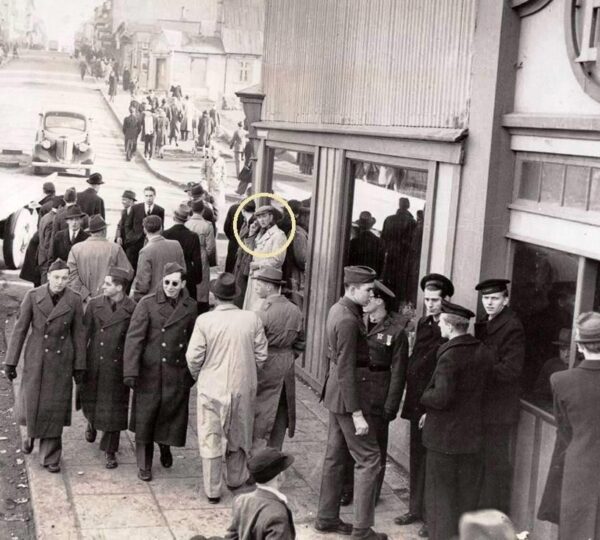
However, one specific element draws attention. The man’s hand is raised near his ear in a position that, to a modern observer, resembles the gesture of speaking on a smartphone or holding a small communication device.
To understand why this detail became so widely discussed, it is important to consider the historical context of Iceland during 1943, a period marked by the global conflict of the Second World War.
At that time, Reykjavík was strategically significant due to its location in the North Atlantic. The city hosted Allied forces, and the presence of soldiers, workers, and civilians created a busy and complex urban environment.
Photography during this era was common, but it was primarily documentary in nature. Many images captured everyday life, military presence, and infrastructure development rather than staged or symbolic compositions.
The man in the photograph appears to be wearing a light-colored coat and hat, typical of mid-twentieth-century civilian fashion in Northern Europe, rather than military uniform or official attire.
Because of this, viewers often assume he may have been an ordinary resident or worker rather than someone directly involved in military operations or communication roles.
The detail that sparked modern curiosity is his hand position, which appears close to the side of his face, creating an illusion that he might be listening or speaking into a device not yet invented at the time.
When the photograph was shared online, many viewers quickly noticed this resemblance and began to speculate about its meaning, leading to widespread discussions across forums and social media platforms.
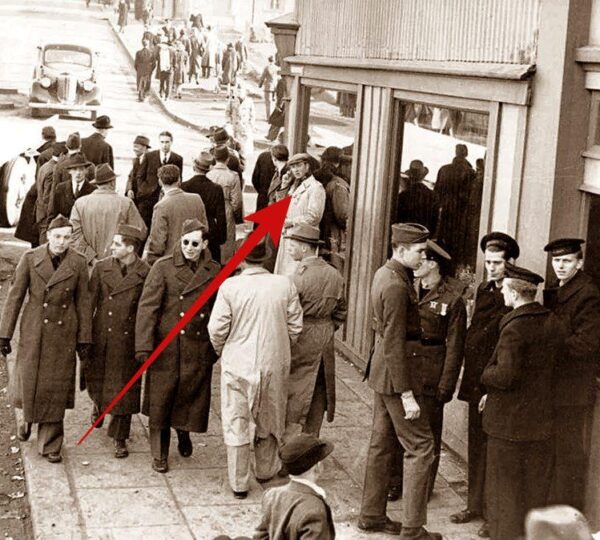
Some interpretations were lighthearted, while others leaned toward imaginative explanations, including the idea that the man could somehow be a “time traveler” captured accidentally in a historical moment.
This theory, while popular in internet culture, is not supported by any historical or scientific evidence, and it belongs more to modern storytelling and curiosity than to factual analysis.
Experts in historical photography and archival research offer more grounded explanations for the visual effect seen in the image and caution against interpreting such details without context.
One possible explanation is that the man may simply have been adjusting his hat, ear, or collar, which were common gestures in cold and windy weather conditions in Iceland.
Another reasonable interpretation is that he could have been holding a small everyday object, such as a cigarette, pipe, or personal item, which might appear unclear due to image quality and distance.
It is also possible that the gesture was completely natural and unplanned, captured at a precise moment when his hand happened to be near his face during a casual movement.
Photography in the 1940s relied on film technology with limited resolution compared to modern digital standards, meaning small details can easily become ambiguous or visually misleading over time.
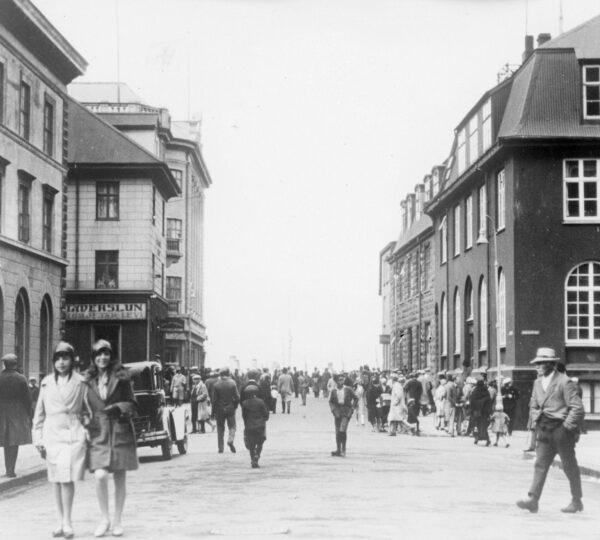
The angle of the shot and lighting conditions also play a significant role in shaping how viewers interpret historical images, especially when context about the subject is limited or unknown.
Modern audiences, accustomed to smartphones and instant communication devices, naturally tend to interpret hand-to-ear gestures as phone-related actions, even when no such technology existed.
This psychological effect is known as visual association bias, where the brain connects unfamiliar historical scenes with familiar modern objects based on shape, posture, or context similarities.
Because mobile phones are now deeply integrated into daily life, it is difficult for many people to separate contemporary habits from historical interpretations when viewing old photographs.
As a result, images like this one often gain renewed popularity online, not because of new evidence, but because they challenge modern perception and invite curiosity and discussion.
The Reykjavík photograph became part of a broader category of viral historical images often shared with speculative captions suggesting mystery, time travel, or unexplained phenomena.
While these interpretations are entertaining, historians emphasize the importance of examining such images using verified context, archival records, and realistic understanding of the period.
There is no documented evidence suggesting the existence of advanced communication devices in the 1940s resembling modern mobile phones or portable digital technology.
Instead, communication during that era relied on landline telephones, radio transmissions, written correspondence, and in some cases military communication systems controlled by specialized equipment.
The fascination with the image therefore lies not in hidden technology, but in how modern viewers project present-day knowledge onto historical moments captured decades earlier.
This phenomenon highlights how perception changes over time, and how cultural and technological evolution influences the way people interpret visual information from the past.
Even without a mysterious explanation, the photograph continues to circulate widely because it invites viewers to question what they see and reflect on the limits of visual interpretation.
The image serves as a reminder that photographs capture only a single moment, without full context, leaving room for imagination, misunderstanding, and reinterpretation across generations.
Ultimately, the enduring interest in the Reykjavík 1943 photograph comes from the intersection of history, human curiosity, and the modern tendency to find meaning in ambiguous visual details.
It stands today not as evidence of mystery, but as an example of how easily ordinary historical moments can take on new life when viewed through the lens of contemporary experience and imagination.

