
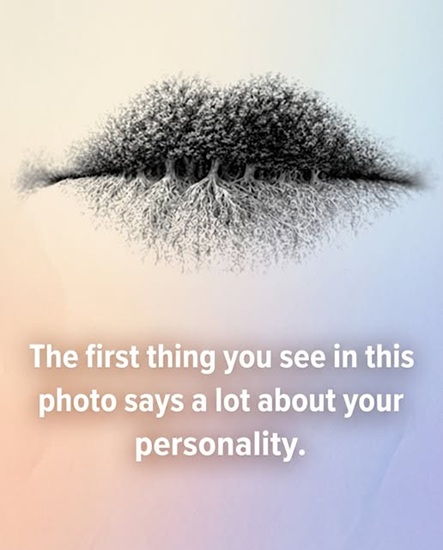
At first glance, the image may seem ordinary, almost unremarkable. But the moment you pause and observe what captures your attention first.
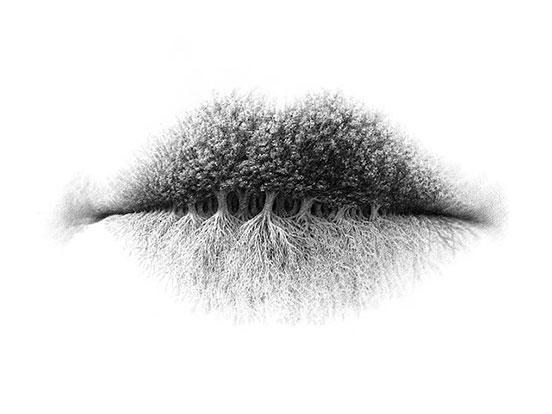
It reveals subtle insights into your natural tendencies, priorities, and intuitive ways of processing information. Some viewers immediately notice lips.
Others’ eyes are drawn to trees, standing tall and bold. A smaller group first sees hidden roots intertwined within the design, subtle and understated, demanding closer inspection. These differences highlight how perception varies across individuals.
What fascinates researchers and casual observers alike is not which element is “correct,” but how rapidly your brain selects a focal point. Reaction time reflects instinctive attention and the unconscious filtering of visual stimuli.
This exercise, though not scientific in the strict sense, provides a playful lens through which to explore personality tendencies. Optical illusions and ambiguous images have long been used to illustrate how human perception overlaps with cognition.
Our brains continuously filter and interpret visual input based on prior experiences, cultural context, emotional state, and attentional focus. Every observer brings a unique mental framework to the same image, which explains divergent initial impressions.
Optical illusions captivate us precisely because they reveal the brain’s interpretive processes. Two people can look at the same figure and see completely different elements first, showing the flexibility and complexity of human perception.
Consider viral debates over ambiguous color illusions. Entire online communities argued passionately over what they saw—differences weren’t caused by error but by individual neurological processing, lighting conditions, and personal perception habits, emphasizing subjectivity in visual interpretation.
Images like these encourage observation without overanalysis. By trusting instinctive reactions, viewers can gain subtle insight into their perceptual style, including whether they notice broad shapes first, fine details, or hidden structures that others might overlook.
If lips stand out first, you may have a natural tendency toward harmony and relational balance. People drawn to rounded, soft shapes often seek calm, stability, and clear, constructive communication in their daily environments.
Such individuals are frequently relied upon as stabilizers in social or professional contexts. Their preference for equilibrium and avoidance of conflict makes them dependable, though they may occasionally neglect their personal needs in favor of supporting others.
Those who first notice trees may possess an outward-focused perspective. Bold, vertical shapes appeal to expressive, socially confident individuals energized by engagement, observation, and interaction with their environment, whether in work or personal life.
Tree-focused observers often enjoy connecting ideas, people, and experiences. Their attention naturally gravitates toward overarching structures, patterns, and visible hierarchies, making them effective planners, coordinators, or mentors in settings that require social insight and organizational skill.
People drawn to roots or hidden elements tend to value depth and introspection. Observing subtle, understated aspects of a design can correlate with analytical thinking, curiosity, and a preference for meaningful, reflective engagement rather than surface-level interpretation.
Root-focused individuals frequently appreciate detail, hidden patterns, and systems of cause and effect. Their observations can provide clarity, insight, and problem-solving skills, especially in complex or nuanced situations that require thoughtful consideration.
No choice in this exercise is inherently better or worse than another. Each perspective reflects a combination of brain wiring, attentional focus, and cognitive style, illustrating the rich diversity of human perception.
Ambiguous visual designs reveal that the mind actively interprets rather than passively records sensory input. What we notice first is shaped by prior experience, familiarity, personal priorities, and even the current emotional state or context in which we view the image.
These perceptual differences extend beyond images. In daily life, people interpret social cues, language, and environmental stimuli in ways shaped by similar unconscious filters. Awareness of these tendencies enhances empathy and social understanding.
Optical illusions also highlight the brain’s predictive nature. Rather than processing every detail equally, the mind emphasizes certain features that it anticipates are significant, providing efficiency but also introducing variability in perception between individuals.
When you first notice lips, the preference for smooth curves suggests attentiveness to relationships, comfort, and emotional cues. It indicates a natural inclination toward nurturing, diplomacy, and creating safe, cohesive environments in both personal and professional settings.
Tree-first observers demonstrate attentional strength for structure, clarity, and visibility. Their eyes are drawn to bold, dominant shapes, which may correlate with leadership qualities, focus on long-term planning, and a preference for overarching patterns rather than minute details.
Root-focused individuals often excel in systems thinking. Seeing hidden structures quickly indicates an ability to notice what others miss, offering insight, strategic foresight, and an appreciation for complexity and layered meaning in abstract or practical situations.
These differences are reinforced by experience, training, and context. A person’s focus can shift over time, highlighting the dynamic interaction between innate tendencies and learned habits, making perception both unique and adaptable throughout life.
Optical illusions also illuminate cognitive biases. What we see first may reflect personal priorities, emotional focus, or habitual thought patterns, revealing tendencies to prioritize harmony, dominance, depth, or simplicity unconsciously.
Neuroscience shows that early visual processing occurs rapidly, often before conscious thought. The areas of the brain responsible for pattern recognition, shape detection, and emotional association influence which element captures attention first in ambiguous images.
Cultural influences also play a subtle role. Individuals from different regions may emphasize symbolic or environmental features differently, meaning initial perception can reflect not only personality but also cultural conditioning and learned attention habits.
Beyond playful insight, these exercises demonstrate how interpretation shapes reality. Two observers witnessing the same event may focus on entirely different elements, leading to divergent interpretations, emotional responses, or decision-making priorities.
Engaging with ambiguous images provides an opportunity for reflection. Noticing what draws attention first can inspire awareness of cognitive patterns, relational tendencies, and instinctive ways of interacting with the world, fostering personal insight and self-understanding.
For those noticing lips first, the tendency toward relational focus can encourage mindfulness about boundaries, ensuring that support for others does not come at the expense of personal well-being or self-expression.
Tree-focused individuals may be reminded to balance structure with flexibility. While attention to clarity and connection is valuable, overemphasis on overarching patterns can sometimes overlook nuanced emotional or interpersonal signals.
Root-focused observers are encouraged to channel reflective tendencies into constructive insight rather than rumination. Awareness of hidden structures can enhance problem-solving, creativity, and strategic thinking, particularly when combined with action-oriented follow-through.
Optical illusions also highlight human adaptability. While initial perception reveals instinctive focus, conscious attention can be trained to shift, expand, and integrate multiple perspectives for more comprehensive understanding and cognitive flexibility.
Engaging with these images repeatedly can enhance attentional control, cognitive agility, and awareness of perceptual bias, demonstrating the practical applications of playful exercises in everyday decision-making, observation, and problem-solving.
Trusting instinctive reactions allows a balance between unconscious processing and conscious reflection. Early impressions reveal tendencies, while deliberate consideration enables integration of diverse perspectives, offering richer insights into complex situations.
Perception-based exercises illustrate the value of observing without judgment. Rather than labeling reactions as right or wrong, noticing natural focus patterns fosters curiosity, empathy, and appreciation for cognitive diversity across individuals and situations.
The simplicity of a single image provides a powerful lesson in perception. It reminds us that what appears ordinary may contain layers of information about attention, personality, and thought processes, accessible through careful observation and reflection.
In practical terms, understanding these tendencies can improve communication. Recognizing that others may perceive the same visual or social stimuli differently promotes empathy, patience, and more effective interpersonal engagement across personal and professional contexts.
Ultimately, the exercise encourages self-awareness, highlighting natural inclinations toward harmony, structure, or depth. It also encourages appreciation of others’ perspectives, illustrating that perception is as much about the observer as the observed.
By reflecting on which element captured attention first, individuals can explore their instinctive approach to problem-solving, relationships, and learning, gaining subtle insight into how perception shapes thought, behavior, and interaction with the world.
These images also remind us that human perception is inherently variable. Two people can observe the same stimulus and experience entirely different interpretations, emphasizing that perspective is personal, malleable, and influenced by countless factors.
Observing without overanalyzing fosters intuitive understanding. Rather than immediately labeling or explaining, simply noticing what draws attention cultivates mindfulness, self-reflection, and awareness of natural cognitive patterns in a relaxed, engaging way.
Finally, optical illusions, ambiguous images, and perception exercises are not tests but tools. They provide a safe, playful environment to explore personality tendencies, cognitive biases, and perceptual diversity, offering insight into how uniquely each mind interacts with the world.

