
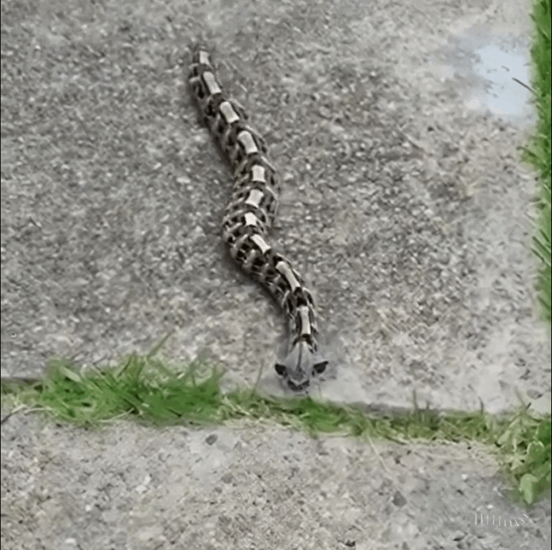
It turned out to be a Gaboon viper. I still thank my lucky stars I didn’t linger — even a second longer or an impulsive reach could have triggered a deadly strike from this elusive snake.
The Gaboon viper, scientifically known as Bitis gabonica, is among Africa’s most formidable snakes and is recognized as the heaviest venomous snake on the planet, with impressive adaptations for hunting and camouflage.
Its natural camouflage is remarkable, making it almost invisible among fallen leaves and forest debris. Even trained eyes can miss it, as the pattern on its scales blends seamlessly into its surroundings.
Gaboon vipers are native to the rainforests and savannahs of sub-Saharan Africa, with populations found in countries including Gabon, Cameroon, Nigeria, and the Democratic Republic of Congo. They thrive in dense, humid forested areas.
One of the most chilling aspects of the Gaboon viper is its size. Adult snakes can grow up to two meters in length, making them not only heavy but physically imposing predators in their habitat.
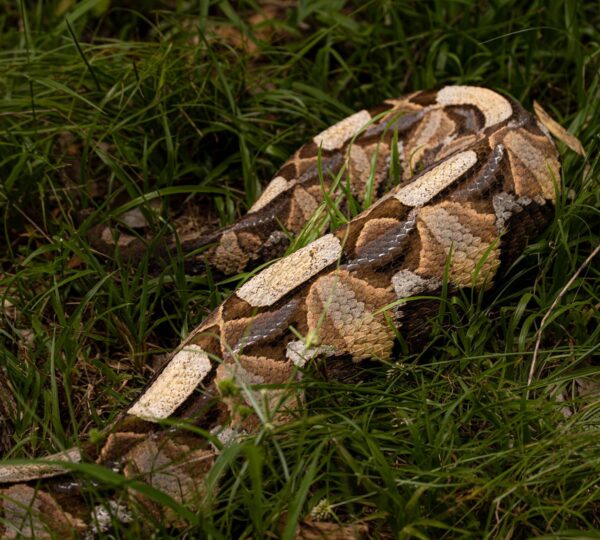
In terms of weight, Gaboon vipers can reach up to eight kilograms, a substantial mass for a terrestrial snake, which contributes to their lethality and allows them to immobilize prey effectively using their immense strength.
Their fangs are perhaps the most terrifying feature: at up to five centimeters long, Gaboon viper fangs are the longest of any snake. These specialized tools inject venom deeply into their prey.
The venom of a Gaboon viper is potent and complex, containing hemotoxins that destroy tissue, disrupt blood clotting, and cause severe internal damage. Human bites are extremely dangerous and require immediate medical intervention.
Despite their deadly capabilities, Gaboon vipers are typically docile. They remain motionless and rely on their camouflage to avoid threats. Aggression is rare, and they usually strike only when provoked or accidentally stepped on.
Most Gaboon viper bites occur by accident, often when humans inadvertently step near one in forested areas. Encounters are dangerous primarily due to the snake’s venom potency and the length of its fangs.
The diet of the Gaboon viper includes small mammals, birds, amphibians, and occasionally reptiles. Their wide gape allows them to swallow relatively large prey, including hedgehogs or small antelope, whole without difficulty.
They are ambush predators, lying in wait for prey to wander close before delivering a swift, precise strike. Their camouflage is essential for this hunting strategy, allowing them to remain virtually invisible until it is too late.
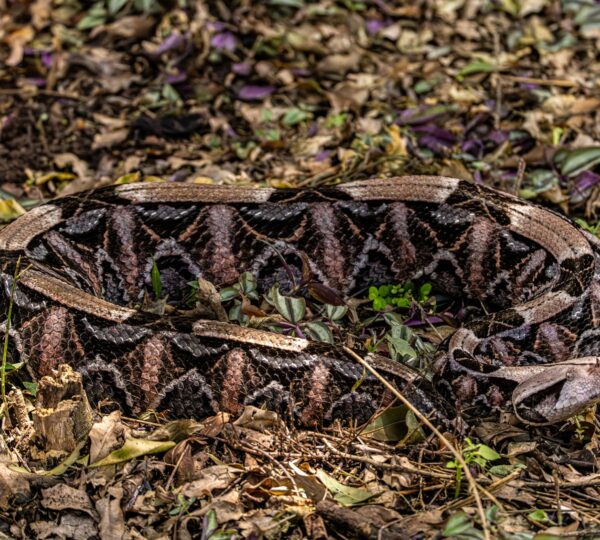
Gaboon vipers rely on both smell and heat-sensing pits to detect prey. These specialized sensory organs allow them to locate warm-blooded animals even in dense undergrowth, enhancing their hunting efficiency.
Unlike many other venomous snakes, the Gaboon viper has a relatively slow metabolism. They can survive on one large meal for several weeks, a testament to their evolutionary adaptation to the rainforest ecosystem.
Reproduction in Gaboon vipers is viviparous, meaning they give birth to live young rather than laying eggs. Litter sizes can range from 20 to 50 offspring, depending on the mother’s size and health.
The venom delivery mechanism of Gaboon vipers is highly advanced. Their long fangs penetrate deeply, ensuring maximum venom transfer into the prey’s bloodstream, which immobilizes it almost immediately.
Though they are lethally venomous, Gaboon vipers are not territorial and generally avoid confrontations with humans. Their docile nature makes most encounters accidental rather than predatory or aggressive.
In areas where Gaboon vipers are common, locals are often educated to watch their step, particularly in dense forests or plantations, to prevent accidental bites, which can be fatal without immediate access to antivenom.
Gaboon vipers can live up to 20 years in captivity under ideal conditions, though in the wild their lifespan is typically shorter due to predation, human activity, and environmental hazards within dense forest habitats.
Their scales are a masterpiece of natural camouflage. The geometric patterns on their skin not only protect them from predators but also enable them to stalk prey effectively, as they remain unnoticed even at close range.
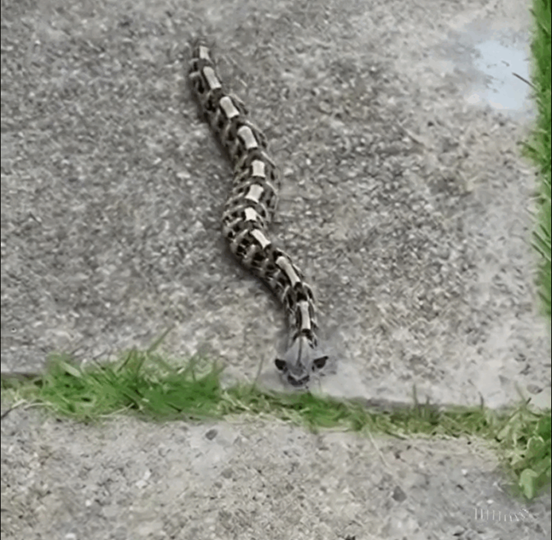
The Gaboon viper’s head is large and triangular, housing venom glands capable of producing up to 1,000 milligrams of venom in a single bite. This quantity can be lethal to humans if not treated promptly.
Interestingly, despite their fearsome reputation, these snakes have a slow, deliberate movement. They are ambush specialists, relying on concealment and patience rather than speed to capture their meals efficiently.
Gaboon vipers are primarily nocturnal, becoming more active at night when temperatures are cooler and prey animals, such as rodents, are more abundant. This behavior also reduces the likelihood of human encounters.
In some regions, Gaboon vipers are threatened by habitat loss due to deforestation, agriculture, and human settlement. Conservation efforts aim to preserve their natural habitats and educate communities about coexisting safely.
Medical cases involving Gaboon viper bites emphasize the importance of antivenom. Rapid treatment is critical, as their venom causes severe tissue destruction, internal bleeding, and potentially fatal complications if left untreated.
They are a vital part of the ecosystem, controlling populations of rodents and small mammals, which can otherwise become agricultural pests, demonstrating the ecological importance of venomous snakes in maintaining environmental balance.
Gaboon vipers exhibit a fascinating evolutionary feature: their fangs are not only long but hollow and reinforced, allowing venom to flow efficiently, ensuring that even a brief strike delivers a lethal dose to prey.
The species’ venom is of particular interest to scientists studying coagulation disorders and tissue necrosis, as it contains enzymes and proteins that provide insight into blood clotting mechanisms and potential medical applications.
Despite the danger they pose, Gaboon vipers are rarely aggressive. Most reported bites occur when humans accidentally disturb them, highlighting that understanding and respect for wildlife behavior are key to safety in their habitats.
Their eyes are positioned to provide excellent binocular vision, aiding in depth perception during ambush hunting. This visual acuity, combined with heat-sensing pits, makes them highly efficient predators in dense undergrowth.
Gaboon vipers often remain motionless for hours or days while waiting for prey, relying on their camouflage and patience rather than speed. This hunting style minimizes energy expenditure while maximizing hunting success.
They can detect vibrations through the ground, alerting them to approaching animals or humans. This sensory adaptation allows them to react defensively, although they usually prefer to remain hidden until provoked.
In addition to their ecological role, Gaboon vipers have fascinated herpetologists for decades due to their size, venom, and unique fang morphology, making them a species of significant scientific interest in toxinology and reptile behavior studies.
Education about Gaboon vipers is essential in areas where human-snake encounters are possible. Understanding their behavior, habitat, and warning signs can prevent accidental bites and improve coexistence with these remarkable reptiles.
Although their venom can be lethal, Gaboon vipers rarely bite unprovoked. Their preference for concealment over confrontation emphasizes that, for humans, the greatest risk comes from carelessness rather than inherent aggression.
The snake’s unique patterning also serves a dual purpose: camouflage from predators and prey, and potentially confusing observers, which contributes to the snake’s fearsome reputation and the caution with which humans approach them.
Gaboon vipers play a significant role in local folklore, with many African communities treating sightings as omens or spiritual symbols, reflecting both reverence and caution toward one of the continent’s most impressive snakes.
When handling Gaboon vipers in captivity, extreme care is required. Experienced herpetologists use specialized tools and safety protocols to avoid bites, given the snake’s slow but precise striking ability and potent venom.
In addition to their diet of small mammals and birds, Gaboon vipers occasionally consume reptiles and amphibians, demonstrating opportunistic feeding behavior and an ability to adapt to varying prey availability within their dense forest habitats.
The physical characteristics of Gaboon vipers are optimized for ambush hunting: broad heads, muscular bodies, and wide mouths allow them to immobilize and ingest large prey efficiently, making them one of Africa’s top terrestrial predators.
Interestingly, the snake’s body is robust yet flexible, allowing it to coil and strike with remarkable speed despite its massive size, which is essential for delivering venom effectively to unsuspecting prey in dense undergrowth.
Despite their terrifying potential, Gaboon vipers contribute to maintaining healthy ecosystems by keeping rodent populations in check, reducing crop damage, and indirectly benefiting both human and animal communities in their natural ranges.
Encounters with humans are rare, but awareness is crucial. Proper footwear, attentiveness in forests, and avoidance of disturbing leaves or undergrowth where snakes may lie hidden can prevent life-threatening bites.
In conclusion, the Gaboon viper is a marvel of evolution: a heavy, venomous, and highly camouflaged predator, equipped with long fangs, potent venom, and remarkable ambush strategies that make it both fascinating and dangerous.
Its combination of size, camouflage, venom potency, and ecological importance ensures that it remains one of the most studied and respected snakes in Africa, commanding both awe and caution from anyone who crosses its path.
While Gaboon vipers are rarely aggressive, the consequences of a bite are severe. Respect, understanding, and caution are essential, and their presence reminds humans of the complexity and power of Africa’s diverse wildlife.

