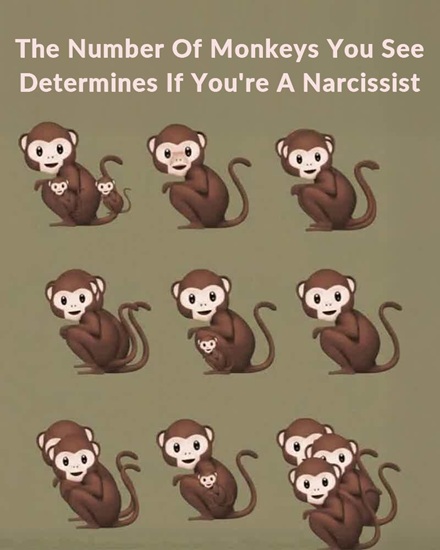
At first glance, the image looks like a playful cartoon, rows of cheerful monkeys lined across a simple, colorful background. The scene is innocent enough to make you smile and pause for a moment.
Then your eyes catch the bold text at the top, claiming: “The number of monkeys you see determines if you’re a narcissist.” That sentence is designed to stop scrolling and provoke immediate curiosity in anyone who reads it.
Almost instinctively, your attention turns to the monkeys. You start counting, convinced there must be a right answer, but the image has been carefully designed to make this task more complicated than it seems.
Some viewers quickly see a fixed number of monkeys, counting only the most obvious figures and moving on with confidence. They trust their first impression as accurate and feel a sense of completion.
Others pause, noticing subtler elements: smaller monkeys hidden in the shapes of larger ones, overlapping figures, repeated patterns, or details that weren’t immediately visible. Their count grows as they examine the image more carefully.
The intriguing aspect of images like this isn’t the number of monkeys at all. It’s the way our brains approach and process visual information, revealing differences in attention, focus, and perception.
Human perception is not a passive recording of reality. Our brains constantly interpret visual input, filtering details, connecting patterns, and deciding which elements deserve our attention first.
This process is influenced by past experiences, mental habits, and expectations, meaning that two people can look at the same image and perceive it very differently. Neither perception is incorrect; they simply reflect unique cognitive styles.
As viewers examine the monkeys, some may notice the larger, simpler shapes first, focusing on broad patterns, while others gravitate toward tiny, hidden details, scanning methodically for intricacies within the design.
These differences highlight that perception is highly subjective. What one person immediately sees as complete, another may see as only a portion of the whole, revealing how context and attention shape what we notice.
Despite the claim that monkey counting can reveal narcissism, there is no scientific evidence supporting this. The statement is purely viral clickbait, created to provoke engagement and encourage shares online.
Such captions exploit human curiosity, leveraging our desire to learn about ourselves while triggering comparisons with others, increasing the likelihood of social interaction and virality.
Nevertheless, the image is not meaningless. The way individuals interact with it can still provide insight into their cognitive focus, whether on broad overviews or fine details, even if it does not diagnose personality traits.
People who spot obvious monkeys quickly may prefer processing large-scale patterns first, potentially reflecting a natural inclination toward big-picture thinking in other aspects of life.
Conversely, those who notice hidden or repeated monkeys early may demonstrate a more detail-oriented observation style, focusing on minutiae before grasping the larger context.
Neither approach is inherently better. They simply reflect natural differences in perception, attention, and cognitive processing that make each viewer’s experience unique.
This inherent variability explains why such visual puzzles spread rapidly across social media. They play on curiosity, self-reflection, and social comparison, compelling people to engage repeatedly.
First comes curiosity: did I miss something? Then self-reflection: what does this say about me? And finally, comparison: how many did other people see? This combination drives engagement and discussion.
The illusion demonstrates how first impressions can be incomplete. What we initially perceive may seem obvious, but deeper examination often reveals previously unnoticed details.
Our brains prioritize efficiency in processing visual information. Rather than recording every detail, the mind selects and interprets elements deemed relevant based on experience and context.
That selection process explains why some monkeys are counted immediately while others are overlooked until closer inspection, highlighting differences in attentional focus and perceptual strategies.
Visual puzzles like this underscore the importance of careful observation. What seems simple or obvious at first glance may hide complexity, patterns, or surprises upon further inspection.
Psychologists studying perception note that such illusions illustrate how expectation, attention, and prior knowledge shape what we see, even in seemingly straightforward tasks.
The spread of viral content built around perception challenges demonstrates how cognitive processes can become entertainment, turning basic psychological principles into interactive experiences.
While the narcissism claim is false, the image provides a more subtle and valuable lesson: paying attention carefully often reveals details we otherwise miss in everyday life.
When viewers examine carefully, they learn to notice overlooked elements, question assumptions, and consider multiple interpretations, an important cognitive skill beyond just counting monkeys.
By prompting repeated examination, the puzzle also encourages mindfulness, patience, and the realization that immediate perception is rarely the full story.
Furthermore, discussions about the image can become social experiences, as people compare counts, share observations, and explore how others perceive visual information differently.
This social layer reflects another human tendency: seeking validation or insight by comparing oneself to peers, reinforcing engagement and conversation around shared experiences.
Overall, the monkey-counting illusion is less about the monkeys themselves and more about cognition, attention, and perception, offering a fascinating glimpse into how the mind processes visual data.
It reveals that differences in focus and observation are natural, and that no single perspective can capture every detail in complex visual stimuli.
The puzzle also illustrates how online content can leverage curiosity, social comparison, and personal reflection to generate engagement, even when the claims themselves are unscientific.
In reality, the number of monkeys one perceives does not indicate personality traits such as narcissism, self-absorption, or intelligence. It simply reflects differences in visual processing and attention.
By taking a closer look, viewers may recognize the value of reconsidering first impressions, exploring subtle patterns, and acknowledging the limits of immediate perception.
Ultimately, the puzzle encourages both critical thinking and playful exploration, highlighting the gap between what we see initially and what is actually present.
So while the headline is misleading, the exercise itself is meaningful, providing insight into perception, attention, and human curiosity without making unsupported claims.
Next time you encounter similar illusions online, consider observing carefully, reflecting on what you notice first, and appreciating the multiple layers of information hidden in simple visuals.
And as for the monkeys, the real lesson is this: sometimes, a second look reveals a world of detail that went unnoticed at first glance, reminding us that first impressions are rarely complete.
So go ahead — count the monkeys again. Notice what you see immediately, and then explore the hidden layers. The experience may be more about learning how you observe than the number itself.
The viral success of such illusions comes from this dual appeal: curiosity and self-reflection. They entertain while subtly teaching about human perception and attention, bridging psychology and playful interaction.
In conclusion, these puzzles are effective because they combine visual challenge, social comparison, and personal introspection, showing us that there is often more than meets the eye in everyday experiences.
And while the monkeys won’t diagnose personality, they do provide a reminder: take a closer look, question assumptions, and appreciate that much more exists beyond first impressions.
