As we move through life, many people encounter moments that feel unusual, meaningful, or difficult to explain, often leading them to reflect on whether there may be deeper forces or patterns influencing certain experiences.
Even individuals who do not strongly identify with a particular religious belief system sometimes acknowledge that certain events appear remarkably coincidental, prompting curiosity about whether these moments are simply chance or something more profound.
This sense of wonder becomes especially strong when people observe natural scenes or unexpected visual phenomena that seem to resemble familiar shapes, symbols, or figures that hold cultural, spiritual, or emotional significance.
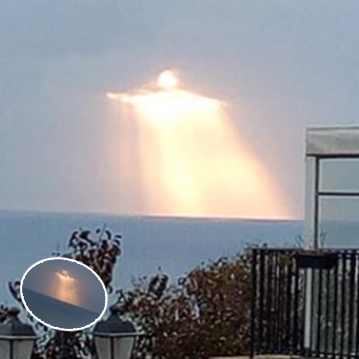
One such example that gained attention online involved a photograph taken by Alfredo Lo Brutto, a resident of Agropoli, a coastal town in southern Italy.
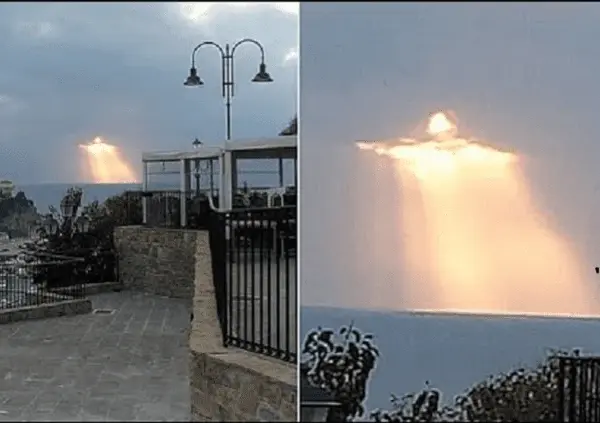
While observing the sea, Alfredo captured an image that appeared to show a large figure formed in the clouds above the water, creating a striking visual that immediately caught his attention.
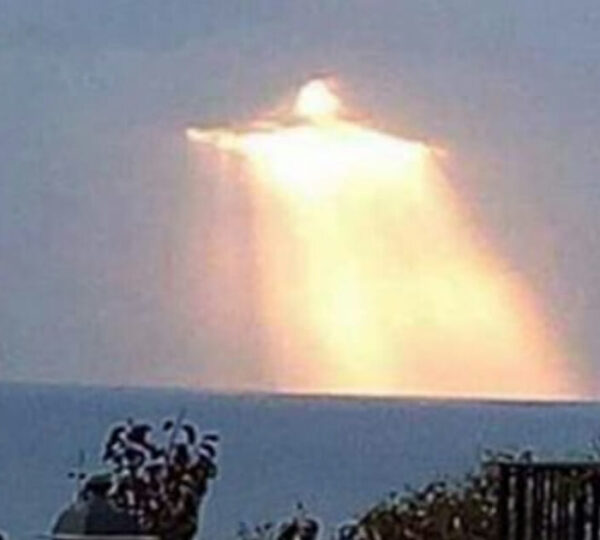
The photograph was taken over the Tyrrhenian Sea, an area known for its scenic beauty, dramatic skies, and ever-changing cloud formations influenced by weather conditions and sunlight.
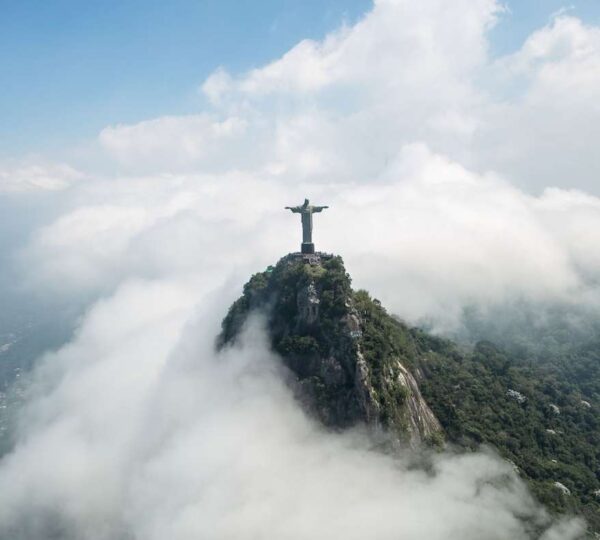
What made this image particularly interesting to viewers was the resemblance many people perceived between the cloud formation and the iconic Christ the Redeemer statue located in Rio de Janeiro.
The statue, one of the most recognizable landmarks in the world, depicts a figure of Jesus Christ with outstretched arms, symbolizing peace, protection, and welcome, which contributed to the emotional response the image generated online.
After capturing the photograph, Alfredo chose to share it publicly, explaining in an interview that he was deeply struck by the beauty of the moment and felt compelled to let others experience what he had seen.
He mentioned that he does not frequently post images on social media, but this particular photograph stood out to him because of its unique appearance and the sense of awe it inspired at the time.
As the image circulated online, it quickly attracted attention, with many viewers expressing amazement at the apparent likeness to the famous statue and interpreting the scene as something meaningful or symbolic.
Some individuals suggested that the image could represent a sign or a moment of spiritual significance, reflecting a long-standing human tendency to find meaning and patterns in natural phenomena.
Others approached the photograph from a more scientific or analytical perspective, proposing that the shape was likely the result of natural cloud formation combined with lighting effects and perspective.
Clouds are known to take on a wide variety of shapes due to atmospheric conditions, wind patterns, temperature differences, and the way sunlight interacts with moisture in the air.
This phenomenon, where people perceive familiar shapes or figures in random patterns, is commonly referred to as pareidolia, a well-documented psychological effect.
Pareidolia explains why individuals might see faces in clouds, animals in rock formations, or recognizable figures in shadows, even when there is no intentional design behind these shapes.
In the case of Alfredo’s photograph, pareidolia provides a plausible explanation for why so many people independently noticed a resemblance to a well-known religious statue.
At the same time, the emotional impact of such images should not be underestimated, as they can evoke feelings of wonder, reflection, and connection to something larger than oneself.
Throughout history, people have often interpreted unusual natural events as signs or messages, especially in cultures where spiritual or religious beliefs play a central role in daily life.
Even in modern times, with widespread access to scientific explanations, many individuals still find personal meaning in moments that appear visually striking or symbolically significant.
The widespread sharing of images on social media platforms has amplified these experiences, allowing photographs like Alfredo’s to reach a global audience within a very short period.
As more people viewed the image, discussions emerged across online communities, with some users firmly convinced that the resemblance was extraordinary and others remaining skeptical.
Debates like these are not uncommon, as interpretations of visual phenomena are often influenced by personal beliefs, cultural background, and individual perspectives.
Importantly, there is no verified evidence to suggest that the cloud formation was anything other than a natural occurrence, shaped by environmental conditions at that specific moment.
However, the lack of a supernatural explanation does not diminish the visual beauty or emotional resonance that many people associate with the photograph.
Images like this often serve as a reminder of how powerful perception can be, shaping the way individuals interpret and respond to the world around them.
They also highlight the human tendency to seek patterns and meaning, even in situations where randomness plays a significant role.
Alfredo’s photograph stands as an example of how a simple moment, captured at the right time and place, can spark widespread conversation and curiosity.
It also demonstrates how art and nature can intersect, creating images that resonate with viewers on both aesthetic and emotional levels.
For some people, the image may reinforce existing beliefs about spirituality or the presence of higher powers, while for others it remains an interesting example of natural coincidence.
Neither perspective is inherently right or wrong, as interpretations of such phenomena are often deeply personal and subjective.
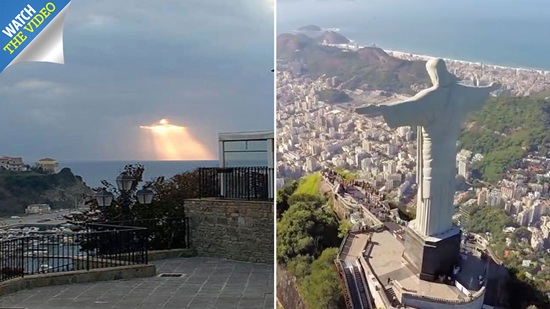
What remains clear is that the photograph itself is genuine, and the cloud formation was indeed captured over the sea as described, without evidence of manipulation or fabrication.
The authenticity of the image contributes to its appeal, as viewers know they are observing a real moment rather than a digitally altered creation.
In a broader sense, the discussion surrounding this image reflects a timeless aspect of human nature: the desire to understand and interpret the unknown.
Whether through science, religion, or personal reflection, people continue to explore the meaning behind the experiences and images that capture their attention.
Moments like these can encourage individuals to pause and appreciate the natural world, recognizing its complexity, unpredictability, and beauty.
They can also inspire creativity, as photographers and observers alike become more attentive to the details and patterns that might otherwise go unnoticed.
The setting of the photograph, with the sea stretching into the distance and the sky illuminated by shifting light, adds to the overall sense of atmosphere and depth.
Such environments are particularly conducive to dramatic visual effects, as the interaction between water, air, and light can produce constantly changing scenes.
In this way, the photograph is not only a subject of debate but also a celebration of the natural elements that make such moments possible.
It reminds viewers that extraordinary images do not always require extraordinary explanations; sometimes they are simply the result of being present at the right moment.
At the same time, it is understandable that people may attach deeper meaning to what they see, especially when the image resembles something familiar or symbolically important.
The resemblance to the Christ the Redeemer statue, in particular, carries strong cultural and emotional associations for many individuals around the world.
This connection likely contributed to the rapid spread of the image and the intensity of the reactions it generated online.
Ultimately, Alfredo Lo Brutto’s photograph continues to be appreciated for its visual impact and the conversation it inspires among viewers with differing viewpoints.
It serves as a reminder that interpretation is a powerful and personal process, shaped by both perception and belief.
Whether seen as a remarkable coincidence or a meaningful symbol, the image invites reflection and discussion without requiring a definitive conclusion.
In the end, the photograph stands as a testament to the beauty of the natural world and the ways in which it can capture human imagination.
It encourages people to remain curious, open-minded, and attentive to the unexpected moments that can arise in everyday life.
While opinions may differ regarding its meaning, there is a shared appreciation for the sense of wonder it evokes.
And perhaps that sense of wonder, more than any specific interpretation, is what makes images like this truly memorable and worth discussing.
