
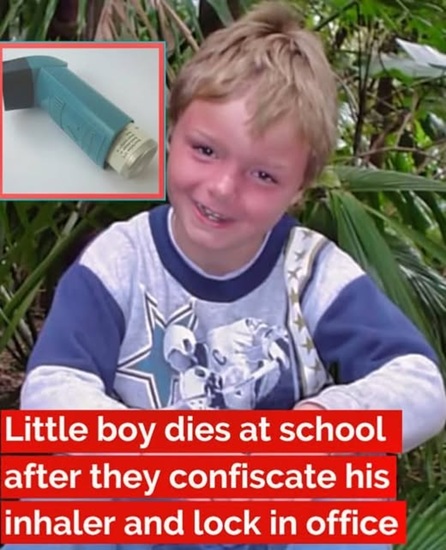
Asthma, a chronic respiratory condition characterized by airway inflammation and constriction, can be frighteningly unpredictable and, in severe cases, fatal if not treated promptly and appropriately.
In October 2012, the world learned a tragic lesson in how vital access to medication can be for those who live with this condition.
Twelve‑year‑old Ryan Gibbons, a Grade 7 student from Straffordville Public School, Ontario, Canada, loved life, sports, and being outdoors with friends and family.
Like so many children his age, Ryan enjoyed running, playing, and participating actively in school recess and sports activities with classmates.
On October 9, 2012, he arrived at school for what seemed like a typical day, unaware that it would end in heartbreak for his family and community.

Ryan had been diagnosed with asthma — a condition requiring regular management and, crucially, fast access to rescue medication known as an inhaler.
An asthma attack causes tightening of the muscles around airways, coughing, wheezing, and difficulty breathing, which can escalate rapidly without prompt intervention.
During recess, Ryan began to experience severe difficulty breathing, the classic signs of an exacerbation that demanded immediate action and an inhaler.
However, his rescue inhaler was not immediately accessible to him; it had been stored away in the principal’s office under a school policy that restricted students’ access to medication.
The policy treated all prescription medication as items that needed to be locked away, without distinction for emergency lifesaving devices like asthma inhalers.
Ryan’s friends saw him struggling and attempted to help, carrying him toward the office in hopes he could reach his inhaler in time.
Tragically, he collapsed before reaching the medication that might have opened his airways and allowed him to breathe and recover.
Ryan never regained consciousness and died as a result of his asthma attack, a loss that shocked not only his community but people across his province.
His death occurred in a context where emergency asthma medication was known to be critical, yet school policies prevented him from having it at his side.
Ryan’s passing highlighted how some school health policies, while intended for safety, can unintentionally endanger children when they restrict access to emergency care.
Following the tragedy, Ryan’s mother, Sandra Gibbons, became a vocal advocate for change, determined to prevent other families from suffering a similar loss.

She spoke publicly about the incident, explaining how school staff repeatedly confiscated her son’s inhalers despite her doctor’s note explaining his medical needs.
In some cases, Ryan’s spare inhalers had been sent home by school staff simply because he had brought them for emergency use.
His mother argued passionately that asthma attacks are not always predictable and that children must carry their inhalers for immediate use when symptoms arise.
As part of her advocacy, she reached out to political representatives to highlight the need for standardized asthma policies across all schools in Ontario.
Progressive Conservative Member of Provincial Parliament (MPP) Jeff Yurek introduced a private member’s bill designed to enact these changes in the Ontario legislature.
The proposed bill was named Ryan’s Law (Ensuring Asthma Friendly Schools) in memory of the boy whose death revealed a critical gap in school health policy.
Ryan’s Law aimed to ensure that no child with asthma would ever again be denied access to their life‑saving medication while at school.
The legislature debated the bill extensively, with all political parties ultimately supporting its passage as common‑sense legislation to protect children’s health.
In April 2015, the Ontario legislature passed the bill unanimously, signaling widespread recognition of the need for asthma‑friendly policies.
The bill received Royal Assent on May 5, 2015, officially becoming law and taking effect across the province.
Ryan’s Law requires every school board in Ontario to establish a comprehensive asthma policy tailored to students’ medical needs.

One of the law’s central provisions is that students with asthma are permitted to carry their own rescue inhalers while on school premises with parental permission.
This change ensures that children can use their inhalers immediately at the first sign of an asthma attack, rather than waiting to access them from an office.
In addition to carrying medication, the law requires individualized asthma action plans for every student with asthma, developed in consultation with families and healthcare providers.
School staff must be trained regularly to recognize signs of asthma exacerbations and know how to respond appropriately during emergencies.
The law also calls for strategies to reduce asthma triggers within schools, such as dust, pollen, mould, and strong scents that can provoke symptoms.
As part of the policy, clear communication plans must exist to share asthma management information with parents, students, and staff.
Emergency procedures are outlined so that teachers and administrators know how to respond if a child begins to experience severe symptoms.
If a staff member believes a student is undergoing an asthma attack, they may administer the inhaler even without preauthorization, saving crucial time during an emergency.

The law also protects school staff who act in good faith during asthma emergencies from legal liability related to their actions.
Overall, Ryan’s Law aims to create “asthma‑friendly schools” where students can thrive without fear that policies will hinder their access to necessary care.
Health organizations such as the Canadian Lung Association have applauded Ryan’s Law for placing student health and safety at the forefront of school policy.
About one in four children in Ontario has asthma, making the law’s protections relevant to a significant portion of the student population.
The law’s requirements extend beyond medication access, emphasizing education, prevention, and readiness in every school environment.
Ryan’s Law is not unique to Ontario in principle; in many regions around the world, medical professionals advocate similar policies in schools for asthma management.
Before the law, policies varied widely, with some schools requiring all medications to remain locked in offices, a practice now widely discouraged.
In Ryan’s case, that variation contributed directly to a preventable tragedy, making the need for legal reform painfully clear.
The changes enacted through Ryan’s Law represent a shift toward proactive health care in educational settings, prioritizing student wellbeing.
As a result of this legislation, future generations of children with asthma in Ontario can carry their inhalers with them confidently and legally.
Parents now work with schools to ensure asthma action plans are current, medications are accessible, and staff are properly trained.
In the years since Ryan’s Law took effect, many school boards have updated their policies to comply with its requirements.
The law’s implementation marks a legacy that seeks to prevent another family from experiencing a loss like that of the Gibbons family.
For many, Ryan’s death remains a poignant reminder of how important it is to balance safety rules with understanding of medical needs.
Although nothing can reverse the heartbreak of his death, his story influenced concrete changes that will save lives in the future.
Ryan’s Law continues to stand as a model of how advocacy, policy, and compassion can intersect to protect vulnerable students.
Knowing that one child’s life led to legislation impacting thousands gives hope amid sorrow and underscores the importance of listening to family voices.
Asthma remains a significant health issue, and Ryan’s Law helps ensure that school environments are prepared for emergencies when they arise.
Every life lost to asthma is a tragedy — but the changes Ryan’s story inspired serve as a lasting tribute and a safeguard for others.

