
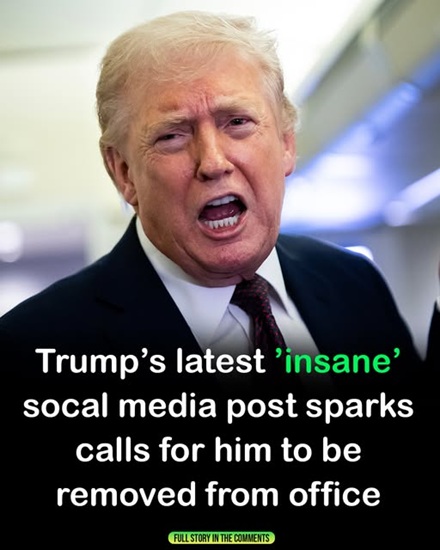
Public criticism is mounting internationally after a controversial statement by Donald Trump amid the ongoing Middle East conflict involving Iran and regional neighbors.
Rising violence and diplomatic tension continue to unsettle global leaders and markets. The situation began in late February 2026 when coordinated military strikes by the United States and Israel targeted Iranian military and strategic sites.
This campaign, widely referred to as part of the “Iran war,” has rapidly escalated violence across the Persian Gulf. Iran has retaliated repeatedly, using missiles and drones against U.S. and allied targets, including airbases in the region. Reports indicate ongoing attacks on strategic locations in Bahrain, Kuwait, and other Gulf states.
In recent days, Iran reportedly launched ballistic missile salvos toward Jerusalem and northern Israel, triggering air raid sirens and raising fears of wider conflict escalation along multiple fronts.
The conflict’s energy dimension intensified when an Israeli strike hit Iran’s South Pars gas field, part of the world’s largest natural gas reserve. The attack significantly damaged production and sparked retaliation against Qatar’s Ras Laffan LNG processing complex.
South Pars fuels a large share of Iran’s domestic energy and export capacity. Damage to this field has disrupted supply chains and contributed to volatility in global oil and gas markets, with prices fluctuating sharply.
In response to the escalation, energy facilities throughout the Gulf region—especially in Kuwait and Saudi Arabia—have reportedly been targeted by Iranian drone strikes, though many were intercepted by defense systems.
Air raid sirens also sounded in the United Arab Emirates and Bahrain, underscoring how broadly the conflict has spread beyond Iran and Israel’s immediate border zones.
Amid these dramatic developments, Donald Trump has been posting frequent and highly visible messages on his social platform, Truth Social, commenting on every major development related to the conflict with Iran.
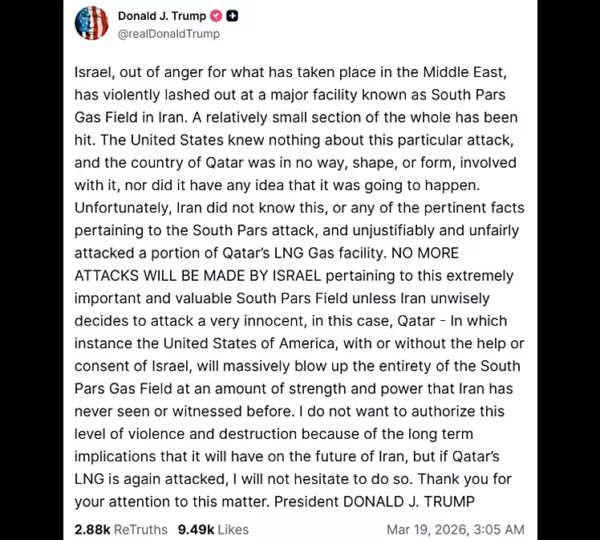
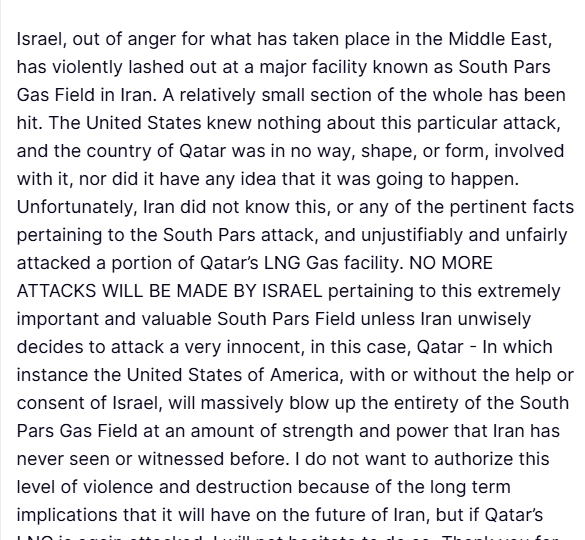
One message in particular sparked alarm: Trump appeared to suggest that Israel acted independently in the South Pars attack and issued a severe warning about future retaliation, drawing widespread online criticism.
In his post, Trump distanced the United States from prior strikes, claiming it had “zero involvement” in the attack — a statement that Israeli officials privately disputed, saying Washington was informed in advance.
He then wrote that if Iran were to attack Qatar again, the United States “will massively blow up the entirety” of the South Pars gas field with unprecedented force, raising concern among critics and foreign observers.
South Pars is shared between Iran and Qatar’s North Field, meaning damage there could not only devastate Iranian energy production but also significantly affect global gas supplies and energy markets.
Criticism of Trump’s message was swift online, with critics arguing that such rhetoric could further destabilize an already volatile region and risk inadvertent escalation among nuclear‑armed states.
One widely shared reaction on social media framed the statement as dangerously impulsive and a sign of lost control, even calling for constitutional remedies to prevent further escalation.
Other commentators questioned Trump’s grasp of the conflict, arguing that non‑experts with significant destructive power should exercise caution and prioritize diplomatic channels over threatening statements.
Analysts noted that such public, bold rhetoric in the midst of active military conflict can impact energy markets, foreign relations, and military coordination, further complicating efforts to deescalate tensions.
Hours after the controversial post, Israeli Prime Minister Benjamin Netanyahu reportedly agreed to delay further strikes on Iranian energy facilities, allegedly at Trump’s urging, signaling some degree of coordination despite rhetoric.
However, the conflict did not pause. Overnight, the Israeli military conducted additional strikes against infrastructure targets in Tehran, leading to reports of multiple explosions in the Iranian capital.
Iran responded with further strikes targeting Israeli territory and assets, continuing a cycle of action and reaction that analysts say risks dragging more nations into the conflict.
The broader geopolitical impact has been significant. Gulf monarchies like the UAE, Saudi Arabia, Kuwait, and Qatar — traditionally concerned about regional stability — have been drawn deeper into the security crisis.
Iran’s attacks on energy and military infrastructure throughout the Gulf have compelled international partners to reassess risk, bolstering naval deployments and air defenses across the region.
U.S. policymakers are reportedly considering requests for substantial new war funding to support ongoing operations and defensive postures, highlighting the financial and strategic depth of the crisis.
Critics of Trump’s messaging say that personal, social‑media style diplomacy complicates formal channels between governments and hinders the coordination traditionally required during active conflict.
Defense experts warn that threats involving vital energy infrastructure — such as gas fields that underpin national economies — could provoke retaliatory measures that spiral beyond initial intentions.
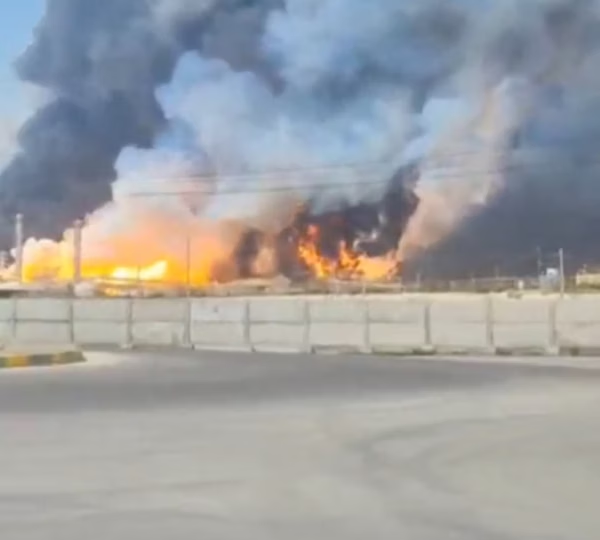
The attacks on energy sites have real economic consequences. Qatar’s energy minister recently warned that the damage could delay production expansion plans by months, potentially disrupting global exports to Asia and Europe.
Iran’s energy interruption has also forced major producers to reassess global supply stability, with impact seen in rising prices and increased market volatility over crude and liquefied natural gas.
Some foreign governments have issued statements condemning attacks on civilian infrastructure and calling for restraint, emphasizing the importance of protecting energy supply chains and civilian populations.
In Europe and Asia, energy markets have reacted sharply, with spikes in gasoline and LNG prices prompting emergency policy discussions among governments and industry stakeholders.
International organizations, including the United Nations, have urged all parties to deescalate and pursue diplomatic solutions, warning that a protracted conflict could have catastrophic consequences.
Humanitarian concerns also continue to rise, with reports of displacement, infrastructure damage, and civilian hardship in areas affected by missile and drone strikes on both sides of the conflict.
Experts note that even limited damage to key energy infrastructure can take years to fully repair, making long‑term planning and recovery a priority for affected nations.
The involvement of multiple regional powers underscores how the conflict has expanded beyond a U.S.–Iran dynamic into a more complex network of alliances and rivalries across the Middle East.
Public opinion in allied nations is also divided, with many civilians and commentators urging peaceful negotiation over continued military escalation, given the human and economic toll.
In Washington, lawmakers of both parties have expressed concern about unchecked presidential rhetoric affecting diplomatic efforts and military strategy, calling for clearer communication from the executive branch.
While Trump’s social media posts are intended to shape public perception and policy narratives, critics argue that such messaging should not replace formal diplomatic discourse between governments.
The impact of this unfolding crisis will likely continue to be felt globally, affecting energy markets, international relations, and military alliances for years to come — even after the immediate conflict ends.
Ultimately, the controversy surrounding Trump’s statement highlights broader debates about leadership, communication, and the responsibilities of global powers in times of war and instability.
As global attention remains fixed on the Middle East, diplomatic efforts continue behind closed doors, seeking ways to halt violence and restore stability to a region whose stability affects millions worldwide.
The long‑term consequences of this war — both human and economic — are still emerging, but there is widespread consensus that the diplomatic path forward will require careful negotiation and deescalation.
Public reaction and international scrutiny are likely to shape how leaders respond to future escalation, underscoring the importance of messaging, strategy, and responsible communication in global conflicts.
Amid these tensions, calls for peace and diplomacy are louder than ever, as world leaders grapple with balancing strategic interests, humanitarian concerns, and global economic stability.
With the conflict evolving daily, tracking developments and responses from governments, markets, and citizens worldwide will be crucial to understanding the full impact of this historic moment.
Ongoing efforts to protect vital energy infrastructure and civilian lives remain a central priority, even as military operations and geopolitical dynamics shift across the region and beyond.
In the weeks and months ahead, analysts, policymakers, and the public will continue to watch how leadership decisions influence the conflict’s direction and potential resolution.

